
Free Safe Operating Procedure (Rescue Winch) Template
Download our free Safe Operating Procedure (Rescue Winch) Template to establish safe work practices. This DOCX and PDF helps formalise your safety protocols.
Free Safe Operating Procedure (Rescue Winch) Template
DOCX • 126 KB + PDF
Updated Oct 2026
No signup required
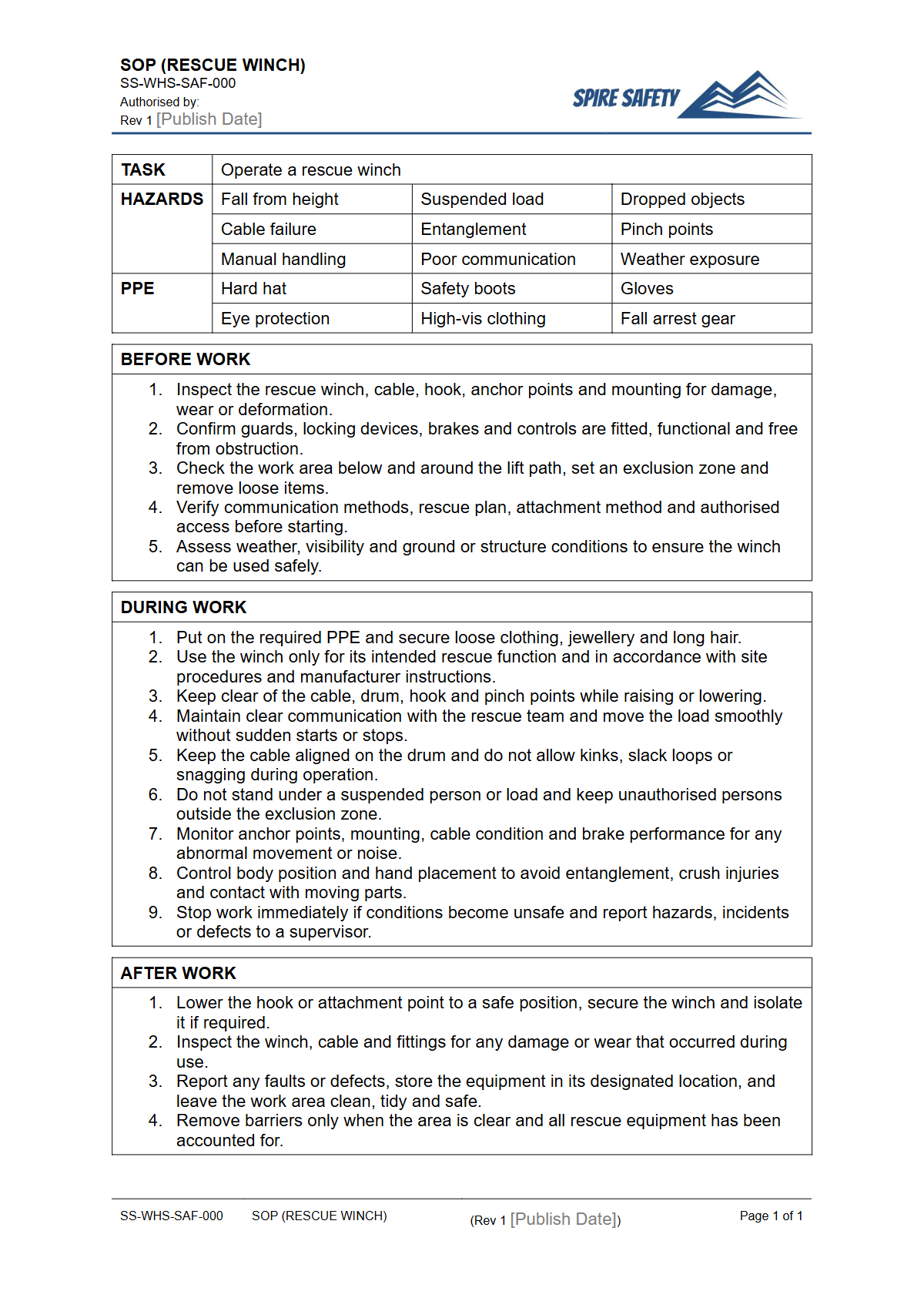
Purpose of the Free Safe Operating Procedure (Rescue Winch) Template
Operating a rescue winch is a high-risk activity that requires precision, training, and clearly defined procedures. Our Free Safe Operating Procedure (Rescue Winch) Template provides a structured starting point for organisations to document the required steps for the safe use of this critical equipment.
This SOP is designed to help you manage significant risks associated with rescue operations, including falls from height, equipment failure, entanglement, and crush injuries. By formalising the process, you can ensure that every step—from pre-use inspection to the execution of the rescue and post-use maintenance—is conducted consistently and safely by all personnel.
A documented SOP serves as an essential training tool and a reference for workers, ensuring they understand the specific hazards and control measures for rescue winch systems. It promotes a systematic approach to safety, helping your organisation meet its primary duty of care under Australian WHS laws.
Integrating this SOP into your broader WHS management systems ensures that rescue procedures are not an afterthought but a planned and controlled part of your overall safety framework.
Video walkthrough
How to use the Free Safe Operating Procedure (Rescue Winch) Template
This document is a template, not a finished product. It is crucial that you customise it to reflect the specific rescue winches used at your workplace, the unique environmental conditions of your site, and your organisation's internal safety protocols.
To use this Safe Operating Procedure for a rescue winch, download the DOCX file and work through each section, adding, removing, and modifying content to align with your operational reality. You should consult with winch operators, maintenance personnel, and safety representatives during this process to ensure the procedure is both comprehensive and practical.
Key areas for customisation include:
- Equipment specifics: List the make, model, and technical specifications of your winches.
- Site-specific hazards: Detail any unique risks related to the locations where the winch may be used (e.g., confined spaces, live electrical environments, unstable ground).
- Emergency contacts: Include relevant internal and external emergency contact information.
- Roles and responsibilities: Clearly define who is authorised to operate the winch, who acts as a spotter, and who is responsible for maintenance.
Important: We have provided this template as a guide based on standard WHS principles. Before implementation, the final, customised SOP must be reviewed and approved by a competent person with the necessary knowledge and experience in rescue systems and your specific workplace hazards.
When to use a Rescue Winch SOP
A Safe Operating Procedure for a rescue winch should be developed, implemented, and readily available before any work that could foreseeably require its use. It is not a document to be created after an incident; it is a proactive control measure.
It is essential for planned high-risk tasks such as confined space entries, where a rescue winch is on standby as part of the rescue plan. It is also critical for any work at height where a fall arrest system is in place and a winch may be needed for retrieval or rescue.
This SOP should be referenced during toolbox talks before a relevant task, used as a basis for training and competency assessments, and be physically or digitally accessible at the work location. Regular drills and simulations of rescue scenarios are highly recommended, using the SOP as the procedural guide.
Similar to how you would require a detailed telehandler SOP for operating high-risk plant, a rescue winch SOP is non-negotiable for ensuring readiness and procedural clarity in an emergency.
Who should use it
This SOP is intended for all personnel involved in the lifecycle of rescue winch operations. This includes, but is not limited to:
- Authorised Operators: Individuals who have been deemed competent through training and assessment to operate the rescue winch.
- Rescue Team Members: All personnel designated as part of a standby or active rescue team who may need to deploy or assist with the winch.
- Supervisors and Managers: Those responsible for overseeing the work, ensuring procedures are followed, and authorising the task.
- WHS Professionals and Safety Officers: Personnel who develop, review, and audit safety procedures to ensure they remain effective and aligned with legal requirements.
- Maintenance Personnel: Technicians responsible for the inspection, servicing, and repair of the winch and associated equipment.
Competency is paramount. No worker should operate a rescue winch without having received specific training on the equipment and the established SOP.
The effectiveness of this procedure relies on the people using it being fully aware of their responsibilities and the critical safety steps involved. Reviewing safety procedures is a continuous process, often informed by activities such as formal WHS compliance auditing to identify gaps and areas for improvement.
Just as other specialised equipment requires its own safe work procedure, such as an air compressor used for breathing apparatus in a confined space, the rescue winch demands the same level of documented diligence. To discover more procedural templates that can support your safety system, you can browse our complete free WHS resources library.
Common mistakes
Common mistakes to avoid
- Using a winch not rated for lifting personnel (i.e., a materials winch) for a rescue operation.
- Failing to conduct and document thorough pre-use inspections, leading to equipment failure during use.
- Lack of regular, practical rescue drills, resulting in an uncoordinated and slow response in a real emergency.
- Anchoring the winch system to a point that has not been verified to withstand the potential rescue load.
Legal references
Legal considerations
The following legal requirements may be relevant to this type of work.
- Work Health and Safety Act (Harmonised) — Provides the primary duties for protecting workers and other people from work health and safety risks.
- Work Health and Safety Regulations (Harmonised) — Sets out requirements supporting the management of workplace hazards and risks.
The following codes may be relevant to this type of work.
- Managing WHS Risks Code of Practice — Provides practical guidance on identifying hazards, assessing risks and applying effective controls.
- Work Health and Safety Consultation, Cooperation and Coordination Code of Practice — Provides practical guidance on consulting workers and coordinating with other duty holders.
- Managing the Work Environment and Facilities Code of Practice — Provides practical guidance on safe work environments, workplace facilities and related controls.
Did you know
Safety Factors
Man-riding or rescue-rated winches are typically designed with a safety factor of 10:1 or higher, whereas materials-handling winches may have a lower safety factor, such as 5:1. This is a primary reason they are not interchangeable.
Confined Space Risk
Statistics show that over 60% of fatalities in confined spaces are would-be rescuers who enter the space without proper equipment, training, or a rescue plan, highlighting the critical need for equipment like rescue winches and documented SOPs.
FAQ
Frequently asked questions
01What should be included in a rescue winch pre-use inspection?
02How often should a rescue winch SOP be reviewed?
03Is a specific licence required to operate a rescue winch in Australia?
04What is the difference between a winch for lifting materials and a rescue winch?
Share this resource
Free Safe Operating Procedure (Rescue Winch) Template
Browse Categories
How To Use It
- 1Download and open in Word or PDF.
- 2Replace the placeholders with your business details.
- 3Get it reviewed by a WHS specialist before rollout.
Need it customised?
Our WHS consultants can adapt this template to your site, run a gap analysis, or audit what you already have in place.
Book a Free Consultation WHS consulting servicesor call 1300 156 382
Related templates
- Free Safe Operating Procedure (Resident Laundry Sort) Template
- Free Safe Operating Procedure (Resident Room Packdown) Template
- Free Safe Operating Procedure (Resident Room Setup) Template
- Free Safe Operating Procedure (Resin Mixing) Template
- Free Safe Operating Procedure (Respirator Cleaning) Template
- Free Safe Operating Procedure (Retail Bagging) Template