
Free Safe Operating Procedure (Remote Crane Control) Template
Download our free Safe Operating Procedure for remote crane control to formalise your safety processes.
Free Safe Operating Procedure (Remote Crane Control) Template
DOCX • 126 KB + PDF
Updated Oct 2026
No signup required
Purpose of the Free Safe Operating Procedure (Remote Crane Control) Template
Operating any crane is a high-risk activity, and using remote or pendant controls introduces unique challenges that must be carefully managed. This Free Safe Operating Procedure (Remote Crane Control) Template provides a structured framework for documenting the required safety steps for these operations.
It helps your organisation standardise its processes, ensuring every operator follows a consistent, safe method for pre-start checks, load handling, and shutdown. By formalising these steps, you can significantly reduce the risk of incidents caused by operator error, equipment failure, or environmental factors.
A well-defined SOP is a critical tool for training, competency assessment, and supervision. It serves as a clear reference point for workers and a key piece of evidence demonstrating your commitment to safety.
Implementing this procedure helps control major risks such as dropped loads, collisions with people or structures, and issues arising from loss of signal or operator line-of-sight. Integrating this SOP is a foundational step in developing robust WHS management systems that protect your team and ensure operational continuity.
Video walkthrough
How to use the Free Safe Operating Procedure (Remote Crane Control) Template
This template is provided as a fully editable DOCX file, designed to be a starting point. It is not a complete, ready-to-use document.
To make it effective, you must adapt it to the specific context of your workplace.
Important: We have created this template as a guide. You must customise it to reflect your specific machinery, site hazards, personnel responsibilities, and legal obligations. Key areas to update include:
- Plant Details: Specify the make, model, and capacity of the crane(s) and remote control units in use.
- Site-Specific Risks: Identify and add controls for hazards unique to your work environment, such as overhead powerlines, ground conditions, blind spots, or radio frequency interference.
- Personnel: Clearly define the roles and responsibilities of the crane operator, dogger/rigger, and supervisor.
- Emergency Procedures: Detail the exact steps to take in case of remote control failure, battery issues, dropped load, or other foreseeable emergencies.
Once customised, the SOP should be communicated to all relevant workers through training sessions and toolbox talks. It should be reviewed regularly and updated whenever there is a change to equipment, processes, or the work environment.
The requirements for high-risk work can be complex, and expert advice from a WHS consulting firm can help ensure your procedures are thorough and effective.
What this Safe Operating Procedure covers
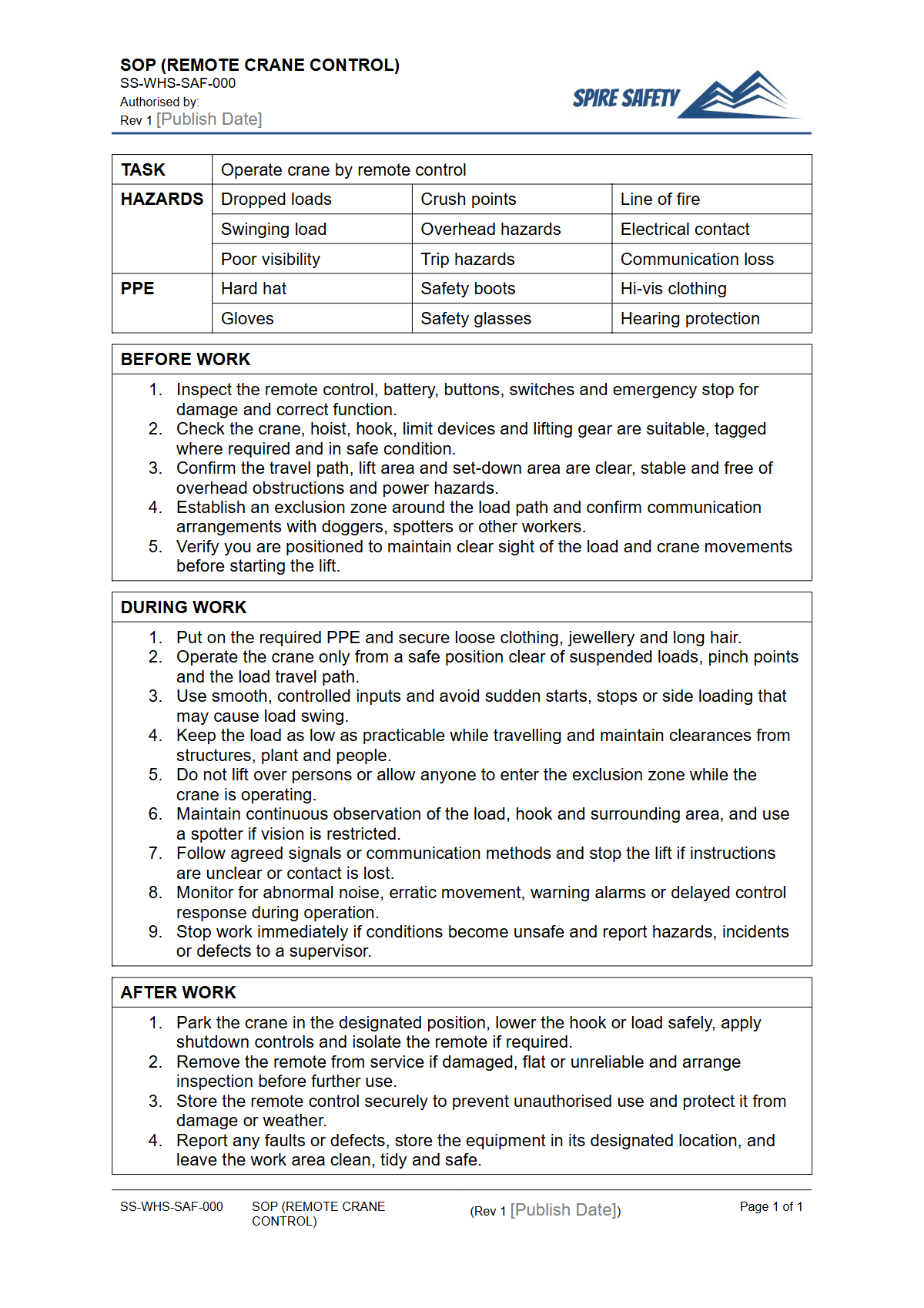
This document provides a logical structure for outlining your process, covering the essential stages of a typical remote crane operation. It includes sections for:
- Required Personal Protective Equipment (PPE).
- Pre-operational checks for both the crane and the remote control unit.
- A step-by-step guide to the operational process, from planning the lift to setting down the load.
- Post-operational checks and shutdown procedures.
- Emergency response actions.
Documenting safety procedures is vital for all types of machinery, not just cranes. If your site uses other specialised plant, you may find our free Telehandler SOP template helpful for managing similar risks.
When to use it
A Safe Operating Procedure for remote crane control should be used as a primary reference document for all related tasks. It is essential during worker inductions and for specific operator training to ensure everyone understands the established safety standards from day one.
It should also be readily available in the work area for operators to consult before starting a shift or a complex lift. Furthermore, supervisors can use the SOP as a checklist during safety observations, and it serves as a critical document during formal WHS compliance auditing to verify that safe systems of work are in place and being followed.
Who should use it
This SOP is intended for all personnel involved in or responsible for lifting operations using remote-controlled cranes. This includes, but is not limited to:
- Licensed Crane Operators: To guide their actions and reinforce safe work habits.
- Doggers and Riggers: To understand the operator's process and coordinate safely during slinging and load direction.
- Supervisors and Team Leaders: To oversee operations, conduct safety observations, and ensure procedures are followed correctly.
- WHS Managers and Advisors: To develop, implement, and review safety documentation as part of the broader safety management system.
The principles of documenting safe work methods apply across all heavy equipment. For tasks involving earthmoving or material handling, consider adapting resources like our FREE Trencher SOP Template to fit your operational needs. For a wider selection of safety documents, you can browse our complete free WHS resources library.
Common mistakes
Common mistakes to avoid
- Failing to perform a pre-start check of the remote unit's battery and emergency stop function.
- Operating from a position without a clear, unobstructed view of the load and the entire lift path.
- Leaving the remote control unit unattended or unsecured, risking unauthorised use.
- Using a generic SOP that hasn't been customised for the specific crane model and site hazards.
Legal references
Legal considerations
The following legal requirements may be relevant to this type of work.
- Work Health and Safety Act (Harmonised) — Provides the primary duties for protecting workers and other people from work health and safety risks.
- Work Health and Safety Regulations (Harmonised) — Sets out requirements supporting the management of workplace hazards and risks.
The following codes may be relevant to this type of work.
- Managing WHS Risks Code of Practice — Provides practical guidance on identifying hazards, assessing risks and applying effective controls.
- Work Health and Safety Consultation, Cooperation and Coordination Code of Practice — Provides practical guidance on consulting workers and coordinating with other duty holders.
- Managing the Work Environment and Facilities Code of Practice — Provides practical guidance on safe work environments, workplace facilities and related controls.
Did you know
Line of Sight
A leading cause of incidents with remote-controlled cranes is the operator losing direct line of sight with the load or the crane's path. A well-written SOP will always designate signal-person (dogger) responsibilities for when the operator's view is obscured.
FAQ
Frequently asked questions
01What is the difference between a pendant and remote-controlled crane?
02Who can operate a remote-controlled crane in Australia?
03Why is an SOP essential for remote crane operations?
04Does this template include pre-start checks for the remote unit?
Share this resource
Free Safe Operating Procedure (Remote Crane Control) Template
Browse Categories
How To Use It
- 1Download and open in Word or PDF.
- 2Replace the placeholders with your business details.
- 3Get it reviewed by a WHS specialist before rollout.
Need it customised?
Our WHS consultants can adapt this template to your site, run a gap analysis, or audit what you already have in place.
Book a Free Consultation WHS consulting servicesor call 1300 156 382
Related templates
- Free Safe Operating Procedure (Resaw Machine) Template
- Free Safe Operating Procedure (Rescue Boat Launch) Template
- Free Safe Operating Procedure (Rescue Winch) Template
- Free Safe Operating Procedure (Resident Laundry Sort) Template
- Free Safe Operating Procedure (Resident Room Packdown) Template
- Free Safe Operating Procedure (Resident Room Setup) Template