
Free Safe Operating Procedure (Recycling Dropoff Check) Template
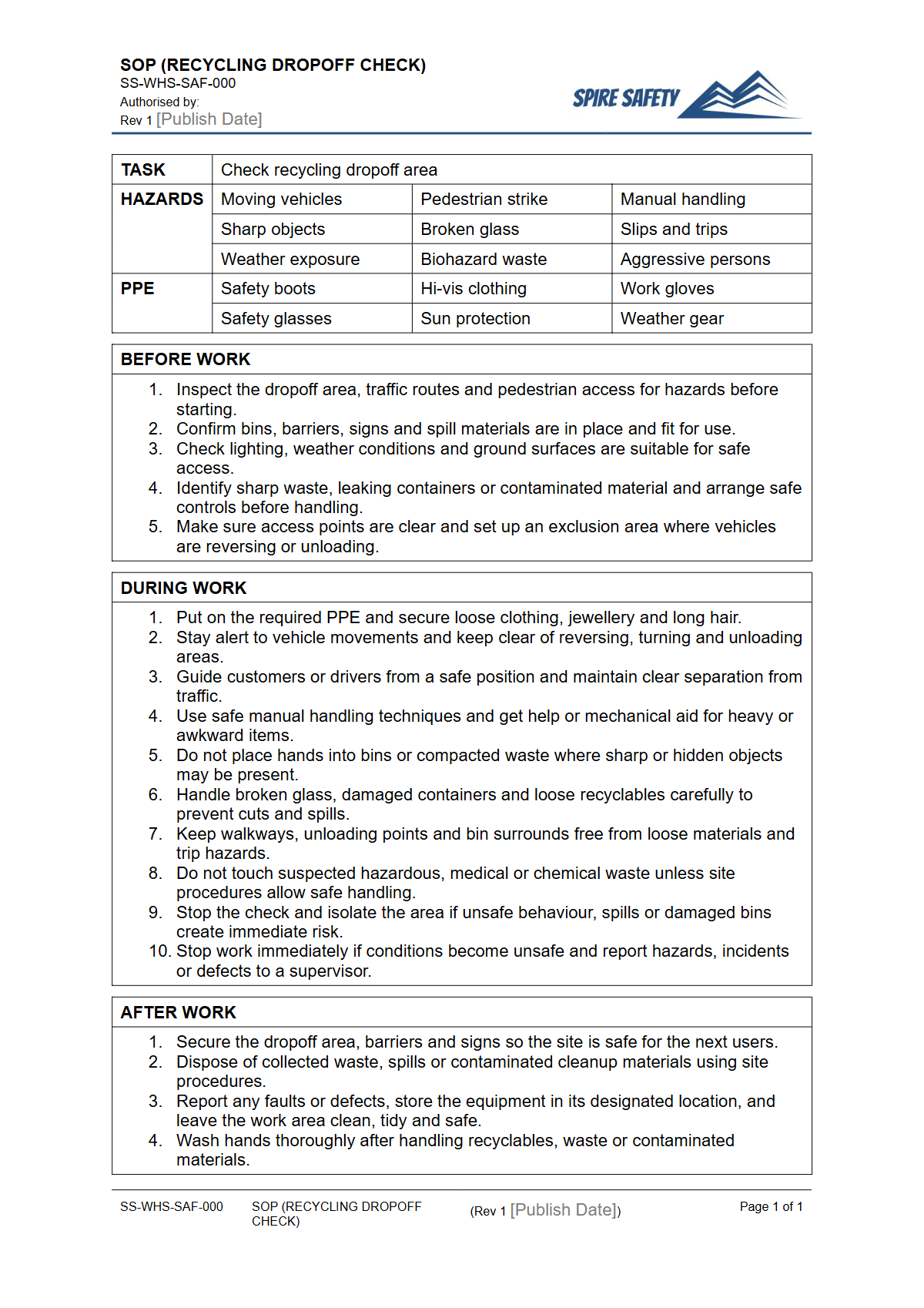
Formalise your site's recycling processes with our free Safe Operating Procedure (Recycling Dropoff Check) template. Download the customisable DOCX now.
Free Safe Operating Procedure (Recycling Dropoff Check) Template
DOCX • 126 KB + PDF
Updated Oct 2026
No signup required
Purpose of the Free Safe Operating Procedure (Recycling Dropoff Check) Template
Managing a recycling drop-off point involves a unique set of risks, from vehicle movements to handling unknown materials. This free Safe Operating Procedure (Recycling Dropoff Check) template provides a structured starting point for documenting the required safety controls and work steps for your facility.
It helps your organisation systematically address common hazards such as traffic management, hazardous manual tasks, public interaction, and exposure to sharps or dangerous goods. Using a formalised SOP promotes consistent, safe work practices among all staff, forming a critical component of a comprehensive WHS management system.
This document is designed to guide supervisors and workers through the essential pre-start, operational, and post-operation checks necessary to maintain a safe environment for both employees and the public using the drop-off facility. It is based on principles from Australia's model WHS framework and is intended to be adapted for your specific operational context.
Video walkthrough
How to use the Free Safe Operating Procedure (Recycling Dropoff Check) Template
This downloadable document is provided in both DOCX and PDF formats for your convenience. The DOCX version is fully editable, allowing you to tailor it to your site's specific requirements.
To use it effectively, you must conduct a thorough risk assessment of your recycling drop-off area and incorporate the findings into the procedure. This includes detailing the specific types of waste accepted, the plant and equipment used, the site layout, and the required Personal Protective Equipment (PPE).
Important: This is a template, not a finished document. We have drafted it to be as helpful as possible, but every workplace is different.
You must customise this Safe Operating Procedure to reflect the actual hazards and control measures relevant to your site. Failure to do so may render the document ineffective and could undermine your safety processes.
Key Hazards to Consider
When customising this SOP, pay close attention to hazards specific to recycling centres, including:
- Traffic Management: Interaction between public vehicles, commercial trucks, and site machinery like forklifts or telehandlers. You may also need a free Telehandler SOP template for specific equipment.
- Manual Tasks: Lifting heavy or awkward items, sorting materials, and emptying bins.
- Hazardous Materials: Unidentified chemicals, batteries, gas bottles, or asbestos that may be illegally dumped.
- Biological Hazards: Handling decomposing organic matter or contaminated waste.
- Slips, Trips, and Falls: Caused by spilled liquids, uneven ground, or debris.
- Public Interaction: Managing unpredictable behaviour from members of the public.
When to use it
A Safe Operating Procedure for recycling drop-offs should be a dynamic part of your safety system. It is used during initial staff training and for refresher courses to ensure all workers understand the expected safety standards.
The procedure should be readily accessible in the work area for quick reference. It also serves as a critical document during incident investigations, toolbox talks, and regular WHS compliance audits to verify that established processes are being followed and remain effective.
Who should use it
This SOP is intended for use by a range of personnel within a waste management or recycling facility. Site supervisors and managers are responsible for implementing, reviewing, and enforcing the procedure. Workers, including gate attendants, yard hands, and sorters, must be trained on the SOP and follow it during their daily tasks. WHS officers and safety committees can use this document as a basis for risk assessments, training development, and workplace inspections. If you need assistance embedding these procedures, specialist WHS consulting can provide tailored support for your organisation. For more templates covering different tasks and equipment, browse our free WHS resources library.
Common mistakes
Common mistakes to avoid
- Using a generic template without performing a site-specific risk assessment and customising the content.
- Failing to provide practical, hands-on training to all relevant workers on the finalised SOP.
- Neglecting to review and update the procedure after an incident, near-miss, or change in operations.
- Storing the document in an office, making it inaccessible to workers at the actual drop-off location.
Legal references
Legal considerations
The following legal requirements may be relevant to this type of work.
- Work Health and Safety Act (Harmonised) — Provides the primary duties for protecting workers and other people from work health and safety risks.
- Work Health and Safety Regulations (Harmonised) — Sets out requirements supporting the management of workplace hazards and risks.
The following codes may be relevant to this type of work.
- Managing WHS Risks Code of Practice — Provides practical guidance on identifying hazards, assessing risks and applying effective controls.
- Work Health and Safety Consultation, Cooperation and Coordination Code of Practice — Provides practical guidance on consulting workers and coordinating with other duty holders.
- Managing the Work Environment and Facilities Code of Practice — Provides practical guidance on safe work environments, workplace facilities and related controls.
Did you know
Industry Risk
According to Safe Work Australia, the Waste Collection, Treatment and Disposal Services industry has one of the highest rates of serious workers' compensation claims, highlighting the critical need for documented safety procedures.
FAQ
Frequently asked questions
01What should be included in a Recycling Dropoff Check SOP?
02Is this SOP template suitable for all types of recycling facilities?
03How often should we review our Recycling Dropoff Check SOP?
04Who is responsible for enforcing the SOP on-site?
Share this resource
Free Safe Operating Procedure (Recycling Dropoff Check) Template
Browse Categories
How To Use It
- 1Download and open in Word or PDF.
- 2Replace the placeholders with your business details.
- 3Get it reviewed by a WHS specialist before rollout.
Need it customised?
Our WHS consultants can adapt this template to your site, run a gap analysis, or audit what you already have in place.
Book a Free Consultation WHS consulting servicesor call 1300 156 382
Related templates
- Free Safe Operating Procedure (Recycling Load Check) Template
- Free Safe Operating Procedure (Recycling Load Sorting) Template
- Free Safe Operating Procedure (Relief Valve Test) Template
- Free Safe Operating Procedure (Remote Crane Control) Template
- Free Safe Operating Procedure (Resaw Machine) Template
- Free Safe Operating Procedure (Rescue Boat Launch) Template