
Free Safe Operating Procedure (Recycling Load Check) Template
Standardise safety checks for incoming recycling loads with our structured template. Download this free Safe Operating Procedure to improve your site's safety.
Free Safe Operating Procedure (Recycling Load Check) Template
DOCX • 126 KB + PDF
Updated Oct 2026
No signup required
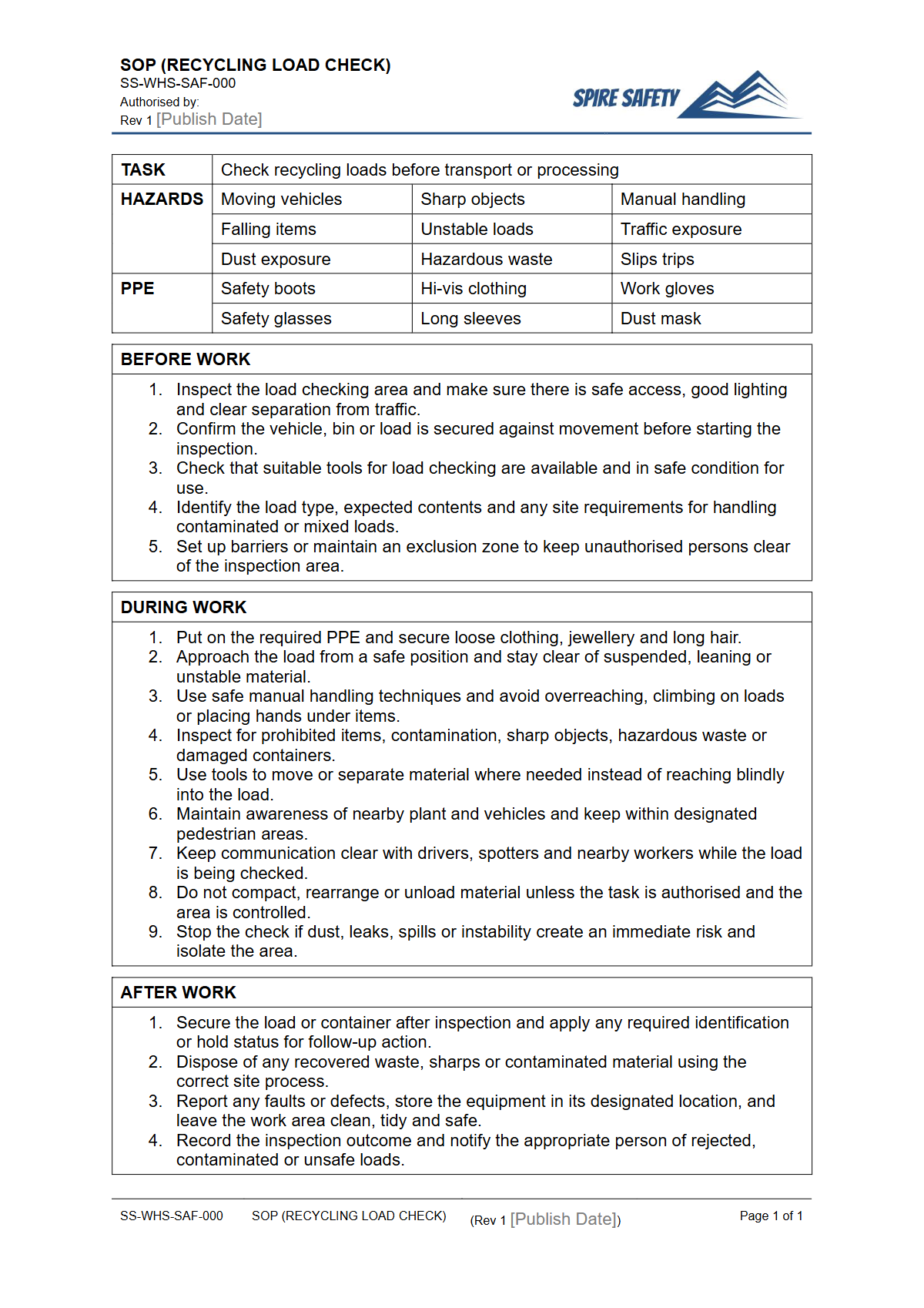
Purpose of the Free Safe Operating Procedure (Recycling Load Check) Template
The primary purpose of this Safe Operating Procedure is to formalise the process of inspecting incoming loads of recyclable materials. It provides a step-by-step guide for workers to ensure that every load is checked for potential hazards before being accepted and processed.
Key objectives include preventing fires from hazardous materials like batteries, protecting machinery from damage caused by non-conforming items, and ensuring worker safety by minimising exposure to dangerous goods or sharps. A documented procedure is a fundamental component of a comprehensive WHS management system, demonstrating due diligence in risk management.
By implementing this SOP, your organisation can standardise safety expectations, improve communication between weighbridge operators, spotters, and machine operators, and create a clear record of safety checks. This systematic approach helps in identifying problematic suppliers and reducing the overall risk profile of the facility.
Video walkthrough
How to use the Free Safe Operating Procedure (Recycling Load Check) Template
This template is designed to be a practical starting point. After downloading the DOCX file, you should review and adapt it to the unique context of your workplace. This involves consulting with your team to identify specific hazards associated with the types of materials you handle (e.g., e-waste, construction and demolition waste, co-mingled household recycling) and the equipment used, such as those covered in our FREE Conveyer System SOP Template.
Important: It is crucial to remember that this is a template, not a finished document. We have designed it as a starting point, but you must adapt it to reflect the specific hazards, equipment, materials, and control measures relevant to your workplace.
Once customised, the SOP should be formally approved, and all relevant workers must be trained on its contents. Regular reviews should be scheduled as part of your internal WHS compliance auditing schedule to ensure it remains current and effective.
When to use it
This Safe Operating Procedure should be actioned every time a vehicle delivers a load of recyclable material to your site. The checks should ideally be performed at the weighbridge or a designated receival point before the load is tipped.
It serves as the first line of defence against contamination and hazards. The SOP is also a vital tool during new worker induction, refresher training sessions, and as a reference point during incident investigations or near-miss reporting. Consistent use reinforces safe work habits and maintains a high level of vigilance among staff who handle raw materials with heavy machinery, which may require procedures like our FREE Telehandler SOP Template.
Who should use it
This SOP is intended for all personnel involved in the materials receival process. This includes, but is not limited to:
- Weighbridge Operators
- Yard Supervisors and Managers
- Spotters or 'Pickers' at the tipping floor
- Mobile Plant Operators (e.g., front-end loader, excavator operators)
- WHS Managers and Safety Officers
Ensuring that every person in this chain understands their role and responsibilities as outlined in the SOP is key to its success. For businesses needing higher-level support in defining these roles and embedding safety culture, engaging external WHS consulting services can provide valuable expertise. Procedures may also be needed for ancillary tasks, like yard maintenance, which can be guided by documents such as our FREE Scraper SOP Template.
By customising and implementing this procedure, your organisation takes a proactive step towards a safer and more efficient recycling operation. You can explore our entire free WHS resources library for more templates to support your safety management system.
Common mistakes
Common mistakes to avoid
- Failing to customise the template for specific site hazards and materials.
- Not providing adequate, task-specific training to all workers involved in the process.
- Inconsistent application of the procedure across different shifts or personnel.
- Poor or non-existent documentation of checks, non-conformances, and corrective actions.
Legal references
Legal considerations
The following legal requirements may be relevant to this type of work.
- Work Health and Safety Act (Harmonised) — Provides the primary duties for protecting workers and other people from work health and safety risks.
- Work Health and Safety Regulations (Harmonised) — Sets out requirements supporting the management of workplace hazards and risks.
The following codes may be relevant to this type of work.
- Managing WHS Risks Code of Practice — Provides practical guidance on identifying hazards, assessing risks and applying effective controls.
- Work Health and Safety Consultation, Cooperation and Coordination Code of Practice — Provides practical guidance on consulting workers and coordinating with other duty holders.
- Managing the Work Environment and Facilities Code of Practice — Provides practical guidance on safe work environments, workplace facilities and related controls.
Did you know
Hidden Fire Hazard
Incorrectly disposed lithium-ion batteries are a primary cause of fires in waste management and recycling facilities across Australia, posing a significant risk to worker safety and infrastructure.
The 'Dirty MRF'
A 'Material Recovery Facility' (MRF) sorts recyclables. A 'Dirty MRF' is a facility designed to also process mixed municipal solid waste to extract any recyclable materials that were not separated at the source.
FAQ
Frequently asked questions
01What is a recycling load check?
02Why are recycling load checks important for safety?
03Can I use this template for any type of recycling facility?
04Who is responsible for conducting the load check?
Share this resource
Free Safe Operating Procedure (Recycling Load Check) Template
Browse Categories
How To Use It
- 1Download and open in Word or PDF.
- 2Replace the placeholders with your business details.
- 3Get it reviewed by a WHS specialist before rollout.
Need it customised?
Our WHS consultants can adapt this template to your site, run a gap analysis, or audit what you already have in place.
Book a Free Consultation WHS consulting servicesor call 1300 156 382
Related templates
- Free Safe Operating Procedure (Recycling Load Sorting) Template
- Free Safe Operating Procedure (Relief Valve Test) Template
- Free Safe Operating Procedure (Remote Crane Control) Template
- Free Safe Operating Procedure (Resaw Machine) Template
- Free Safe Operating Procedure (Rescue Boat Launch) Template
- Free Safe Operating Procedure (Rescue Winch) Template