
Free Safe Operating Procedure (Recycling Load Sorting) Template
Formalise your recycling load sorting process with our structured Safe Operating Procedure template. Download this free, customisable guide to improve safety.
Free Safe Operating Procedure (Recycling Load Sorting) Template
DOCX • 126 KB + PDF
Updated Oct 2026
No signup required
Purpose of the Free Safe Operating Procedure (Recycling Load Sorting) Template
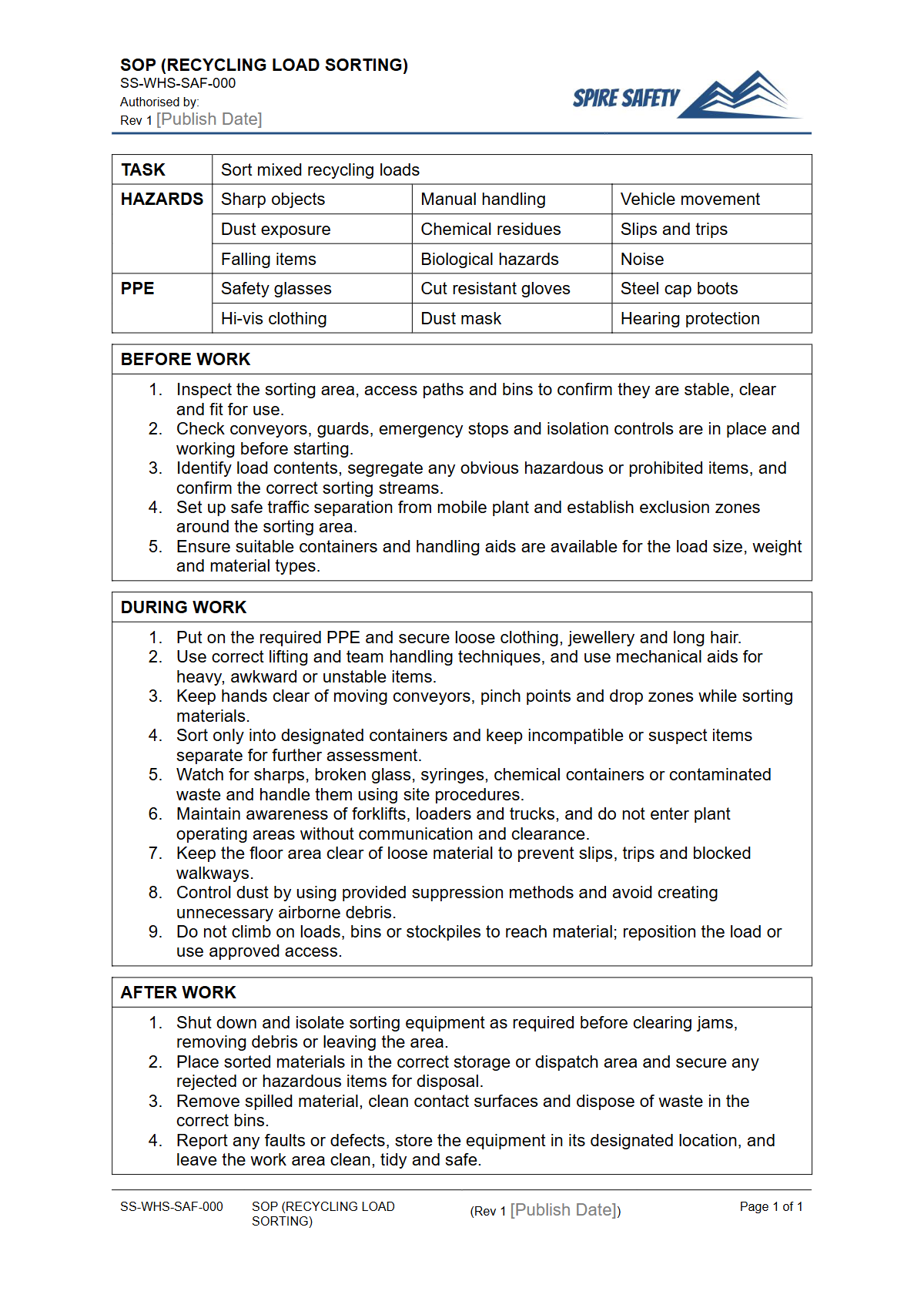
This Free Safe Operating Procedure (Recycling Load Sorting) Template provides a structured framework for businesses to document the required steps for safely sorting mixed recycling loads. Sorting recycled materials involves numerous hazards, including manual handling, exposure to hazardous substances, and interaction with mobile plant.
Establishing a clear, documented procedure helps to control these risks, ensuring that workers understand their responsibilities and the safety controls in place. Using a standardised SOP promotes consistent work practices, aids in worker training and induction, and forms a key part of your overall safety management system.
A well-developed SOP is more than just a document; it's a critical tool for risk management. It helps your organisation meet its primary duty of care under WHS legislation by demonstrating that you have identified foreseeable hazards and implemented effective control measures.
This template is designed as a comprehensive starting point, aligned with Australian WHS principles, to help you formalise your processes. For tasks involving specific machinery, you may also need a dedicated Conveyer System SOP to cover its operation in detail.
Video walkthrough
How to use the Free Safe Operating Procedure (Recycling Load Sorting) Template
To effectively use this Free Safe Operating Procedure (Recycling Load Sorting) Template, download the DOCX file and adapt it to the specific context of your workplace. It is crucial to replace the generic placeholder text with details relevant to your site's equipment, materials, environment, and personnel.
Conduct a site-specific risk assessment to ensure all potential hazards associated with your load sorting activities are identified and addressed within the procedure.
Important: We have provided this template as a guide. You must customise it to reflect the unique risks and operational realities of your business and worksite.
This includes consulting with your workers and any health and safety representatives during the drafting and review process. A generic procedure that isn't tailored to your specific operations may not effectively control risks. Once customised, the SOP should be integrated into your broader WHS management system.
After customisation, ensure all relevant workers are trained on the final procedure. This training should cover the specific steps, identified risks, control measures, and emergency procedures outlined in the document.
Keep records of this training and schedule regular reviews of the SOP to ensure it remains current and effective, especially when new equipment is introduced or processes change. If mobile plant like forklifts or telehandlers are used, consider incorporating a FREE Telehandler SOP Template into your document library.
When to use a Recycling Load Sorting SOP
A Safe Operating Procedure for recycling load sorting should be used whenever workers are required to manually or mechanically sort materials from mixed recycling streams. This applies to dedicated recycling facilities, waste transfer stations, and any business that processes its own recyclable waste.
The SOP should be a reference point during daily operations, a core component of new employee induction, and a tool for refresher training. It is particularly important when tasks are performed infrequently or when new or inexperienced workers are involved.
The procedure should also be referenced during incident investigations, workplace inspections, and safety audits. If a near miss or injury occurs during sorting activities, the SOP can be reviewed to identify any gaps or weaknesses in the established safety process.
Regularly reviewing the SOP's effectiveness can be supported by professional WHS compliance auditing services, which provide an external perspective on your systems.
Who should use this Safe Operating Procedure
This SOP is intended for use by all personnel involved in recycling load sorting tasks. This includes plant operators, pickers on a sorting line, yard hands, and their direct supervisors or managers.
Managers and supervisors are responsible for ensuring the procedure is implemented, understood, and consistently followed by their teams. They must also provide the necessary resources, training, and personal protective equipment (PPE) specified in the document.
Workers have a responsibility to follow the instructions outlined in the SOP to protect their own health and safety and that of their colleagues. Health and Safety Representatives (HSRs) and committee members should also be familiar with the procedure, as it is a key document for consultation on workplace safety matters. For equipment used in the process, such as those powered by compressed air, you might also require a Free Air Compressor SOP.
This is just one of many templates we offer to support Australian businesses. You can explore our complete free WHS resources library for other useful documents, checklists, and guides to build out your safety systems.
Common mistakes
Common mistakes to avoid
- Using the template as-is without customising it for specific site hazards and equipment.
- Failing to provide adequate training to all workers on the finalised procedure.
- Not enforcing the mandatory use of specified Personal Protective Equipment (PPE).
- Neglecting to schedule and conduct regular reviews of the SOP's effectiveness.
Legal references
Legal considerations
The following legal requirements may be relevant to this type of work.
- Work Health and Safety Act (Harmonised) — Provides the primary duties for protecting workers and other people from work health and safety risks.
- Work Health and Safety Regulations (Harmonised) — Sets out requirements supporting the management of workplace hazards and risks.
The following codes may be relevant to this type of work.
- Managing WHS Risks Code of Practice — Provides practical guidance on identifying hazards, assessing risks and applying effective controls.
- Work Health and Safety Consultation, Cooperation and Coordination Code of Practice — Provides practical guidance on consulting workers and coordinating with other duty holders.
- Managing the Work Environment and Facilities Code of Practice — Provides practical guidance on safe work environments, workplace facilities and related controls.
Did you know
High-Risk Industry
The waste and recycling collection industry in Australia has one of the highest rates of serious workers' compensation claims, making documented safety procedures like SOPs critically important.
Hidden Dangers
Lithium-ion batteries, often found in discarded electronics, are a major fire hazard in recycling facilities. If damaged by sorting equipment, they can ignite and cause major fires.
FAQ
Frequently asked questions
01What are the main hazards when sorting recycling loads?
02Why is a specific SOP needed for recycling sorting?
03How often should a recycling load sorting SOP be reviewed?
04What personal protective equipment (PPE) is required for recycling load sorting?
Share this resource
Free Safe Operating Procedure (Recycling Load Sorting) Template
Browse Categories
How To Use It
- 1Download and open in Word or PDF.
- 2Replace the placeholders with your business details.
- 3Get it reviewed by a WHS specialist before rollout.
Need it customised?
Our WHS consultants can adapt this template to your site, run a gap analysis, or audit what you already have in place.
Book a Free Consultation WHS consulting servicesor call 1300 156 382
Related templates
- Free Safe Operating Procedure (Relief Valve Test) Template
- Free Safe Operating Procedure (Remote Crane Control) Template
- Free Safe Operating Procedure (Resaw Machine) Template
- Free Safe Operating Procedure (Rescue Boat Launch) Template
- Free Safe Operating Procedure (Rescue Winch) Template
- Free Safe Operating Procedure (Resident Laundry Sort) Template