
Free Safe Operating Procedure (Recycling Bin Service) Template
Establish clear safety protocols for handling recycling bins with our customisable template. Download your free Safe Operating Procedure to get started.
Free Safe Operating Procedure (Recycling Bin Service) Template
DOCX • 126 KB + PDF
Updated Oct 2026
No signup required
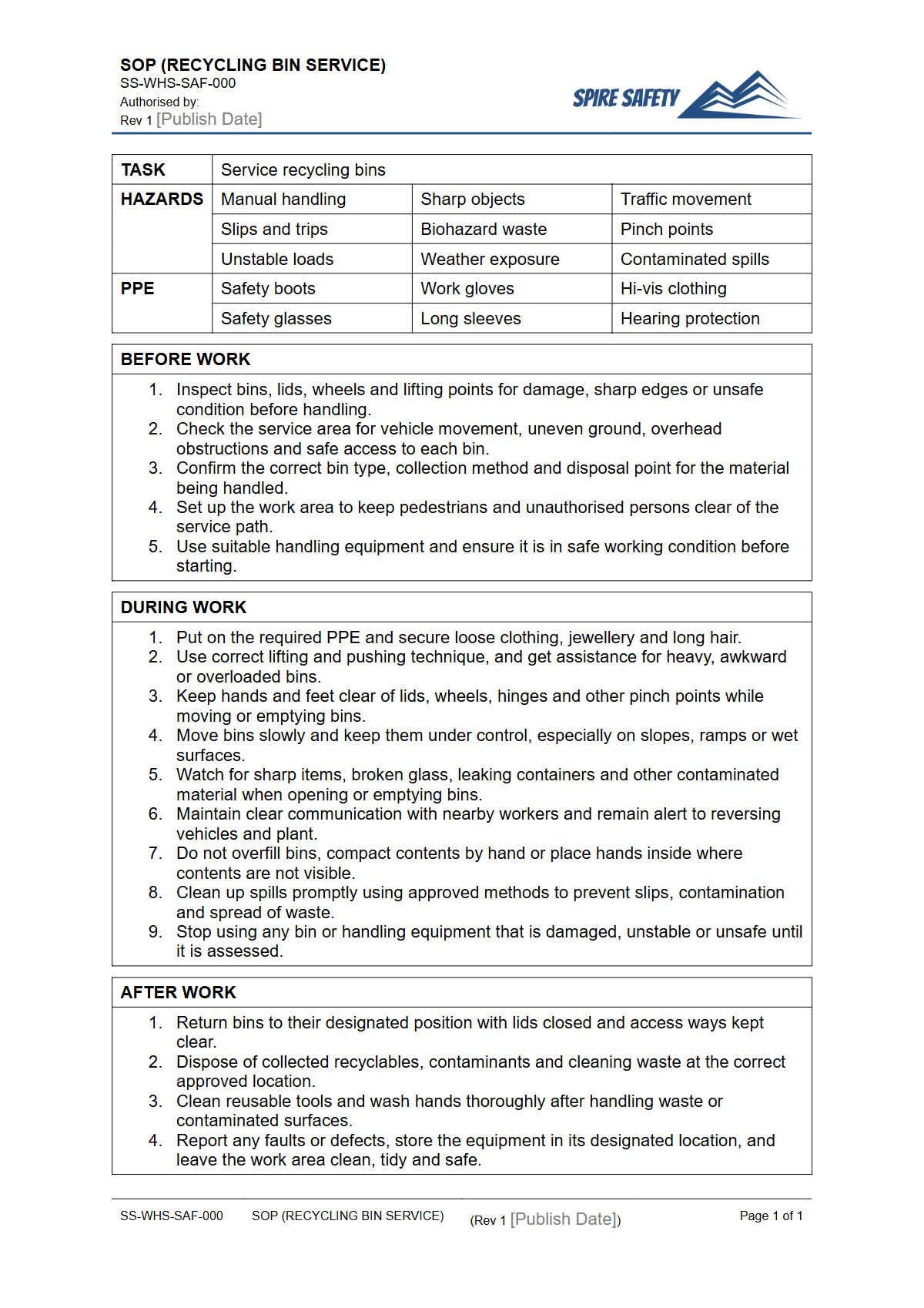
Purpose of the Free Safe Operating Procedure (Recycling Bin Service) Template
Servicing recycling bins, whether in a commercial, industrial, or public setting, involves a range of hazards that can lead to serious injury if not properly managed. Our Free Safe Operating Procedure (Recycling Bin Service) Template provides a structured starting point for your organisation to document the specific risks and control measures associated with this common task.
Using this SOP helps formalise safety protocols, ensuring every worker understands the required steps for tasks like bin collection, transportation, emptying, and cleaning.
This procedure is designed to help you identify hazards such as manual handling injuries from pushing or lifting heavy bins, crush injuries from collection vehicles, exposure to hazardous materials, and slips, trips, and falls. By documenting these risks and the corresponding controls, you create a safer system of work.
A well-developed SOP is a foundational element of robust WHS management systems, demonstrating a commitment to proactive risk management.
What's included in this Safe Operating Procedure?
This template is aligned with Australian WHS good practice and includes sections to detail:
- Required Personal Protective Equipment (PPE)
- Pre-operational checks for equipment and work areas
- Step-by-step instructions for safely servicing recycling bins
- Key hazards and their associated risk control measures
- Emergency procedures and contacts
- Training and competency requirements
Video walkthrough
How to use the Free Safe Operating Procedure (Recycling Bin Service) Template
This template is provided in both DOCX and PDF formats for your convenience. The DOCX file is fully editable, allowing you to tailor the content directly to the unique environment of your workplace, including the specific types of bins, collection methods, and machinery used.
Integrating this procedure with other task-specific documents, like a FREE Telehandler SOP Template if one is used for lifting large bins, ensures comprehensive coverage of your operations.
To get started, simply download the file and follow the prompts within the document. It is critical to consult with workers who actually perform the task, as their direct experience is invaluable for identifying all relevant hazards and practical control measures.
Please note: This document is a template and must be customised to your specific workplace, equipment, and processes. We have included guidance on where to add your site-specific details, but you are responsible for ensuring the final document is accurate and reflects the risks present in your operations.
When to use it
A Safe Operating Procedure for recycling bin services should be a living document integrated into your daily operations. It is essential for:
- Induction and Training: Use the SOP as a primary training tool for new employees or workers new to the task.
- Pre-Task Planning: Workers should review the SOP before starting work, especially if the task is performed infrequently.
- Refresher Training: Incorporate the SOP into regular safety meetings and toolbox talks to reinforce safe work habits.
- Incident Investigation: The procedure serves as a benchmark for expected safe practice when investigating why an incident or near-miss occurred.
Regularly reviewing your SOPs is also a key activity during a WHS compliance auditing program, helping to verify that documented procedures are being followed correctly in practice.
Who should use it
This template is designed for use by a wide range of personnel involved in workplace safety and operations. This includes:
- WHS Managers and Advisors: To develop and implement standardised safety procedures across the organisation.
- Supervisors and Team Leaders: To train their teams and monitor compliance with safe work practices on the ground.
- Waste Management Workers and Cleaners: As a direct guide for performing their duties safely.
- Facilities and Building Managers: To ensure contractors and employees servicing their sites adhere to established safety standards.
For organisations with complex waste streams, such as those involving automated sorting, it may be necessary to develop additional procedures for related machinery. A FREE Conveyer System SOP can provide a useful framework for those adjacent tasks. If you need more templates for other equipment or tasks, you can explore our complete free WHS resources library.
Common mistakes
Common mistakes to avoid
- Using a generic template without customising it for specific site conditions, bin types, and collection vehicles.
- Failing to consult with workers who perform the task when drafting or reviewing the procedure.
- Not providing practical training on the finalised SOP, assuming workers will read and understand it on their own.
- Forgetting to review and update the SOP after an incident, a near-miss, or a change in the work process.
Legal references
Legal considerations
The following legal requirements may be relevant to this type of work.
- Work Health and Safety Act (Harmonised) — Provides the primary duties for protecting workers and other people from work health and safety risks.
- Work Health and Safety Regulations (Harmonised) — Sets out requirements supporting the management of workplace hazards and risks.
The following codes may be relevant to this type of work.
- Managing WHS Risks Code of Practice — Provides practical guidance on identifying hazards, assessing risks and applying effective controls.
- Work Health and Safety Consultation, Cooperation and Coordination Code of Practice — Provides practical guidance on consulting workers and coordinating with other duty holders.
- Managing the Work Environment and Facilities Code of Practice — Provides practical guidance on safe work environments, workplace facilities and related controls.
Did you know
Manual Handling Risks
According to Safe Work Australia, injuries resulting from manual handling are the most common type of workplace injury in the country, highlighting the importance of proper procedures for tasks like moving heavy bins.
Recycling Efforts
In 2020-21, Australia generated an estimated 75.8 million tonnes of waste, with a national recovery rate of 63%. Effective and safe collection services are critical to improving this rate and supporting a circular economy.
FAQ
Frequently asked questions
01What are the main hazards involved in recycling bin services?
02Is a Safe Operating Procedure a legal requirement in Australia?
03How often should a recycling bin service SOP be reviewed?
04What is the difference between a Safe Operating Procedure (SOP) and a Safe Work Method Statement (SWMS)?
Share this resource
Free Safe Operating Procedure (Recycling Bin Service) Template
Browse Categories
How To Use It
- 1Download and open in Word or PDF.
- 2Replace the placeholders with your business details.
- 3Get it reviewed by a WHS specialist before rollout.
Need it customised?
Our WHS consultants can adapt this template to your site, run a gap analysis, or audit what you already have in place.
Book a Free Consultation WHS consulting servicesor call 1300 156 382
Related templates
- Free Safe Operating Procedure (Recycling Contamination) Template
- Free Safe Operating Procedure (Recycling Dropoff Check) Template
- Free Safe Operating Procedure (Recycling Load Check) Template
- Free Safe Operating Procedure (Recycling Load Sorting) Template
- Free Safe Operating Procedure (Relief Valve Test) Template
- Free Safe Operating Procedure (Remote Crane Control) Template