
Free Safe Operating Procedure (Recycling Contamination) Template
Manage recycling contamination risks with our free template. Download this Safe Operating Procedure to standardise sorting and handling processes.
Free Safe Operating Procedure (Recycling Contamination) Template
DOCX • 126 KB + PDF
Updated Oct 2026
No signup required
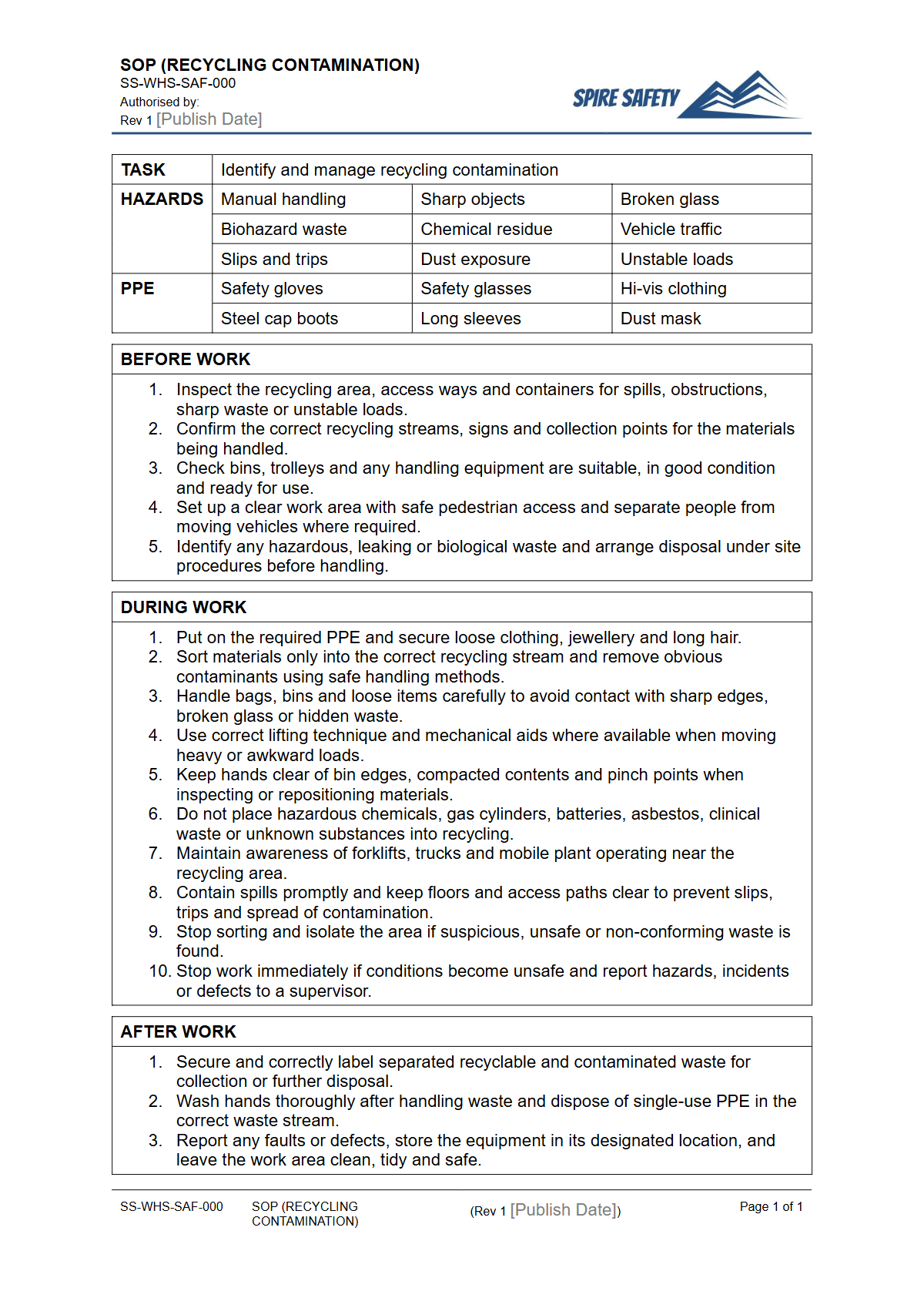
Purpose of the Free Safe Operating Procedure (Recycling Contamination) Template
This Free Safe Operating Procedure (Recycling Contamination) Template provides a structured framework for businesses to document the required steps for safely identifying, handling, and managing contaminated materials within a recycling stream. Its primary purpose is to minimise health and safety risks to workers, such as exposure to hazardous substances, sharps, biological waste, and musculoskeletal injuries from incorrect manual handling.
By establishing a clear, repeatable process, this SOP helps ensure that all personnel understand their responsibilities and the control measures in place to protect them from harm.
Implementing a formal procedure promotes a consistent approach to quality control and operational efficiency. It assists in training new employees and serves as a reference for experienced staff.
Proper management of contamination is not only a safety issue but also critical for the viability of recycling operations, preventing damage to machinery and ensuring the final recycled product meets quality standards. This document is a foundational component of a robust safety management system, demonstrating a commitment to proactive risk management aligned with Australian WHS principles.
Video walkthrough
How to use the Free Safe Operating Procedure (Recycling Contamination) Template
Our Free Safe Operating Procedure (Recycling Contamination) Template is provided in an editable DOCX format for easy customisation. To use it effectively, you must adapt the content to the specific hazards, materials, equipment, and processes unique to your workplace.
This involves conducting a thorough risk assessment to identify all potential dangers associated with contamination in your facility, from the tipping floor to the final sorted product.
You should populate the template with details specific to your operations, including:
- The types of common contaminants encountered (e.g., hazardous chemicals, asbestos, medical waste, food waste, non-recyclable plastics).
- Specific Personal Protective Equipment (PPE) required for different tasks.
- Step-by-step instructions for manual sorting, decontamination, and disposal of non-conforming materials.
- Emergency procedures for spills, exposure, or injury.
- The machinery involved in the process, which may have its own dedicated procedures, similar to the protocols outlined in our free Conveyer System SOP template.
Important: This is a template only. We are not WHS consultants, and this document is not a substitute for professional advice.
You must consult with your workers and other stakeholders during customisation and review the final document to ensure it is suitable for your specific workplace conditions and complies with all relevant state and federal legislation. Integrating this SOP into your broader WHS management systems ensures a consistent approach to safety across all operations.
When to use it
A Safe Operating Procedure for recycling contamination should be used whenever workers are required to interact with unsorted or post-consumer waste streams where the presence of non-target and potentially hazardous materials is possible. This includes daily operational tasks such as manual sorting on a picking line, quality control checks, clearing blockages in machinery caused by contaminants, and the clean-up of spills.
This SOP should be a primary training document during employee induction and be readily accessible at the point of work for reference. It is also a critical tool for refresher training, particularly after an incident or near-miss involving contamination.
Regular reviews and updates should be triggered by changes in the waste stream, the introduction of new equipment, or findings from WHS compliance auditing activities.
Who should use it
This SOP is intended for all personnel involved in the physical handling and processing of recyclable materials. This includes plant operators, sorters, maintenance staff, supervisors, and managers within waste management facilities, material recovery facilities (MRFs), and recycling depots.
Supervisors and managers should use the SOP to enforce safe work practices, conduct workplace inspections, and deliver toolbox talks.
Health and Safety Representatives (HSRs) and committee members will also find this document useful for understanding established procedures and participating in consultative processes for risk management. For tasks involving mobile plant to move materials, specific procedures should also be established; our FREE Telehandler SOP Template can provide a useful starting point for such equipment.
The principles in this SOP are scalable and can be adapted by any organisation, large or small, that handles recyclable materials and faces risks from contamination.
Common mistakes
Common mistakes to avoid
- Failing to provide specific training on how to identify and safely handle different types of contaminants.
- Providing inadequate or poorly maintained Personal Protective Equipment (PPE) for staff on sorting lines.
- Not updating the SOP after an incident or when new sorting machinery is commissioned.
- Poor communication of procedures, leading to inconsistent practices between different shifts or teams.
Legal references
Legal considerations
The following legal requirements may be relevant to this type of work.
- Work Health and Safety Act (Harmonised) — Provides the primary duties for protecting workers and other people from work health and safety risks.
- Work Health and Safety Regulations (Harmonised) — Sets out requirements supporting the management of workplace hazards and risks.
The following codes may be relevant to this type of work.
- Managing WHS Risks Code of Practice — Provides practical guidance on identifying hazards, assessing risks and applying effective controls.
- Work Health and Safety Consultation, Cooperation and Coordination Code of Practice — Provides practical guidance on consulting workers and coordinating with other duty holders.
- Managing the Work Environment and Facilities Code of Practice — Provides practical guidance on safe work environments, workplace facilities and related controls.
Did you know
Contamination Rates
According to the Australian Government's National Waste Report, contamination rates in kerbside recycling bins can be as high as 10-15% by weight, posing significant challenges for processing facilities.
The 'Dirty Dozen'
Many councils refer to a 'dirty dozen' of common contaminants, which often include plastic bags, nappies, food waste, clothing, and batteries. These items can injure workers and jam multi-million dollar sorting equipment.
FAQ
Frequently asked questions
01What is recycling contamination?
02Why is an SOP for recycling contamination necessary?
03How often should our recycling contamination SOP be reviewed?
04Can this template be used for all types of recycling facilities?
Share this resource
Free Safe Operating Procedure (Recycling Contamination) Template
Browse Categories
How To Use It
- 1Download and open in Word or PDF.
- 2Replace the placeholders with your business details.
- 3Get it reviewed by a WHS specialist before rollout.
Need it customised?
Our WHS consultants can adapt this template to your site, run a gap analysis, or audit what you already have in place.
Book a Free Consultation WHS consulting servicesor call 1300 156 382
Related templates
- Free Safe Operating Procedure (Recycling Dropoff Check) Template
- Free Safe Operating Procedure (Recycling Load Check) Template
- Free Safe Operating Procedure (Recycling Load Sorting) Template
- Free Safe Operating Procedure (Relief Valve Test) Template
- Free Safe Operating Procedure (Remote Crane Control) Template
- Free Safe Operating Procedure (Resaw Machine) Template