
Free Safe Operating Procedure (Recliner Chair Cleaning) Template
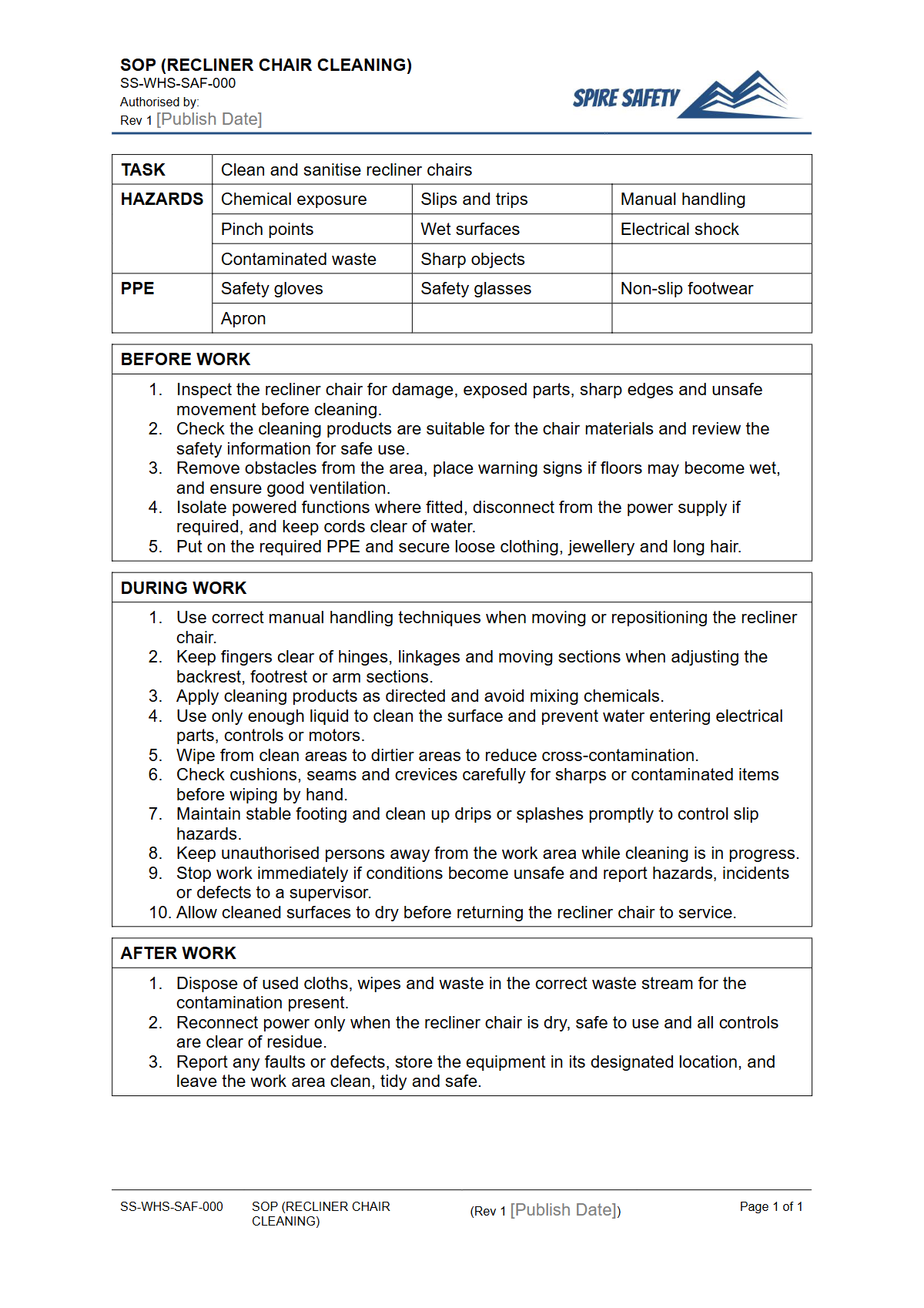
Download our free template for recliner chair cleaning. This Safe Operating Procedure helps you outline key hazards and controls for your team.
Free Safe Operating Procedure (Recliner Chair Cleaning) Template
DOCX • 126 KB + PDF
Updated Oct 2026
No signup required
Purpose of the Free Safe Operating Procedure (Recliner Chair Cleaning) Template
This Free Safe Operating Procedure (Recliner Chair Cleaning) Template provides a structured starting point for businesses to document a safe system of work for cleaning recliner chairs. The task, common in aged care, accommodation, and professional cleaning services, presents several workplace hazards.
These include manual handling risks when moving bulky furniture, potential exposure to hazardous cleaning chemicals, electrical risks associated with powered recliners, and slip hazards from spills. This SOP template is designed to help you identify these risks and document clear, step-by-step instructions and control measures to ensure the task is performed safely and consistently by all workers.
A well-developed SOP is a critical component of a proactive safety culture. By formalising procedures, you provide clear guidance to workers, streamline training for new staff, and create a verifiable record of your safety processes.
Integrating specific SOPs like this one into your broader WHS management systems demonstrates a commitment to managing operational risks at a granular level. The template guides you through detailing necessary personal protective equipment (PPE), pre-operational checks, waste disposal, and emergency procedures relevant to cleaning recliner chairs.
Video walkthrough
How to use the Free Safe Operating Procedure (Recliner Chair Cleaning) Template
To begin, download the template in your preferred format (DOCX for easy editing or PDF). The core of using this resource effectively is customisation.
Workplace environments, the specific types of recliners (manual vs. electric), and the cleaning chemicals used will vary significantly between businesses.
You must adapt the content to reflect the specific equipment, substances, and risks present in your workplace. This involves conducting a risk assessment for the task in consultation with the workers who perform it.
Important: This is a template only. It provides a framework but is not a complete or document as is.
We are not familiar with your specific operations, so you must take this document and customise it to your business. This involves adding your company name and logo, and most importantly, consulting with your team to detail the specific steps, hazards, and controls relevant to your actual workplace.
Failure to customise this SOP for your specific circumstances may not adequately control risks. If you need assistance with this process, consider engaging specialist WHS consulting services.
When to use it
A Safe Operating Procedure for recliner chair cleaning should be an active document used in daily operations. It is not a set-and-forget file.
Use this SOP as a primary training tool for new employees or for refresher training to ensure consistent, safe practices. It should be readily accessible to all relevant workers, either in a printed format near the work area or digitally via a company intranet.
The SOP also serves as a critical reference during pre-task planning and safety briefings. Furthermore, it is a key piece of evidence reviewed during safety inspections and WHS compliance auditing to verify that formalised safe work methods are in place and being followed.
Who should use it
This SOP should be used by a range of personnel within an organisation. Primarily, workers who perform the cleaning tasks (e.g., cleaners, maintenance staff, healthcare assistants) must be trained on and follow the procedure.
Supervisors and managers are responsible for implementing the SOP, ensuring workers understand and adhere to it, and conducting regular reviews to confirm its continued relevance and effectiveness. WHS officers and safety committees will use the SOP as part of their risk management and safety assurance activities.
Developing a library of task-specific procedures is a cornerstone of good safety management, and you can explore our full free WHS resources library for other templates.
While this document focuses on cleaning furniture, the principles of documenting safe procedures apply to many different tasks. For instance, commercial kitchens must have clear instructions for equipment use, which can be captured in documents like our deep fryer SOP. The fundamental process of identifying hazards, documenting controls, and training workers remains the same across diverse operational environments.
Common mistakes
Common mistakes to avoid
- Using a generic SOP without customising it for site-specific recliners and cleaning chemicals.
- Failing to consult with cleaners and maintenance staff during the drafting and review process.
- Neglecting to include procedures for isolating power to electric recliners before cleaning.
- Not making the Safety Data Sheet (SDS) for each cleaning product readily accessible to workers.
Legal references
Legal considerations
The following legal requirements may be relevant to this type of work.
- Work Health and Safety Act (Harmonised) — Provides the primary duties for protecting workers and other people from work health and safety risks.
- Work Health and Safety Regulations (Harmonised) — Sets out requirements supporting the management of workplace hazards and risks.
The following codes may be relevant to this type of work.
- Managing WHS Risks Code of Practice — Provides practical guidance on identifying hazards, assessing risks and applying effective controls.
- Work Health and Safety Consultation, Cooperation and Coordination Code of Practice — Provides practical guidance on consulting workers and coordinating with other duty holders.
- Managing the Work Environment and Facilities Code of Practice — Provides practical guidance on safe work environments, workplace facilities and related controls.
Did you know
Manual Handling Risks
Lifting or moving awkward furniture like recliner chairs is a leading cause of musculoskeletal injuries. The Hazardous Manual Tasks Code of Practice recommends assessing the load and using team lifts or mechanical aids where possible.
Chemical Safety
Many commercial cleaning products contain chemicals that can cause dermatitis or respiratory irritation. Always refer to the Safety Data Sheet (SDS) to understand the specific hazards and required controls, such as ventilation and PPE.
FAQ
Frequently asked questions
01What should be included in an SOP for recliner chair cleaning?
02Who is responsible for creating and updating this SOP?
03How often should a cleaning SOP be reviewed?
04Is training required after implementing a new SOP for recliner cleaning?
Share this resource
Free Safe Operating Procedure (Recliner Chair Cleaning) Template
Browse Categories
How To Use It
- 1Download and open in Word or PDF.
- 2Replace the placeholders with your business details.
- 3Get it reviewed by a WHS specialist before rollout.
Need it customised?
Our WHS consultants can adapt this template to your site, run a gap analysis, or audit what you already have in place.
Book a Free Consultation WHS consulting servicesor call 1300 156 382
Related templates
- Free Safe Operating Procedure (Recycling Bay Cleanup) Template
- Free Safe Operating Procedure (Recycling Bin Service) Template
- Free Safe Operating Procedure (Recycling Contamination) Template
- Free Safe Operating Procedure (Recycling Dropoff Check) Template
- Free Safe Operating Procedure (Recycling Load Check) Template
- Free Safe Operating Procedure (Recycling Load Sorting) Template