
Free Safe Operating Procedure (Reception Desk Cleaning) Template
Download our free Safe Operating Procedure (Reception Desk Cleaning) template to standardise cleaning tasks and manage chemical risks. Get your DOCX today.
Free Safe Operating Procedure (Reception Desk Cleaning) Template
DOCX • 126 KB + PDF
Updated Oct 2026
No signup required
Purpose of the Free Safe Operating Procedure (Reception Desk Cleaning) Template
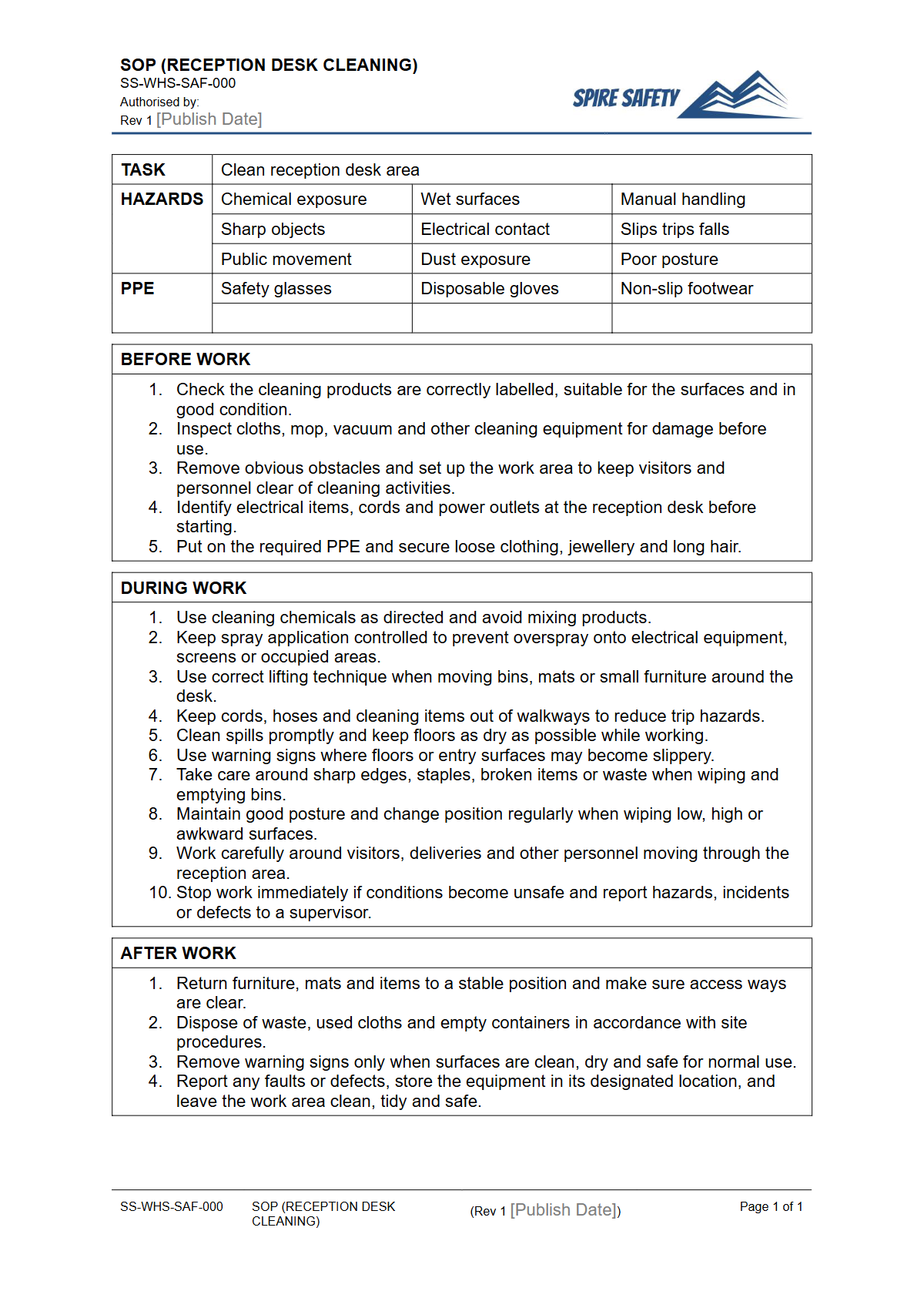
Establishing a clear, consistent cleaning process for your reception area is crucial for workplace health, safety, and professional presentation. Our Free Safe Operating Procedure (Reception Desk Cleaning) Template provides a structured starting point for documenting the required steps, personal protective equipment (PPE), and safety precautions for this common task.
A documented Safe Operating Procedure (SOP) helps ensure every worker performs the task safely and effectively, minimising risks associated with hazardous chemicals and preventing the spread of illness in a high-traffic area.
This document is designed to be adapted into a formal workplace procedure, promoting a standardised approach that is aligned with Australian WHS practice. By outlining a clear sequence of actions, you reduce ambiguity and improve the overall safety culture within your organisation.
It serves as a practical tool for risk management, addressing foreseeable hazards before they can cause harm.
Key Hazards Addressed
A comprehensive SOP for cleaning should address several potential hazards. The primary risks involved in reception desk cleaning include chemical exposure (e.g., skin irritation, respiratory issues from sprays), ergonomic strains from repetitive movements or awkward postures, and slip, trip, and fall hazards from wet floors or trailing cords.
While this SOP covers a specific task, the principles apply broadly. For example, procedures for using simple equipment, detailed in documents like our Free Air Compressor SOP (Safe Operating Procedure) Template, also focus on controlling user-level risks through clear, step-by-step guidance.
Video walkthrough
How to use the Free Safe Operating Procedure (Reception Desk Cleaning) Template
This download is a template, not a finished, ready-to-use document. To be effective, you must customise it to reflect the specific chemicals, equipment, surfaces, and unique hazards present in your workplace. After downloading the DOCX file, review each section and replace the placeholder text with your site-specific information.
This includes adding your company branding, specifying the exact names of the cleaning products used, and detailing correct dilution ratios, required contact times for disinfectants, and disposal methods.
The completed SOP should be made easily accessible to all relevant staff. It should be integrated into your broader safety framework to ensure procedures are managed systematically.
Developing robust WHS management systems provides a comprehensive structure for all your safety documentation, training records, and risk assessments, ensuring a cohesive approach to workplace safety across the entire organisation.
When to use it
This Safe Operating Procedure should be the primary reference document for all routine and periodic cleaning of the reception desk and immediate surrounding areas. It provides a reliable benchmark for safe work practices. Key scenarios for its use include:
- Daily or end-of-shift cleaning routines.
- Scheduled deep cleaning tasks.
- Training and inducting new receptionists or cleaning staff on their responsibilities.
- As a reference tool for supervisors monitoring work practices and ensuring standards are met.
- As part of a corrective action following a safety observation or incident investigation.
Procedures should be living documents that are reviewed and updated regularly. A periodic check ensures the SOP remains relevant and effective, a process which can be validated as part of a formal WHS compliance auditing program to verify that documented procedures match actual work practices.
Who should use it
This template is designed for use by several key roles within an organisation to ensure a unified approach to safety and hygiene:
- Reception Staff and Administrative Assistants: The primary users who perform the cleaning task as part of their daily duties.
- Cleaning Personnel: If cleaning is handled by a dedicated team, this SOP ensures their methods are consistent with front-of-house standards and safety requirements.
- Managers and Supervisors: Responsible for training staff, enforcing standards, conducting workplace inspections, and ensuring the procedure is followed correctly.
- WHS Officers and Committees: To identify hazards, assess risks, and implement control measures related to cleaning chemicals and work practices.
For organisations requiring expert guidance to develop or refine their safety documentation, engaging external specialists can be highly beneficial. Our WHS consulting services provide tailored support to help businesses of all sizes meet their safety obligations.
You can also explore our free WHS resources library for other templates and guides.
Common mistakes
Common mistakes to avoid
- Failing to train workers on the specific procedures outlined in the SOP.
- Using the wrong cleaning chemicals for a surface, potentially causing damage or an ineffective clean.
- Not allowing sufficient 'contact time' for disinfectants to work before wiping them away.
- Forgetting to include emergency procedures for chemical spills or accidental exposure.
Legal references
Legal considerations
The following legal requirements may be relevant to this type of work.
- Work Health and Safety Act (Harmonised) — Provides the primary duties for protecting workers and other people from work health and safety risks.
- Work Health and Safety Regulations (Harmonised) — Sets out requirements supporting the management of workplace hazards and risks.
The following codes may be relevant to this type of work.
- Managing WHS Risks Code of Practice — Provides practical guidance on identifying hazards, assessing risks and applying effective controls.
- Work Health and Safety Consultation, Cooperation and Coordination Code of Practice — Provides practical guidance on consulting workers and coordinating with other duty holders.
- Managing the Work Environment and Facilities Code of Practice — Provides practical guidance on safe work environments, workplace facilities and related controls.
Did you know
Disinfectant Dwell Time
For a disinfectant to be effective, it must remain on a surface for a specific amount of time, known as 'contact' or 'dwell' time. Simply spraying and wiping immediately may not kill germs effectively.
Desk Germs
Studies have shown that the average office desk can harbour hundreds of times more bacteria than an office toilet seat, making regular, effective cleaning a critical health and safety measure.
FAQ
Frequently asked questions
01What should be included in a SOP for reception desk cleaning?
02Why is a specific SOP needed just for cleaning a reception desk?
03How often should our reception cleaning SOP be reviewed?
04Can this SOP template be used for other office cleaning tasks?
Share this resource
Free Safe Operating Procedure (Reception Desk Cleaning) Template
Browse Categories
How To Use It
- 1Download and open in Word or PDF.
- 2Replace the placeholders with your business details.
- 3Get it reviewed by a WHS specialist before rollout.
Need it customised?
Our WHS consultants can adapt this template to your site, run a gap analysis, or audit what you already have in place.
Book a Free Consultation WHS consulting servicesor call 1300 156 382
Related templates
- Free Safe Operating Procedure (Recliner Chair Cleaning) Template
- Free Safe Operating Procedure (Recycling Bay Cleanup) Template
- Free Safe Operating Procedure (Recycling Bin Service) Template
- Free Safe Operating Procedure (Recycling Contamination) Template
- Free Safe Operating Procedure (Recycling Dropoff Check) Template
- Free Safe Operating Procedure (Recycling Load Check) Template