
Free Safe Operating Procedure (Rebar Bender) Template
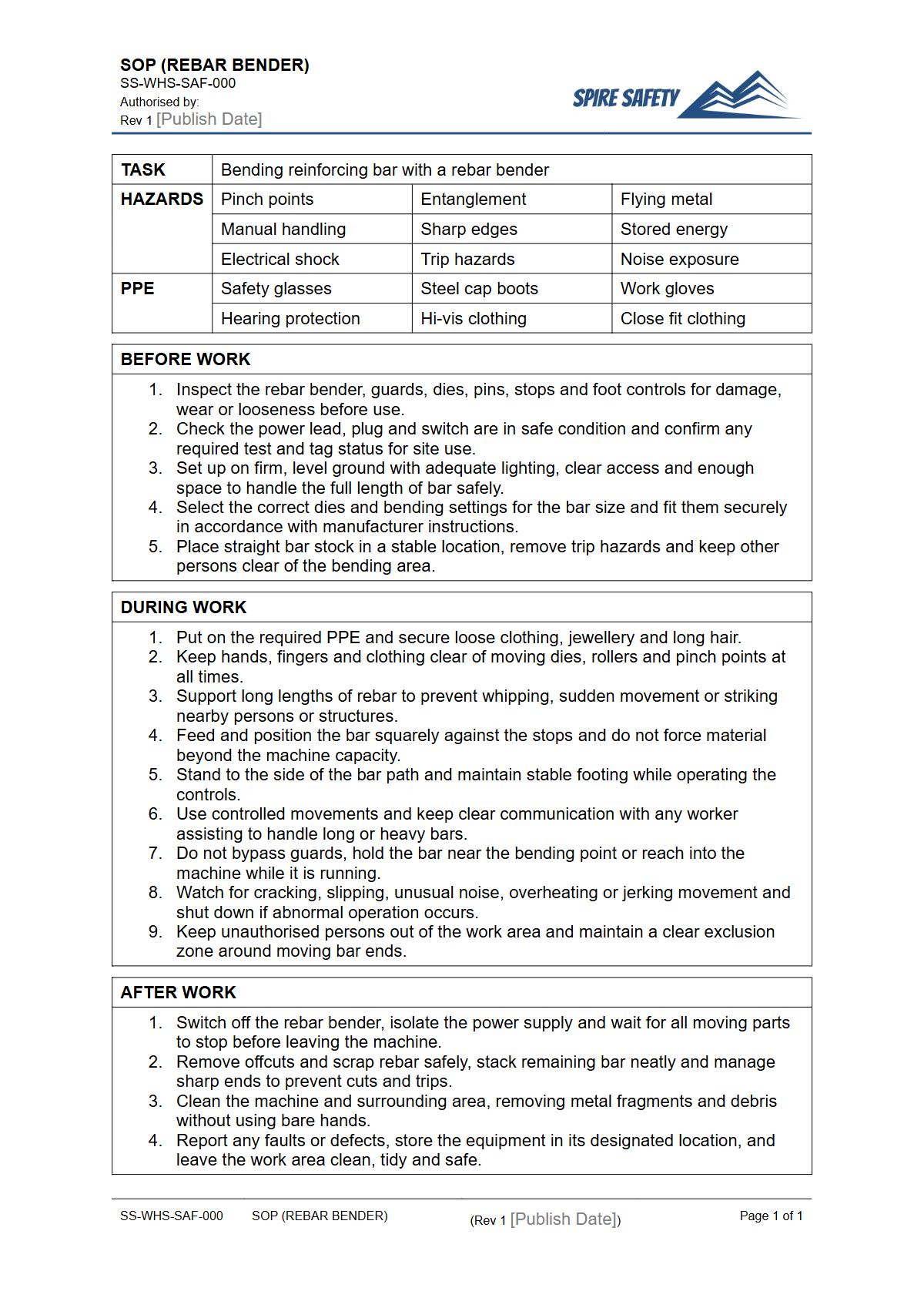
Download our free Rebar Bender Safe Operating Procedure template to document task-specific risks. Customise the DOCX or PDF to suit your workplace needs.
Free Safe Operating Procedure (Rebar Bender) Template
DOCX • 126 KB + PDF
Updated Oct 2026
No signup required
Purpose of the Free Safe Operating Procedure (Rebar Bender) Template
This Free Safe Operating Procedure (Rebar Bender) Template provides a structured starting point for organisations to document the risks and control measures associated with using powered rebar bending equipment. Operating a rebar bender involves significant hazards, including crushing, entanglement, and severe musculoskeletal injuries if not managed correctly.
A documented SOP is a fundamental tool for ensuring operators understand the required steps for pre-start checks, safe operation, and shutdown procedures.
Using a clear and comprehensive Safe Operating Procedure (SOP) demonstrates a commitment to workplace safety and is a key component of a risk management process. Integrating specific procedures like this one into your broader framework helps build robust WHS management systems that are practical, repeatable, and aligned with Australian WHS expectations.
This template is designed to be adapted to your specific machinery and operational context, helping you meet your duty of care to provide a safe working environment.
Video walkthrough
How to use the Free Safe Operating Procedure (Rebar Bender) Template
Using this template is straightforward. First, download the file in your preferred format—DOCX for easy editing or PDF as a reference.
The document is logically structured with sections for PPE, pre-operational checks, step-by-step operating instructions, and post-operational tasks. Your primary task is to review and customise every section to reflect the specific rebar bender model used at your workplace, your site conditions, and your organisation's internal safety policies.
Important: This document is a template only. We are not your safety consultants, and this template does not constitute legal advice.
You MUST customise this document by consulting with your workers, supervisors, and any relevant technical experts to ensure it accurately reflects the specific hazards and controls for your workplace. A generic procedure is not sufficient; a site-specific SOP is essential for effective risk control.
This process is similar for other equipment, such as when adapting a circular saw SOP for a specific model.
Key Hazards to Consider
When customising this template, pay close attention to the primary hazards associated with rebar benders. These include:
- Entanglement: Loose clothing, hair, or jewellery can be caught in the moving parts of the machine, leading to severe injuries.
- Crushing/Pinch Points: Hands and fingers can be crushed between the rebar and the bending components or between the machine and other objects.
- Manual Handling: Lifting and positioning heavy lengths of rebar can cause sprains, strains, and other musculoskeletal injuries.
- Uncontrolled Movement: If the rebar is not properly secured, it can whip around during the bending process, striking the operator or others nearby.
- Electrical Hazards: Faulty wiring or improper grounding can pose a risk of electric shock, especially on construction sites.
Each of these hazards must be addressed with specific control measures in your finalised SOP. It's also important to consider the interaction of machinery on a busy site, which is why other procedures like a free Telehandler SOP template are equally important for overall site safety.
When to use a Safe Operating Procedure for a Rebar Bender
A Safe Operating Procedure for a rebar bender should be used consistently as part of daily operations. It is not a document to be filed and forgotten.
It should be used for worker training and induction, ensuring every operator is competent before they are authorised to use the equipment. Supervisors can use it as a checklist for observing work practices and confirming that procedures are being followed correctly.
Furthermore, the SOP should be a key reference document during incident investigations or near-miss reporting. It also forms part of the documentation reviewed during internal or external safety audits.
Regular WHS compliance auditing helps verify that your documented procedures are being implemented effectively in practice.
Who should use this SOP Template
Multiple roles within an organisation have a responsibility related to this SOP:
- Persons Conducting a Business or Undertaking (PCBUs): Have the primary duty of care to ensure, so far as is reasonably practicable, the health and safety of workers. This includes providing and maintaining safe plant and safe systems of work, like a validated SOP.
- WHS Managers and Supervisors: Are responsible for implementing the SOP, ensuring workers are trained on its contents, and monitoring compliance on a day-to-day basis. They are often tasked with leading the customisation process.
- Operators: Must be trained on and follow the procedures outlined in the final SOP to ensure their own safety and the safety of others. They also have a responsibility to report any faults or hazards immediately.
If your organisation lacks the internal expertise to confidently adapt this template and manage associated risks, seeking specialist WHS consulting can provide the necessary guidance and support. You can also explore our free WHS resources library for other helpful documents and templates.
Common mistakes
Common mistakes to avoid
- Using the template without customising it for the specific rebar bender model and site conditions.
- Failing to adequately train operators on the specific procedures outlined in the finalised SOP.
- Neglecting to include detailed instructions for pre-start checks and emergency shutdown procedures.
- Not reviewing and updating the SOP after an incident, near-miss, or when equipment or processes change.
Legal references
Legal considerations
The following legal requirements may be relevant to this type of work.
- Work Health and Safety Act (Harmonised) — Provides the primary duties for protecting workers and other people from work health and safety risks.
- Work Health and Safety Regulations (Harmonised) — Sets out requirements supporting the management of workplace hazards and risks.
The following codes may be relevant to this type of work.
- Managing WHS Risks Code of Practice — Provides practical guidance on identifying hazards, assessing risks and applying effective controls.
- Work Health and Safety Consultation, Cooperation and Coordination Code of Practice — Provides practical guidance on consulting workers and coordinating with other duty holders.
- Managing the Work Environment and Facilities Code of Practice — Provides practical guidance on safe work environments, workplace facilities and related controls.
Did you know
Material Properties
Rebar (reinforcing bar) has ridges, known as deformations, to help it form a stronger bond with concrete. The grade of steel used determines its tensile strength and how it responds to the forces applied during bending.
Hydraulic Power
Most modern rebar benders use hydraulic systems to generate the immense force required for bending. These systems can amplify a small input force into one capable of bending solid steel bars up to 50mm in diameter or more.
FAQ
Frequently asked questions
01What is a Safe Operating Procedure for a rebar bender?
02Is this rebar bender SOP template free to download and use?
03Who is responsible for writing a rebar bender SOP?
04How often should an SOP for a rebar bender be reviewed?
Share this resource
Free Safe Operating Procedure (Rebar Bender) Template
Browse Categories
How To Use It
- 1Download and open in Word or PDF.
- 2Replace the placeholders with your business details.
- 3Get it reviewed by a WHS specialist before rollout.
Need it customised?
Our WHS consultants can adapt this template to your site, run a gap analysis, or audit what you already have in place.
Book a Free Consultation WHS consulting servicesor call 1300 156 382
Related templates
- Free Safe Operating Procedure (Rebar Cutter) Template
- Free Safe Operating Procedure (Rebar Scanner) Template
- Free Safe Operating Procedure (Rebar Straightener) Template
- Free Safe Operating Procedure (Rebar Tying Tool) Template
- Free Safe Operating Procedure (Reception Area Cleaning) Template
- Free Safe Operating Procedure (Reception Desk Cleaning) Template