
Free Safe Operating Procedure (Rebar Scanner) Template
Streamline your site safety with our free Safe Operating Procedure for rebar scanners. Download this customisable template to get started today.
Free Safe Operating Procedure (Rebar Scanner) Template
DOCX • 126 KB + PDF
Updated Oct 2026
No signup required
Purpose of the Free Safe Operating Procedure (Rebar Scanner) Template
A rebar scanner is a critical non-destructive tool used on construction and demolition sites to locate metallic objects within concrete structures before drilling, cutting, or coring. Using one incorrectly can lead to dangerous equipment damage, structural failure, or severe injury from striking rebar, live electrical conduits, or post-tensioned cables.
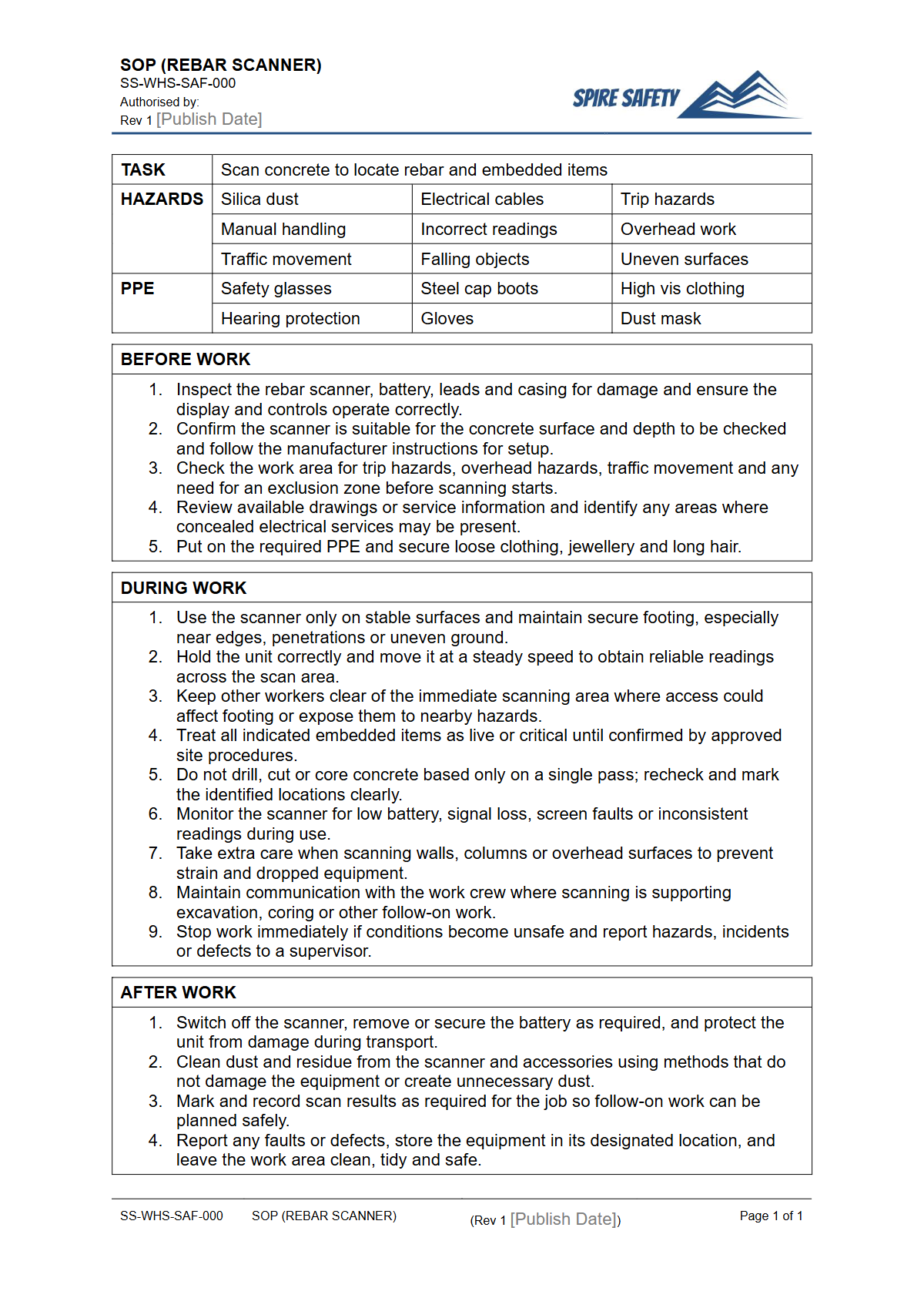
This Free Safe Operating Procedure (Rebar Scanner) Template provides a structured starting point for documenting the required steps to use this equipment safely.
Developing a formal SOP helps standardise processes, provides a clear basis for operator training, and demonstrates a commitment to risk management. This template is designed to be adapted to your specific operational needs, outlining key safety considerations from pre-start checks to operation and post-use maintenance.
It serves as an essential component within broader WHS management systems, ensuring tasks are performed consistently and safely every time.
What is a Safe Operating Procedure for a Rebar Scanner?
A Safe Operating Procedure (SOP) is a written document that provides step-by-step instructions on how to safely perform a specific task or operate a piece of equipment. For a rebar scanner, the SOP details the hazards associated with its use (such as inaccurate readings or misinterpretation of data) and outlines the control measures required to mitigate those risks.
It typically covers pre-operational checks, scanning techniques, interpretation of results, and emergency procedures, forming a key part of your risk assessment process.
Video walkthrough
How to use the Free Safe Operating Procedure (Rebar Scanner) Template
This document is provided as a foundation for your organisation to build upon. It is not a complete, ready-to-use safety document.
Download the DOCX file and methodically work through each section, adding or removing details to align with your specific rebar scanner model, site conditions, personnel competency levels, and internal safety protocols.
Important: You must customise this template to reflect the specific hazards and control measures relevant to your workplace. This includes referencing the manufacturer's operating manual for your particular device.
We are not liable for any incidents that arise from the use of this template. A generic procedure is not a substitute for a site-specific risk assessment.
Engaging specialists for periodic WHS compliance auditing can help verify that your documented procedures are being implemented effectively on-site.
When to use it
A rebar scanner SOP should be implemented and followed before any activity that involves breaking, penetrating, or altering a concrete surface. This is crucial for preventing costly and dangerous utility strikes or structural damage. Key applications include:
- Before drilling holes for anchors, dowels, or fixings.
- Prior to core drilling for plumbing, electrical, or HVAC penetrations.
- Before using concrete saws for creating openings or expansion joints.
- When assessing the structural integrity of existing concrete elements.
- During renovation or demolition projects to map out embedded services and reinforcement.
Using a scanner is a key control measure. For other high-risk activities involving handheld tools, a specific procedure like our FREE Circular Saw SOP Template can also help formalise safe work practices and minimise risk to operators.
Who should use it
This SOP is intended for several key roles within an organisation to ensure a comprehensive approach to safety:
- Operators: Any worker tasked with using the rebar scanner must be trained on the procedure and be deemed competent in its use. They are responsible for following the SOP for every task.
- Supervisors and Site Foremen: These leaders are responsible for ensuring that operators are trained, the SOP is available, and that work is conducted in accordance with the documented procedure. They often sign off on permits to work that require concrete scanning.
- WHS Managers and Advisors: Health and safety professionals use the SOP as a tool for training, inductions, incident investigations, and safety audits. They are typically responsible for developing, reviewing, and updating the procedure.
On larger construction sites, the use of this equipment may run concurrently with other plant operations. Ensuring all teams have clear procedures is vital, which is why we also provide resources like our FREE Telehandler SOP Template. For more specific tasks like groundworks, a free Trencher SOP Template can provide similar guidance. You can explore our entire collection in our free WHS resources library.
Common mistakes
Common mistakes to avoid
- Failing to calibrate the device before each use or as per manufacturer guidelines.
- Scanning the concrete surface too quickly, leading to missed objects or inaccurate readings.
- Relying solely on the scanner without cross-referencing with available structural drawings.
- Using an inappropriate or low-powered scanner for the required depth or concrete density.
Legal references
Legal considerations
The following legal requirements may be relevant to this type of work.
- Work Health and Safety Act (Harmonised) — Provides the primary duties for protecting workers and other people from work health and safety risks.
- Work Health and Safety Regulations (Harmonised) — Sets out requirements supporting the management of workplace hazards and risks.
The following codes may be relevant to this type of work.
- Managing WHS Risks Code of Practice — Provides practical guidance on identifying hazards, assessing risks and applying effective controls.
- Work Health and Safety Consultation, Cooperation and Coordination Code of Practice — Provides practical guidance on consulting workers and coordinating with other duty holders.
- Managing the Work Environment and Facilities Code of Practice — Provides practical guidance on safe work environments, workplace facilities and related controls.
Did you know
Ground Penetrating Radar
Many modern rebar scanners use Ground Penetrating Radar (GPR) technology, which sends a tiny pulse of energy into the concrete and records the strength and time required for the return of any reflected signal.
Post-Tensioning Risk
Accidentally drilling into a post-tensioned (PT) cable can cause a catastrophic failure. The high-tensile steel tendon can eject from the concrete at lethal speed, making pre-drilling scanning a critical safety step.
FAQ
Frequently asked questions
01What is a Safe Operating Procedure (SOP) for a rebar scanner?
02Is training required to use a rebar scanner?
03How often should a rebar scanner SOP be reviewed?
04Can a rebar scanner detect non-metallic services like PVC pipes?
Share this resource
Free Safe Operating Procedure (Rebar Scanner) Template
Browse Categories
How To Use It
- 1Download and open in Word or PDF.
- 2Replace the placeholders with your business details.
- 3Get it reviewed by a WHS specialist before rollout.
Need it customised?
Our WHS consultants can adapt this template to your site, run a gap analysis, or audit what you already have in place.
Book a Free Consultation WHS consulting servicesor call 1300 156 382
Related templates
- Free Safe Operating Procedure (Rebar Straightener) Template
- Free Safe Operating Procedure (Rebar Tying Tool) Template
- Free Safe Operating Procedure (Reception Area Cleaning) Template
- Free Safe Operating Procedure (Reception Desk Cleaning) Template
- Free Safe Operating Procedure (Recliner Chair Cleaning) Template
- Free Safe Operating Procedure (Recycling Bay Cleanup) Template