
Free Safe Operating Procedure (Rebar Cutter) Template
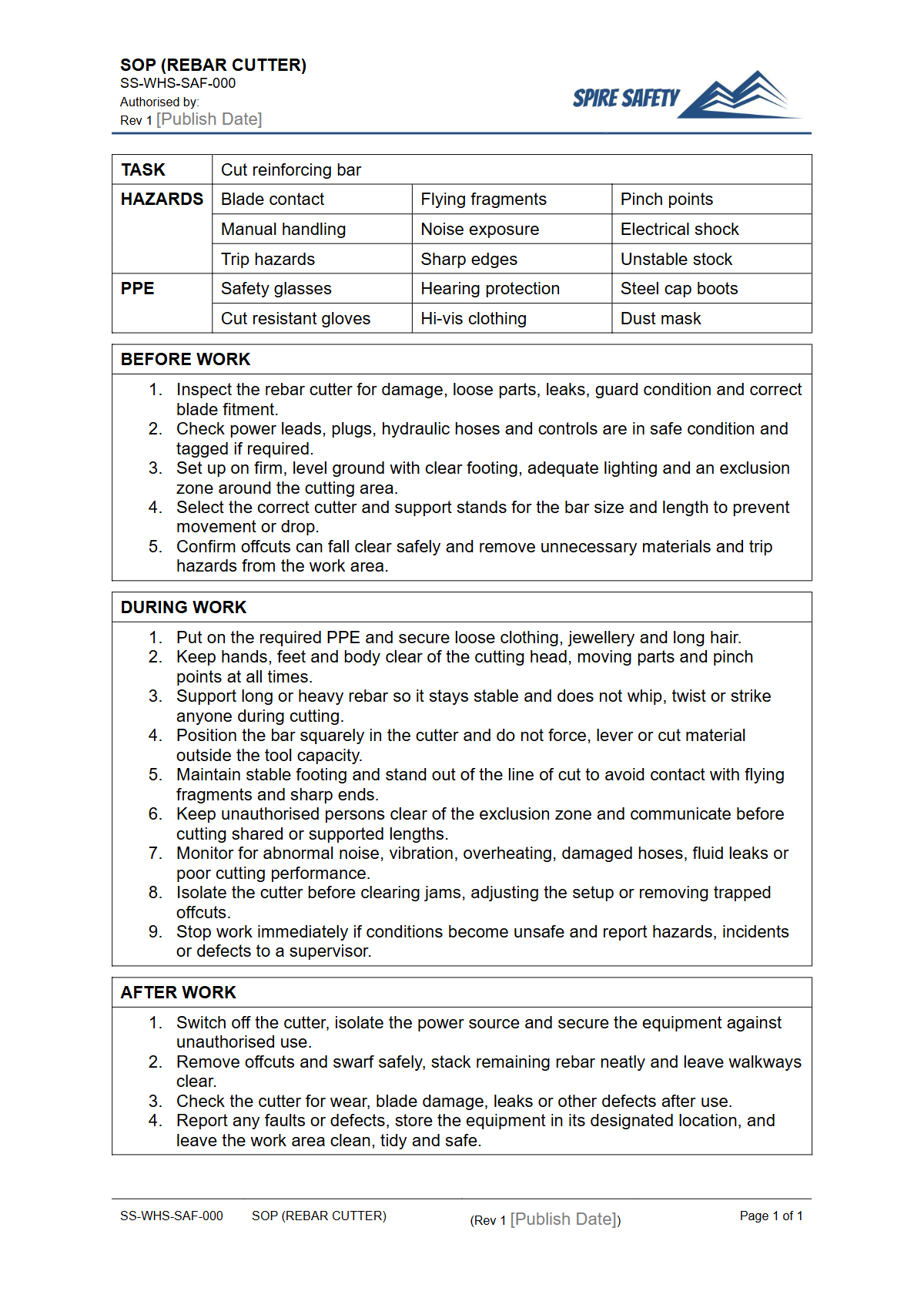
Download our free Safe Operating Procedure (Rebar Cutter) Template to help manage high-risk construction tasks. Customise your DOCX or PDF today.
Free Safe Operating Procedure (Rebar Cutter) Template
DOCX • 126 KB + PDF
Updated Oct 2026
No signup required
Purpose of the Free Safe Operating Procedure (Rebar Cutter) Template
This Free Safe Operating Procedure (Rebar Cutter) Template provides a structured framework for documenting the safe use of portable and stationary rebar cutting equipment. Operating a rebar cutter, whether hydraulic, electric, or manual, involves significant risks if not managed correctly.
These hazards include severe lacerations, projectile injuries from snapped rebar or blade fragments, electrical shock, ergonomic strains from repetitive tasks, and exposure to high levels of noise and vibration.
A documented SOP is an essential control measure for mitigating these hazards. It formalises the safest method for performing the task, ensuring consistency and clarity for all operators.
By establishing a clear, step-by-step process, this Safe Operating Procedure helps your organisation meet its duty of care obligations under Australian WHS legislation. It forms a critical component of your overall WHS management systems, demonstrating a systematic approach to identifying and controlling risks.
How to use the Free Safe Operating Procedure (Rebar Cutter) Template
This template is a starting point, not a finished document. It is designed to be downloaded in DOCX or PDF format and then customised to reflect the specific rebar cutter models, tasks, and unique environment of your workplace.
To use it effectively, you should review each section and populate it with information relevant to your operations.
Important: We have provided this template as a general guide. You must adapt it to your specific equipment, environment, and personnel to ensure it is effective for your organisation's operations.
This involves conducting a site-specific risk assessment, consulting with the workers who operate the equipment, and incorporating details like manufacturer instructions, site emergency procedures, and required personal protective equipment (PPE).
Video walkthrough
When to use this Safe Operating Procedure
A Safe Operating Procedure for a rebar cutter is not a document to be filed away and forgotten. It should be actively used in day-to-day operations and integrated into your safety management processes. Key times to use this SOP include:
- During worker inductions and task-specific training to establish a baseline of safe behaviour.
- As a pre-start reference before each use to remind operators of key checks and hazards.
- As a reference tool for supervisors monitoring work and conducting safety observations.
- During incident investigations to understand if there were any deviations from the established procedure.
- As part of periodic safety reviews. Procedures for powerful tools like these are often examined during WHS compliance auditing activities.
The principles of documenting pre-start checks and operational steps are similar across various types of portable equipment, like those outlined in our FREE Circular Saw SOP Template.
Who should use this Safe Operating Procedure
The responsibility for creating, implementing, and following this SOP is shared across several roles within an organisation. A collaborative approach ensures the procedure is both practical and effective.
- Persons Conducting a Business or Undertaking (PCBUs): Have the primary duty of care to provide and maintain safe systems of work, which includes the provision of resources like SOPs.
- Managers and Supervisors: Must ensure workers are adequately trained in the SOP, have access to it, and adhere to its instructions during their work.
- Workers and Operators: Must follow the procedures outlined in the SOP to ensure their own health and safety and that of others in the workplace. Their feedback is also crucial for keeping the document relevant and practical. Many SOPs for plant, such as our FREE Telehandler SOP Template, rely on operator input for refinement.
- Safety Officers and WHS Consultants: Can use this template as a foundation for developing and implementing tailored safety documentation as part of their advisory role.
For organisations needing expert help to develop and integrate these documents across their operations, our WHS consulting services can provide tailored support. You can also explore our entire free WHS resources library for other useful templates.
Common mistakes
Common mistakes to avoid
- Using the generic template without customising it for site-specific hazards and equipment models.
- Failing to adequately train workers on the content of the finished SOP.
- Not wearing mandatory personal protective equipment (PPE), particularly high-impact eye protection and cut-resistant gloves.
- Neglecting to perform pre-use inspections of the cutter blade, guards, and power source (cords, batteries, or hydraulic lines).
Legal references
Legal considerations
The following legal requirements may be relevant to this type of work.
- Work Health and Safety Act (Harmonised) — Provides the primary duties for protecting workers and other people from work health and safety risks.
- Work Health and Safety Regulations (Harmonised) — Sets out requirements supporting the management of workplace hazards and risks.
The following codes may be relevant to this type of work.
- Managing WHS Risks Code of Practice — Provides practical guidance on identifying hazards, assessing risks and applying effective controls.
- Work Health and Safety Consultation, Cooperation and Coordination Code of Practice — Provides practical guidance on consulting workers and coordinating with other duty holders.
- Managing the Work Environment and Facilities Code of Practice — Provides practical guidance on safe work environments, workplace facilities and related controls.
Did you know
Vibration Risk
Prolonged use of power tools like rebar cutters can lead to Hand-Arm Vibration Syndrome (HAVS). A well-written SOP helps manage this risk by stipulating usage limits and control measures.
Cutting Force
Hydraulic rebar cutters can generate immense force, often exceeding 15 tonnes, to shear through hardened steel bars in seconds. This power is why strict adherence to safe procedures is non-negotiable.
FAQ
Frequently asked questions
01What key information must be in a Safe Operating Procedure for a rebar cutter?
02Is a Safe Operating Procedure a legal requirement in Australia?
03How often should we review our rebar cutter SOP?
04Can this SOP template be used for both electric and hydraulic rebar cutters?
Share this resource
Free Safe Operating Procedure (Rebar Cutter) Template
Browse Categories
How To Use It
- 1Download and open in Word or PDF.
- 2Replace the placeholders with your business details.
- 3Get it reviewed by a WHS specialist before rollout.
Need it customised?
Our WHS consultants can adapt this template to your site, run a gap analysis, or audit what you already have in place.
Book a Free Consultation WHS consulting servicesor call 1300 156 382
Related templates
- Free Safe Operating Procedure (Rebar Scanner) Template
- Free Safe Operating Procedure (Rebar Straightener) Template
- Free Safe Operating Procedure (Rebar Tying Tool) Template
- Free Safe Operating Procedure (Reception Area Cleaning) Template
- Free Safe Operating Procedure (Reception Desk Cleaning) Template
- Free Safe Operating Procedure (Recliner Chair Cleaning) Template