
Free Safe Operating Procedure (RC Drill Rig) Template
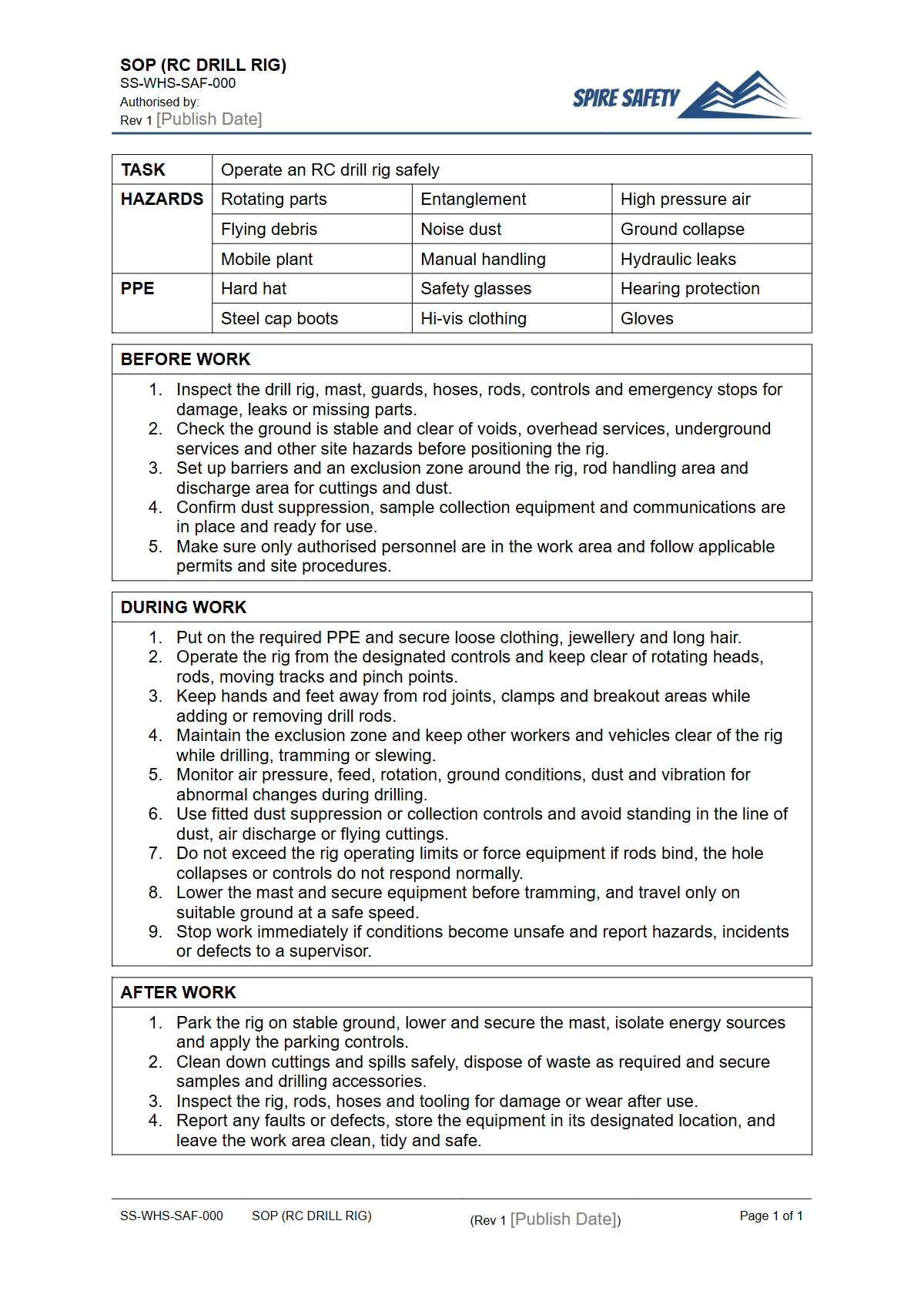
Download our Free Safe Operating Procedure (RC Drill Rig) Template to establish clear, step-by-step safety instructions for your drilling operations.
Free Safe Operating Procedure (RC Drill Rig) Template
DOCX • 126 KB + PDF
Updated Oct 2026
No signup required
Purpose of the Free Safe Operating Procedure (RC Drill Rig) Template
Operating a Reverse Circulation (RC) drill rig involves significant risks, including high-pressure air, heavy rotating parts, and challenging geological conditions. This Free Safe Operating Procedure (RC Drill Rig) Template provides a structured starting point for documenting the required safety controls and work sequence for these high-risk tasks.
Implementing a clear and detailed Safe Operating Procedure (SOP) is fundamental for ensuring operations are conducted consistently and safely, minimising the risk of injury to personnel and damage to expensive equipment. It serves as a crucial tool for worker training, competency assessment, and as a reference point for supervisors and managers.
A well-drafted SOP is a cornerstone of an organisation's safety framework, demonstrating a commitment to proactive risk management. It helps standardise work methods across different crews and shifts, reducing variability and the potential for unsafe shortcuts.
Integrating this procedure into your broader WHS management systems reinforces safe work culture and supports continuous improvement in your safety performance.
Video walkthrough
How to use the Free Safe Operating Procedure (RC Drill Rig) Template
This template is provided in both DOCX and PDF formats to suit your needs. The DOCX file is fully editable, allowing you to tailor the content to your specific operational context.
It is critical to understand that this document is a template, not a finished procedure. You must customise it to reflect the specific make and model of your RC drill rig, the unique hazards of your worksite, your company's internal safety policies, and the relevant state or territory WHS regulations.
To effectively use this resource, download the DOCX version and engage with key personnel, including experienced drillers, offsiders, and supervisors, to review and modify each section. Add site-specific details, emergency contacts, and any unique procedures related to local ground conditions or environmental constraints.
Once finalised, the SOP should be formally approved, and all relevant workers must be trained on its contents before commencing work. For examples of other equipment-specific procedures, you might find value in resources like our free Telehandler SOP.
Key Elements of an RC Drill Rig Safe Operating Procedure
An effective SOP for an RC drill rig should be comprehensive, covering all phases of the operation. The template is structured to guide you through these key areas, ensuring no critical step is overlooked.
A thorough procedure typically includes sections on required Personal Protective Equipment (PPE), a detailed risk assessment, and step-by-step instructions for each major task.
Pre-Start Checks and Site Preparation
Before any drilling begins, a series of rigorous checks is essential. This includes inspecting the rig's mechanical and hydraulic systems, safety guards, emergency stops, and fire suppression equipment.
The worksite must also be assessed for hazards such as overhead powerlines, unstable ground, and vehicle interaction. Because RC drilling relies on high-volume, high-pressure air, it is vital to also have a dedicated Air Compressor SOP and inspect all hoses and connections for wear or damage as part of the pre-start process.
Setup and Operation
This section details the step-by-step process for setting up the rig, including levelling, mast raising, and connecting services. The operational phase covers tasks like collaring the hole, adding and removing drill rods, managing sample collection, and monitoring the drilling process.
Each step should have associated hazards and controls clearly identified. On many sites, pad construction is a prerequisite, often requiring a Safe Operating Procedure for a grader to ensure a stable and level base is established safely.
Shutdown, Maintenance and Emergencies
The procedure must outline the correct sequence for shutting down the rig safely at the end of a shift or for maintenance. It should also include clear instructions for handling foreseeable emergencies, such as rig fires, hose failures (whipping hoses), loss of circulation, or medical emergencies.
Regular reviews of these procedures are essential and often form part of routine WHS compliance audits to verify their effectiveness and worker understanding.
By systematically addressing each of these areas, your customised SOP becomes a powerful tool for embedding safe work practices. Feel free to explore our complete free WHS resources library for other templates and tools that can support your safety management efforts.
Common mistakes
Common mistakes to avoid
- Failing to customise the template for the specific drill rig model and site conditions.
- Not involving experienced drillers and offsiders in the development and review of the SOP.
- Treating the SOP as a static, 'tick-and-flick' document instead of a live tool for training and daily use.
- Neglecting to include detailed procedures for foreseeable emergencies like rig fires or high-pressure air loss.
Legal references
Legal considerations
The following legal requirements may be relevant to this type of work.
- Work Health and Safety Act (Harmonised) — Provides the primary duties for protecting workers and other people from work health and safety risks.
- Work Health and Safety Regulations (Harmonised) — Sets out requirements supporting the management of workplace hazards and risks.
The following codes may be relevant to this type of work.
- Managing WHS Risks Code of Practice — Provides practical guidance on identifying hazards, assessing risks and applying effective controls.
- Work Health and Safety Consultation, Cooperation and Coordination Code of Practice — Provides practical guidance on consulting workers and coordinating with other duty holders.
- Managing the Work Environment and Facilities Code of Practice — Provides practical guidance on safe work environments, workplace facilities and related controls.
Did you know
High-Pressure Hazard
RC drilling uses high-pressure air, often between 350-500 psi, to lift rock cuttings to the surface. A failure in a hose or coupling at this pressure can release enormous energy, making it a critical safety risk.
Manual Handling Risk
Despite increased mechanisation with rod handlers, manual handling of drill rods, tooling, and heavy sample bags remains a leading cause of musculoskeletal injuries among drill crews.
FAQ
Frequently asked questions
01What is the difference between a SWMS and an SOP for an RC drill rig?
02How often should an RC Drill Rig SOP be reviewed?
03Does this SOP template cover rod handling hazards?
04Can I use this template for other types of drill rigs, like diamond or air core?
Share this resource
Free Safe Operating Procedure (RC Drill Rig) Template
Browse Categories
How To Use It
- 1Download and open in Word or PDF.
- 2Replace the placeholders with your business details.
- 3Get it reviewed by a WHS specialist before rollout.
Need it customised?
Our WHS consultants can adapt this template to your site, run a gap analysis, or audit what you already have in place.
Book a Free Consultation WHS consulting servicesor call 1300 156 382
Related templates
- Free Safe Operating Procedure (RCD Testing) Template
- Free Safe Operating Procedure (Reach Truck) Template
- Free Safe Operating Procedure (Rebar Bender) Template
- Free Safe Operating Procedure (Rebar Cutter) Template
- Free Safe Operating Procedure (Rebar Scanner) Template
- Free Safe Operating Procedure (Rebar Straightener) Template