
Free Safe Operating Procedure (RCD Testing) Template
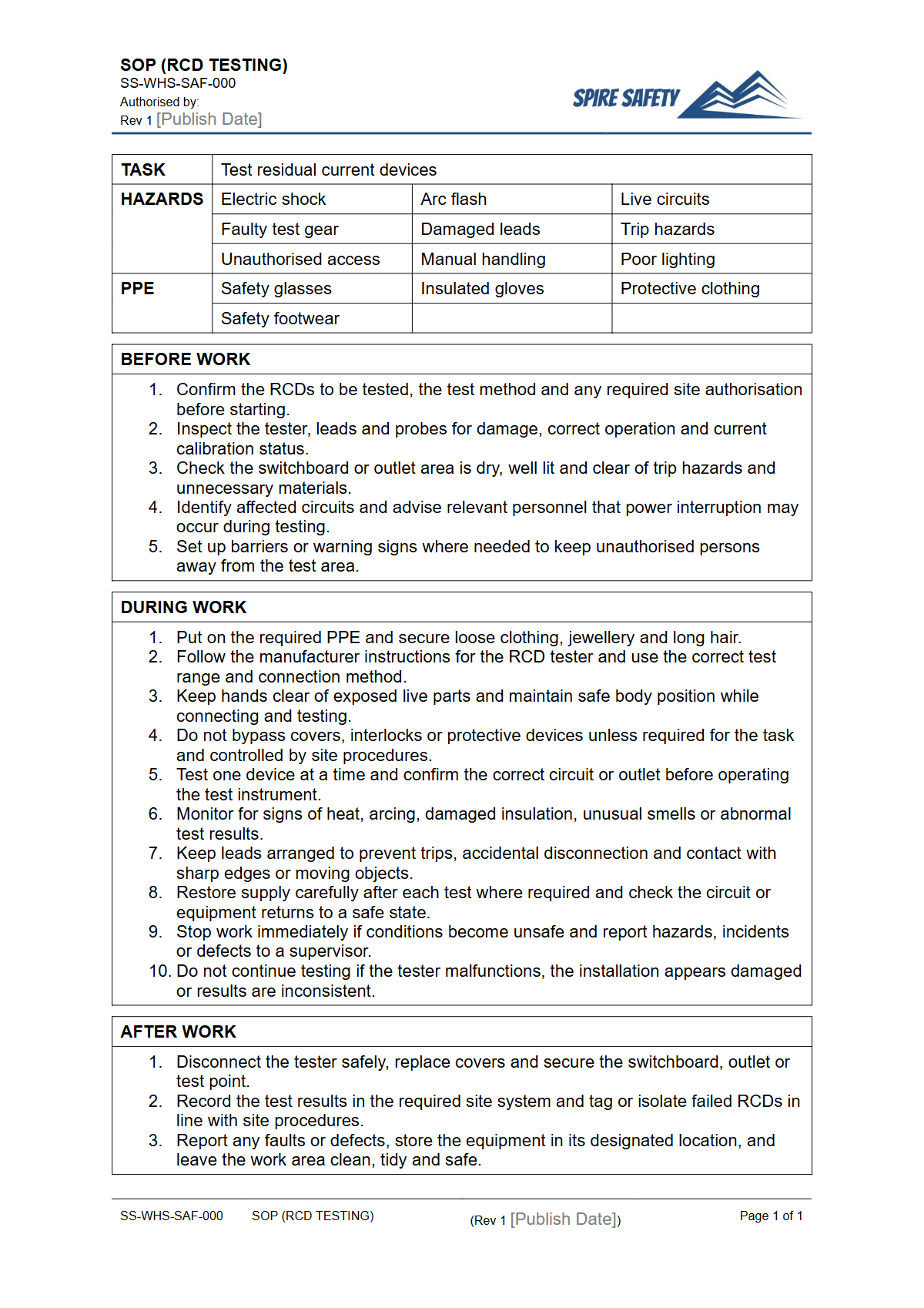
Document the routine testing of residual current devices with our free Safe Operating Procedure (RCD Testing) Template.
Free Safe Operating Procedure (RCD Testing) Template
DOCX • 126 KB + PDF
Updated Oct 2026
No signup required
Purpose of the Free Safe Operating Procedure (RCD Testing) Template
Establishing a clear process for electrical safety is critical for any Australian workplace. This Free Safe Operating Procedure (RCD Testing) Template provides a structured starting point for documenting the steps required to safely test residual current devices (RCDs), also known as safety switches.
The primary purpose of this Safe Operating Procedure is to standardise the testing process, ensuring it is performed consistently and correctly to mitigate the risk of electric shock and prevent equipment damage. It outlines the required checks, testing methods, and record-keeping obligations to verify that RCDs are functioning within their life-saving specifications.
By implementing a formal SOP, your organisation demonstrates a proactive approach to managing electrical hazards. This procedure acts as a key training and reference tool for workers, ensuring everyone understands their responsibilities.
Formalising these steps helps integrate electrical safety into your broader comprehensive WHS management systems, supporting your duty of care under Australian WHS legislation.
Video walkthrough
How to use the Free Safe Operating Procedure (RCD Testing) Template
This document provides a robust framework for developing your site-specific procedure for testing RCDs. To use it effectively, download the DOCX or PDF and populate the fields with your company's details, including the site location, procedure author, and review dates.
It is essential to adapt the technical steps to match the specific types of RCDs used in your workplace (e.g., fixed, portable, socket-outlet) and the manufacturer's instructions.
Important: This document is a template and must be customised to suit the specific RCDs, equipment, and environment of your workplace. We are not liable for any incidents that may occur from the use of this document.
It is the responsibility of the PCBU (Person Conducting a Business or Undertaking) to ensure the information is accurate, relevant, and properly implemented.
Consult with competent persons, such as licensed electricians and the workers who will perform the tests, to ensure the procedure is practical and effective. Once finalised, this SOP should be used as part of your induction and ongoing training programs.
Consider it alongside other equipment-specific procedures, such as our Free Air Compressor SOP, to build a complete library of safe work instructions.
Key Steps in RCD Testing
Your customised SOP should clearly detail the following stages:
- Pre-operational Checks: Visual inspection of the RCD unit and surrounding area for any signs of damage, moisture, or defects before any testing begins.
- Push-Button Test: A simple mechanical test to ensure the RCD trip mechanism is not stuck. This is typically done more frequently and can often be performed by a trained operator.
- Trip-Time Test: A technical test performed by a competent person (usually a licensed electrician) using a calibrated RCD tester. This measures the actual time the RCD takes to trip, ensuring it meets the standards prescribed in AS/NZS 3760.
- Recording Results: Documenting the date, tester's name, RCD identifier, and the pass/fail result of each test in a dedicated logbook or digital record system.
When to use this Safe Operating Procedure
The RCD Testing SOP should be followed according to a predetermined schedule based on legislative requirements, manufacturer recommendations, and a risk assessment of the operating environment. This includes regular, scheduled push-button tests—often monthly or quarterly for fixed RCDs and before each use for portable units.
It is also used whenever a competent person is engaged to perform the periodic trip-time tests, which may be required annually or biennially depending on the jurisdiction and workplace type (e.g., construction vs. office).
The procedure should also be triggered after any electrical repairs or modifications to a circuit protected by an RCD, or if an RCD has tripped for an unknown reason. These documented procedures and their corresponding records are essential evidence during regular WHS compliance audits.
Who should use this Safe Operating Procedure
This SOP is intended for multiple roles within an organisation. General workers and equipment operators should be trained to use the part of the procedure covering daily pre-use checks and push-button tests on portable RCDs.
Supervisors and managers are responsible for ensuring the testing schedule is followed, records are maintained, and that workers are trained and competent for their assigned tasks.
The more technical aspects of the procedure, specifically the section on trip-time testing, must only be performed by a 'competent person' as defined by WHS regulations. This is typically a licensed electrician with the correct qualifications and calibrated testing equipment. Their involvement is critical for ensuring compliance and electrical safety, especially when managing high-risk plant like that covered in our free Telehandler SOP.
WHS Officers or Safety Managers should use this template as a foundational document to be reviewed and updated regularly. They are also responsible for ensuring operators of equipment on RCD-protected circuits have the correct training, such as for tools detailed in a free Circular Saw SOP.
By properly documenting and implementing this procedure, you create a reliable system that protects your people and your business. Explore our complete free WHS resources library to find more templates and checklists to support your safety management system.
Common mistakes
Common mistakes to avoid
- Forgetting to document the results of every test, creating gaps in compliance records.
- Only performing push-button tests and neglecting the legally required trip-time tests by a competent person.
- Using a generic SOP without customising it for the specific RCDs and environment at the worksite.
- Failing to train workers on how and when to perform their part of the testing procedure.
Legal references
Legal considerations
The following legal requirements may be relevant to this type of work.
- Work Health and Safety Act (Harmonised) — Provides the primary duties for protecting workers and other people from work health and safety risks.
- Work Health and Safety Regulations (Harmonised) — Sets out requirements supporting the management of workplace hazards and risks.
The following codes may be relevant to this type of work.
- Managing WHS Risks Code of Practice — Provides practical guidance on identifying hazards, assessing risks and applying effective controls.
- Work Health and Safety Consultation, Cooperation and Coordination Code of Practice — Provides practical guidance on consulting workers and coordinating with other duty holders.
- Managing the Work Environment and Facilities Code of Practice — Provides practical guidance on safe work environments, workplace facilities and related controls.
Did you know
The 30 Millisecond Rule
A correctly functioning RCD is designed to trip and cut the power supply in less than 30 milliseconds. This rapid response is faster than the time it takes for a fatal electric shock to occur, potentially saving a life.
Types of RCDs
RCDs come in three main types: fixed (in the switchboard), socket-outlet (built into a power point), and portable (plug-in units). Each type requires a slightly different testing approach which should be reflected in your SOP.
FAQ
Frequently asked questions
01What is the difference between a push-button test and a trip-time test for an RCD?
02How often should RCDs be tested in Australia?
03Can anyone fill out this Safe Operating Procedure template?
04Is an SOP the same as a SWMS?
Share this resource
Free Safe Operating Procedure (RCD Testing) Template
Browse Categories
How To Use It
- 1Download and open in Word or PDF.
- 2Replace the placeholders with your business details.
- 3Get it reviewed by a WHS specialist before rollout.
Need it customised?
Our WHS consultants can adapt this template to your site, run a gap analysis, or audit what you already have in place.
Book a Free Consultation WHS consulting servicesor call 1300 156 382
Related templates
- Free Safe Operating Procedure (Reach Truck) Template
- Free Safe Operating Procedure (Rebar Bender) Template
- Free Safe Operating Procedure (Rebar Cutter) Template
- Free Safe Operating Procedure (Rebar Scanner) Template
- Free Safe Operating Procedure (Rebar Straightener) Template
- Free Safe Operating Procedure (Rebar Tying Tool) Template