
Free Safe Operating Procedure (Rangehood Cleaning) Template
Download our free Safe Operating Procedure (Rangehood Cleaning) Template to manage hazards in your commercial kitchen. Get your customisable DOCX and PDF now.
Free Safe Operating Procedure (Rangehood Cleaning) Template
DOCX • 126 KB + PDF
Updated Oct 2026
No signup required
Purpose of the Free Safe Operating Procedure (Rangehood Cleaning) Template
Effectively managing workplace risks requires clear, documented processes for hazardous tasks. This is especially true in commercial kitchens where a combination of heat, grease, chemicals, and electricity creates a complex risk profile.
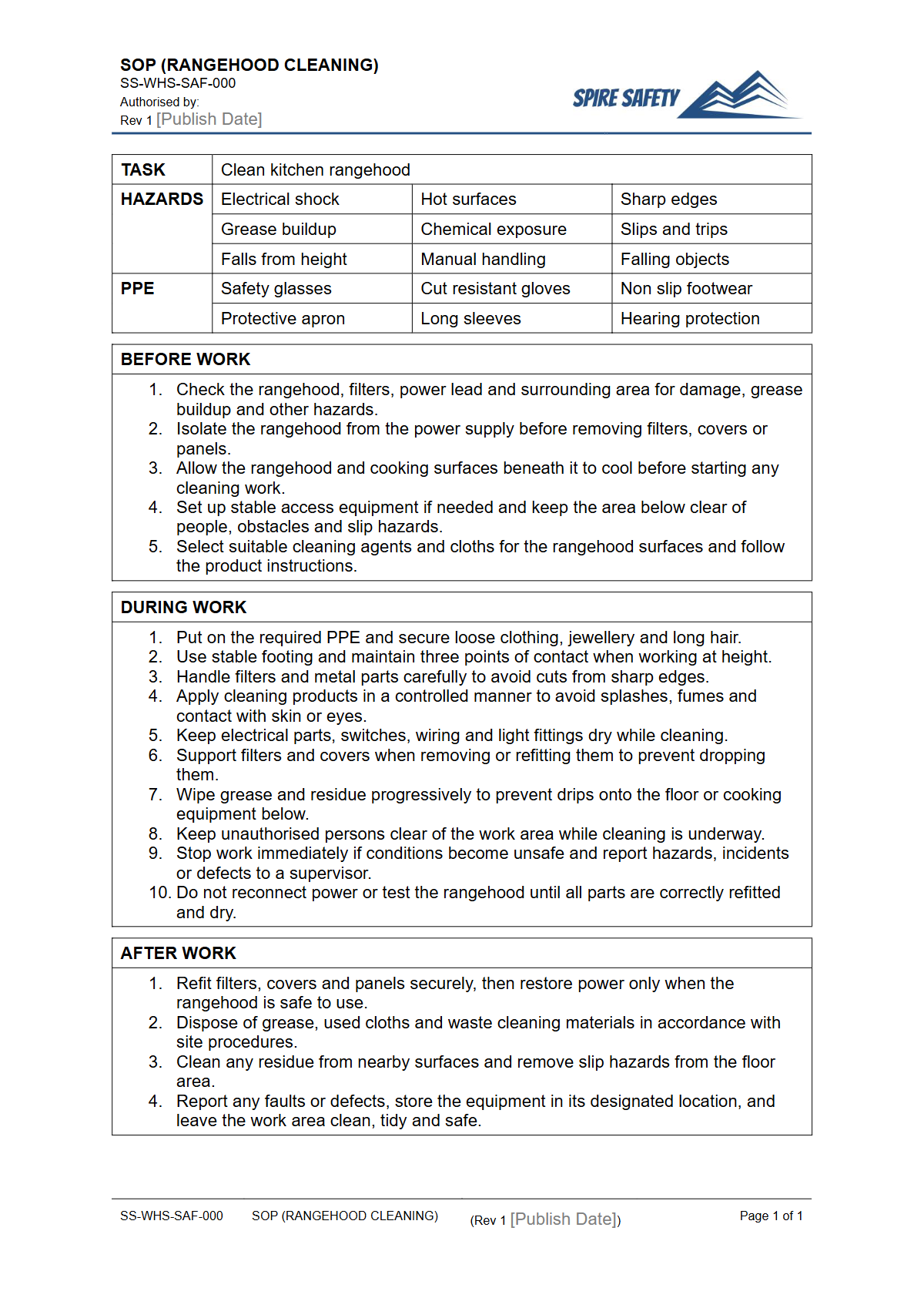
Our Free Safe Operating Procedure (Rangehood Cleaning) Template provides a structured starting point for documenting the step-by-step process for this essential maintenance task. It is designed to help you control common hazards such as slips and falls, exposure to cleaning chemicals, electrical shock, burns, and injuries from manual handling.
Using a formal SOP helps ensure every worker follows the same safe method, every time.
This document is aligned with Australian WHS best practices and provides a solid foundation for your site-specific procedures. While this SOP covers rangehoods, similar principles apply to other high-risk kitchen equipment.
For example, documenting the process for handling hot oil is equally critical, which is covered in our Safe Operating Procedure for deep fryer operation. Formalising these processes is a key part of demonstrating due diligence in managing workplace safety.
Video walkthrough
How to use the Free Safe Operating Procedure (Rangehood Cleaning) Template
This resource is available as a DOCX file, which is fully editable in Microsoft Word or other compatible software, and a PDF for easy printing and distribution. The template is structured with sections for you to detail the required PPE, pre-operational checks, step-by-step cleaning instructions, and post-cleaning procedures.
Its primary purpose is to be a master document that you adapt for your business.
Important: This is a template, not a finished document. You must customise it to reflect the specific equipment, chemicals, environment, and personnel in your workplace.
We cannot know your site's unique risks. A generic procedure is not sufficient to meet your WHS obligations.
Effective SOPs are developed through consultation with workers and tailored to the exact task they perform. Integrating these customised SOPs is a fundamental part of building robust WHS management systems.
Key Customisation Steps
- Identify Specifics: List the exact make and model of the rangehood and any associated equipment. Reference the specific names and manufacturers of all cleaning chemicals, ensuring you have the current Safety Data Sheet (SDS) for each one.
- Consult Your Team: Involve the workers who perform the cleaning. They have firsthand knowledge of the challenges and risks involved and can provide valuable input to make the procedure practical and effective.
- Detail Site-Specific Controls: Add information about your workplace layout. How will workers access the hood? Specify the type of ladder or platform to be used. What are the exact steps for electrical isolation (lockout/tagout)? Where is the nearest first aid station or emergency shower?
- Review and Approve: Once customised, the SOP should be reviewed and approved by a competent person, such as a supervisor or WHS manager. Ensure a version control system is in place to track updates.
When to use it
A Safe Operating Procedure for rangehood cleaning should be used consistently as part of your operational routine. It serves multiple functions throughout the safety lifecycle.
Use this SOP to formally induct and train new kitchen hands or cleaning staff, ensuring they understand the approved method from day one. It should also be used for periodic refresher training for existing staff to prevent complacency.
The document is a valuable reference tool that workers can consult before starting the task. Furthermore, it should be a key document reviewed during safety reviews or WHS compliance auditing to verify that documented processes are being followed in practice.
Who should use it
This SOP template is designed for use by multiple groups within an organisation. Primarily, workers assigned to clean kitchen extraction systems must be trained on and follow the finalised procedure.
Supervisors and managers should use it to oversee the work, conduct safety observations, and supports your compliance efforts. WHS and HR managers can use the template as part of a library of standard procedures to ensure consistency across all high-risk tasks.
Documenting processes for all hazardous equipment is a core responsibility for PCBUs; creating an SOP for cleaning a rangehood is just as important as developing an air compressor Safe Operating Procedure for maintenance tasks or a circular saw SOP for workshop activities. Each procedure addresses the unique risks of the equipment in question.
Ultimately, this template helps Persons Conducting a Business or Undertaking (PCBUs) fulfil their primary duty of care under WHS law by providing a safe system of work. For more templates and safety guides covering a wide range of equipment and tasks, browse our complete free WHS resources library.
Common mistakes
Common mistakes to avoid
- Failing to properly isolate electricity before starting cleaning.
- Using incorrect or incompatible cleaning chemicals without consulting the SDS.
- Not providing stable, appropriate access equipment for working at height.
- Treating the template as a final document without customising it to the specific workplace.
Legal references
Legal considerations
The following legal requirements may be relevant to this type of work.
- Work Health and Safety Act (Harmonised) — Provides the primary duties for protecting workers and other people from work health and safety risks.
- Work Health and Safety Regulations (Harmonised) — Sets out requirements supporting the management of workplace hazards and risks.
The following codes may be relevant to this type of work.
- Managing WHS Risks Code of Practice — Provides practical guidance on identifying hazards, assessing risks and applying effective controls.
- Work Health and Safety Consultation, Cooperation and Coordination Code of Practice — Provides practical guidance on consulting workers and coordinating with other duty holders.
- Managing the Work Environment and Facilities Code of Practice — Provides practical guidance on safe work environments, workplace facilities and related controls.
Did you know
Grease Fire Risk
A significant buildup of grease in a commercial kitchen's extraction system is a major fire hazard. Regular, thorough cleaning according to a documented procedure is a critical fire prevention control.
Chemical Safety
Many commercial degreasers are caustic and can cause severe skin and eye burns. An SOP ensures workers use the correct Personal Protective Equipment (PPE) specified in the chemical's Safety Data Sheet (SDS).
FAQ
Frequently asked questions
01What hazards are involved in cleaning a commercial rangehood?
02Is a Safe Operating Procedure a legal requirement in Australia?
03How often should a rangehood cleaning SOP be reviewed?
04Can I use this template for cleaning a domestic rangehood at home?
Share this resource
Free Safe Operating Procedure (Rangehood Cleaning) Template
Browse Categories
How To Use It
- 1Download and open in Word or PDF.
- 2Replace the placeholders with your business details.
- 3Get it reviewed by a WHS specialist before rollout.
Need it customised?
Our WHS consultants can adapt this template to your site, run a gap analysis, or audit what you already have in place.
Book a Free Consultation WHS consulting servicesor call 1300 156 382
Related templates
- Free Safe Operating Procedure (RC Drill Rig) Template
- Free Safe Operating Procedure (RCD Testing) Template
- Free Safe Operating Procedure (Reach Truck) Template
- Free Safe Operating Procedure (Rebar Bender) Template
- Free Safe Operating Procedure (Rebar Cutter) Template
- Free Safe Operating Procedure (Rebar Scanner) Template