
Free Safe Operating Procedure (Rail Depot Waste) Template
Manage rail depot waste safely and efficiently with our structured Safe Operating Procedure template. Download your free, customisable DOCX and PDF now.
Free Safe Operating Procedure (Rail Depot Waste) Template
DOCX • 126 KB + PDF
Updated Oct 2026
No signup required
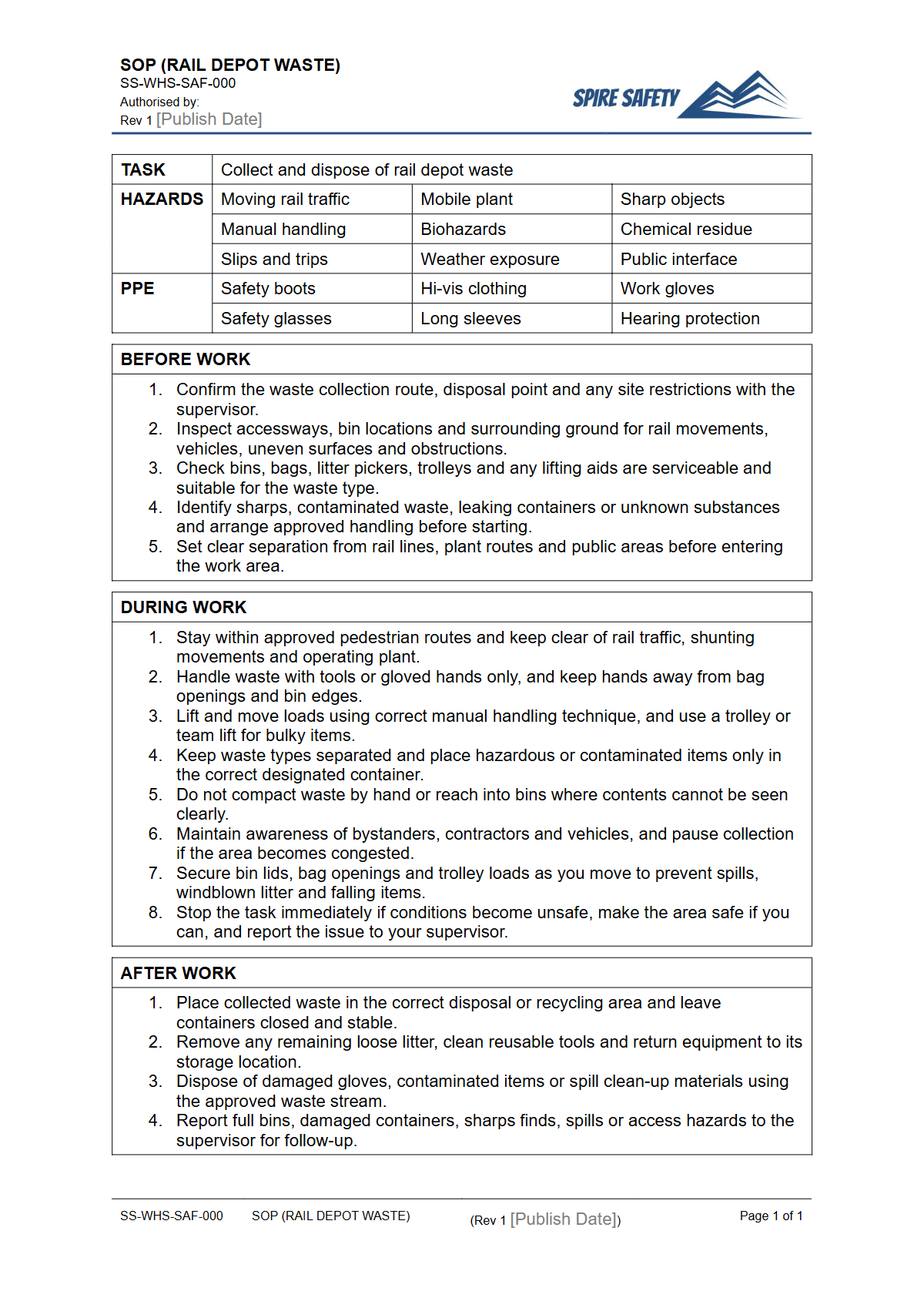
Purpose of the Free Safe Operating Procedure (Rail Depot Waste) Template
Managing waste in a rail depot presents a unique set of health and safety challenges, from manual handling of heavy containers to potential exposure to hazardous materials. A documented Safe Operating Procedure (SOP) is essential for establishing a consistent, safe, and efficient process for all waste-related tasks.
Our Free Safe Operating Procedure (Rail Depot Waste) Template provides a structured starting point for your organisation to formalise its approach to waste management.
This template is designed to help you identify hazards and implement control measures for tasks including:
- Collecting general, recyclable, and hazardous waste from various depot locations.
- Segregating different waste streams correctly.
- Transporting waste to designated storage areas.
- Operating waste management equipment (e.g., compactors, balers).
- Preparing waste for off-site disposal or recycling.
An effective SOP is a cornerstone of a robust WHS management system, providing clear instructions to workers and demonstrating your commitment to safety and environmental responsibility. It serves as a vital training tool and a reference for supervisors to ensure procedures are followed correctly.
Video walkthrough
How to use the Free Safe Operating Procedure (Rail Depot Waste) Template
This template is provided in both DOCX and PDF formats for your convenience. The DOCX file is fully editable, allowing you to tailor the content to the specific environment of your rail depot.
A successful SOP must reflect the reality of your workplace.
Please note: This document is a template and not a complete safety solution. To be effective, you must customise it with your site-specific details.
We strongly advise conducting a thorough risk assessment for all waste management activities and incorporating your findings. This includes specifying the exact equipment models used, the types of waste generated at your depot, PPE requirements, emergency contacts, and local disposal procedures.
If you need assistance developing a comprehensive waste management plan, our WHS consulting services can provide expert guidance.
During customisation, consider integrating procedures for related equipment. For instance, if your depot uses specific machinery for moving waste bins, you may need to reference or attach the relevant FREE Telehandler SOP Template to your overall waste management plan.
When to use a Safe Operating Procedure for Rail Depot Waste
A rail depot waste SOP should be a living document, used consistently throughout your operations. Key times to use and refer to it include:
- Daily Operations: As a guide for all personnel involved in the day-to-day collection, sorting, and storage of waste.
- Worker Training: During the induction of new employees and for refresher training to ensure competency.
- Incident Investigation: As a baseline to determine if procedural deviations contributed to a near miss or injury.
- Procedural Reviews: When introducing new types of waste, new equipment, or changing processes.
Regularly reviewing and updating your SOPs is a key part of maintaining safety standards. This process often forms part of a larger WHS compliance audit, which helps verify that your documented procedures align with on-the-ground practices and current regulations.
Who should use this Safe Operating Procedure
This SOP should be accessible to and understood by anyone whose role involves or interacts with waste management in the rail depot. This includes:
- Rail Yard Workers and Maintenance Crews: The primary users who perform the waste handling tasks.
- Depot Supervisors and Team Leaders: Responsible for enforcing the SOP, providing training, and monitoring compliance.
- WHS/HSE Managers: Responsible for developing, reviewing, and updating the SOP as part of the overall safety management system.
- Cleaning and Facility Staff: Who manage waste streams from offices, workshops, and amenities.
- Contractors: Who may be on-site to perform specialised waste removal services.
If waste is processed or moved using automated systems, it is essential that operators are also familiar with the relevant procedures for that machinery, such as those outlined in a FREE Conveyer System SOP (Safe Operating Procedure) Template. You can find more templates for various tasks and equipment in our comprehensive free WHS resources library.
Common mistakes
Common mistakes to avoid
- Using the generic template without customising it for site-specific hazards and equipment.
- Failing to adequately train workers on the procedures outlined in the finalised SOP.
- Neglecting to include procedures for handling unexpected or non-routine waste types.
- Poor record-keeping for hazardous waste manifests and disposal certificates.
Legal references
Legal considerations
The following legal requirements may be relevant to this type of work.
- Work Health and Safety Act (Harmonised) — Provides the primary duties for protecting workers and other people from work health and safety risks.
- Work Health and Safety Regulations (Harmonised) — Sets out requirements supporting the management of workplace hazards and risks.
The following codes may be relevant to this type of work.
- Managing WHS Risks Code of Practice — Provides practical guidance on identifying hazards, assessing risks and applying effective controls.
- Work Health and Safety Consultation, Cooperation and Coordination Code of Practice — Provides practical guidance on consulting workers and coordinating with other duty holders.
- Managing the Work Environment and Facilities Code of Practice — Provides practical guidance on safe work environments, workplace facilities and related controls.
Did you know
Waste Classification is Critical
Incorrectly classifying and disposing of hazardous waste from rail operations (like oily rags or used batteries) can lead to significant environmental fines and penalties under state and federal environmental protection laws.
Circular Economy in Rail
Many materials used in rail, like steel tracks and concrete sleepers, are highly recyclable. Effective waste management programs help divert these valuable resources from landfill, contributing to the circular economy and reducing the industry's environmental footprint.
FAQ
Frequently asked questions
01What types of waste does a rail depot waste SOP typically cover?
02Is a Safe Operating Procedure legally required for waste management in Australia?
03How often should a rail depot waste SOP be reviewed?
04Does this template cover the segregation of different waste types?
Share this resource
Free Safe Operating Procedure (Rail Depot Waste) Template
Browse Categories
How To Use It
- 1Download and open in Word or PDF.
- 2Replace the placeholders with your business details.
- 3Get it reviewed by a WHS specialist before rollout.
Need it customised?
Our WHS consultants can adapt this template to your site, run a gap analysis, or audit what you already have in place.
Book a Free Consultation WHS consulting servicesor call 1300 156 382
Related templates
- Free Safe Operating Procedure (Rail Platform Cleaning) Template
- Free Safe Operating Procedure (Rail Sanding Refill) Template
- Free Safe Operating Procedure (Rail Yard Housekeeping) Template
- Free Safe Operating Procedure (Raised Bed Maintenance) Template
- Free Safe Operating Procedure (Rangehood Cleaning) Template
- Free Safe Operating Procedure (RC Drill Rig) Template