
Free Safe Operating Procedure (Rail Platform Cleaning) Template
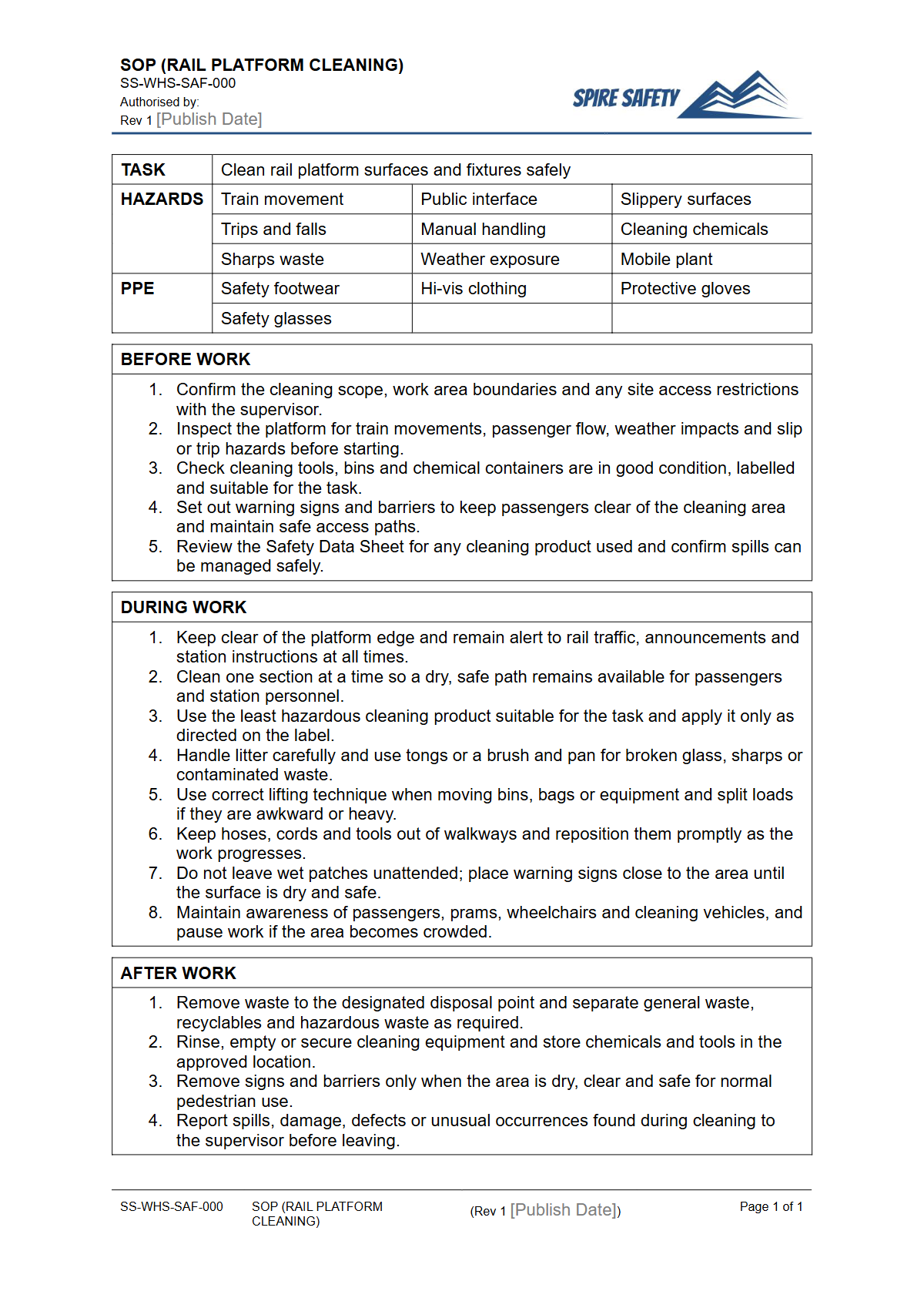
Download our free Safe Operating Procedure for rail platform cleaning. This template helps you outline the steps and controls needed for safe operations.
Free Safe Operating Procedure (Rail Platform Cleaning) Template
DOCX • 126 KB + PDF
Updated Oct 2026
No signup required
Purpose of the Free Safe Operating Procedure (Rail Platform Cleaning) Template
Rail platforms are dynamic environments with a unique combination of hazards, including moving trains, public interaction, and exposure to the elements. This Free Safe Operating Procedure (Rail Platform Cleaning) Template provides a structured framework for documenting a safe system of work for your cleaning operations.
It is designed to help your organisation meet its duty of care by identifying hazards, assessing risks, and implementing effective control measures. A documented SOP ensures that all workers follow a consistent, safe process, reducing the risk of incidents, injuries, and property damage.
Formalising your processes with an SOP is a key component of a robust safety framework. It assists in demonstrating due diligence and forms an essential part of your overall WHS management system. This template guides you through detailing pre-operational checks, step-by-step cleaning procedures, and post-operational tasks to ensure safety from start to finish.
Video walkthrough
How to use the Free Safe Operating Procedure (Rail Platform Cleaning) Template
This Safe Operating Procedure template is provided as a fully editable DOCX file and a print-ready PDF. To use it, download the file and open it in your preferred word processor.
The document is structured with sections for you to populate with your site-specific information, including details about the equipment used, chemicals handled, required PPE, and emergency procedures.
Important: This document is a template and must be customised to your workplace. We have provided a structured starting point aligned with Australian WHS principles, but you must adapt the content to reflect the specific hazards, equipment, chemicals, work environment, and rail network rules applicable to your site.
A generic procedure is not sufficient; effective safety management requires site-specific details.
Key Hazards in Rail Platform Cleaning
A thorough risk assessment should be conducted to identify all potential hazards. This SOP template provides prompts for you to detail controls for common hazards, including:
- Slips, Trips & Falls: Caused by wet surfaces, cleaning equipment, hoses, uneven platform surfaces, or discarded items.
- Moving Trains: The most significant hazard, creating risks of impact and crushing. Procedures must include strict rules for maintaining safe distances and awareness of train schedules.
- Public Interface: Unpredictable behaviour from commuters can create hazards for both the public and cleaning staff.
- Chemical Exposure: Inhalation or skin contact with cleaning agents requires specific controls, such as ventilation and correct PPE. As with other specific tasks, handling chemicals requires clear instructions, similar to those you might find in a Safe Operating Procedure for deep fryer cleaning.
- Manual Tasks: Lifting heavy equipment, mopping, and scrubbing can lead to musculoskeletal injuries if not managed with correct techniques and ergonomic equipment.
- Electrical Hazards: Risk of electric shock from powered cleaning equipment (e.g., buffers, pressure washers) or contact with platform electrical systems.
- Noise: Prolonged exposure to noise from cleaning equipment like pressure washers or vacuums can cause hearing damage. Similar noise hazards are addressed in our Free Air Compressor SOP, which outlines controls for noisy plant.
Properly documenting these hazards and their controls is not just good practice; it's a critical step that will be scrutinised during any WHS compliance auditing.
When to Use This Safe Operating Procedure
An SOP for rail platform cleaning should be used consistently as a key operational document. It is essential for:
- Training and Induction: Use it to train new employees on the established safe method for cleaning platforms.
- Pre-Task Planning: Workers and supervisors should review the SOP before commencing work to refresh their understanding of the steps and safety controls.
- Refresher Training: It serves as the basis for regular competency checks and refresher training sessions.
- Incident Investigation: Following an incident or near-miss, the SOP should be reviewed to determine if the procedure was followed and if it needs revision.
- Workplace Inspections: Supervisors can use the SOP as a checklist to ensure tasks are being performed correctly and safely.
For large transit hubs that utilise mechanised systems, you might also require procedures for other equipment. For example, our FREE Conveyer System SOP can be adapted for baggage or freight handling systems within the station.
Who Should Use It
This SOP is intended for use by all personnel involved in the cleaning and maintenance of rail platforms. Key users include:
- Cleaning Operatives: The primary users who must follow the procedure to perform their tasks safely.
- Supervisors and Team Leaders: Responsible for ensuring workers are trained on and adhere to the SOP.
- WHS Managers and Advisors: Use the SOP as a tool for risk management, training development, and compliance monitoring.
- Contractor Management: If cleaning is outsourced, this SOP can form part of the contractual safety requirements provided to the contractor.
Developing this document should be a collaborative effort involving consultation with the workers who perform the task. Their direct experience is invaluable for creating a practical and effective procedure.
If you need more templates for different tasks, you can explore our complete free WHS resources library for a wide range of documents.
Common mistakes
Common mistakes to avoid
- Using the template without customising it for site-specific hazards like platform gaps, train schedules, and public density.
- Failing to train workers on the finalised SOP and verify their understanding before they undertake the task.
- Neglecting to specify the exact type and standard of Personal Protective Equipment (PPE) required for handling specific chemicals.
- Not reviewing and updating the SOP after an incident, near-miss, or change in working conditions.
Legal references
Legal considerations
The following legal requirements may be relevant to this type of work.
- Work Health and Safety Act (Harmonised) — Provides the primary duties for protecting workers and other people from work health and safety risks.
- Work Health and Safety Regulations (Harmonised) — Sets out requirements supporting the management of workplace hazards and risks.
The following codes may be relevant to this type of work.
- Managing WHS Risks Code of Practice — Provides practical guidance on identifying hazards, assessing risks and applying effective controls.
- Work Health and Safety Consultation, Cooperation and Coordination Code of Practice — Provides practical guidance on consulting workers and coordinating with other duty holders.
- Managing the Work Environment and Facilities Code of Practice — Provides practical guidance on safe work environments, workplace facilities and related controls.
Did you know
Slips, Trips, and Falls
Slips, trips, and falls are a leading cause of serious workplace injuries in Australia, with the cleaning and transport industries being particularly high-risk sectors.
PCBU Duty of Care
The model WHS Act requires a Person Conducting a Business or Undertaking (PCBU) to ensure the health and safety of workers and others at the workplace, so far as is reasonably practicable.
FAQ
Frequently asked questions
01Is a Safe Operating Procedure a legal requirement for platform cleaning in Australia?
02What is the difference between an SOP and a Safe Work Method Statement (SWMS)?
03How often should this rail platform cleaning SOP be reviewed?
04Can I use this template for cleaning inside train carriages?
Share this resource
Free Safe Operating Procedure (Rail Platform Cleaning) Template
Browse Categories
How To Use It
- 1Download and open in Word or PDF.
- 2Replace the placeholders with your business details.
- 3Get it reviewed by a WHS specialist before rollout.
Need it customised?
Our WHS consultants can adapt this template to your site, run a gap analysis, or audit what you already have in place.
Book a Free Consultation WHS consulting servicesor call 1300 156 382
Related templates
- Free Safe Operating Procedure (Rail Sanding Refill) Template
- Free Safe Operating Procedure (Rail Yard Housekeeping) Template
- Free Safe Operating Procedure (Raised Bed Maintenance) Template
- Free Safe Operating Procedure (Rangehood Cleaning) Template
- Free Safe Operating Procedure (RC Drill Rig) Template
- Free Safe Operating Procedure (RCD Testing) Template