
Free Safe Operating Procedure (Rail Sanding Refill) Template
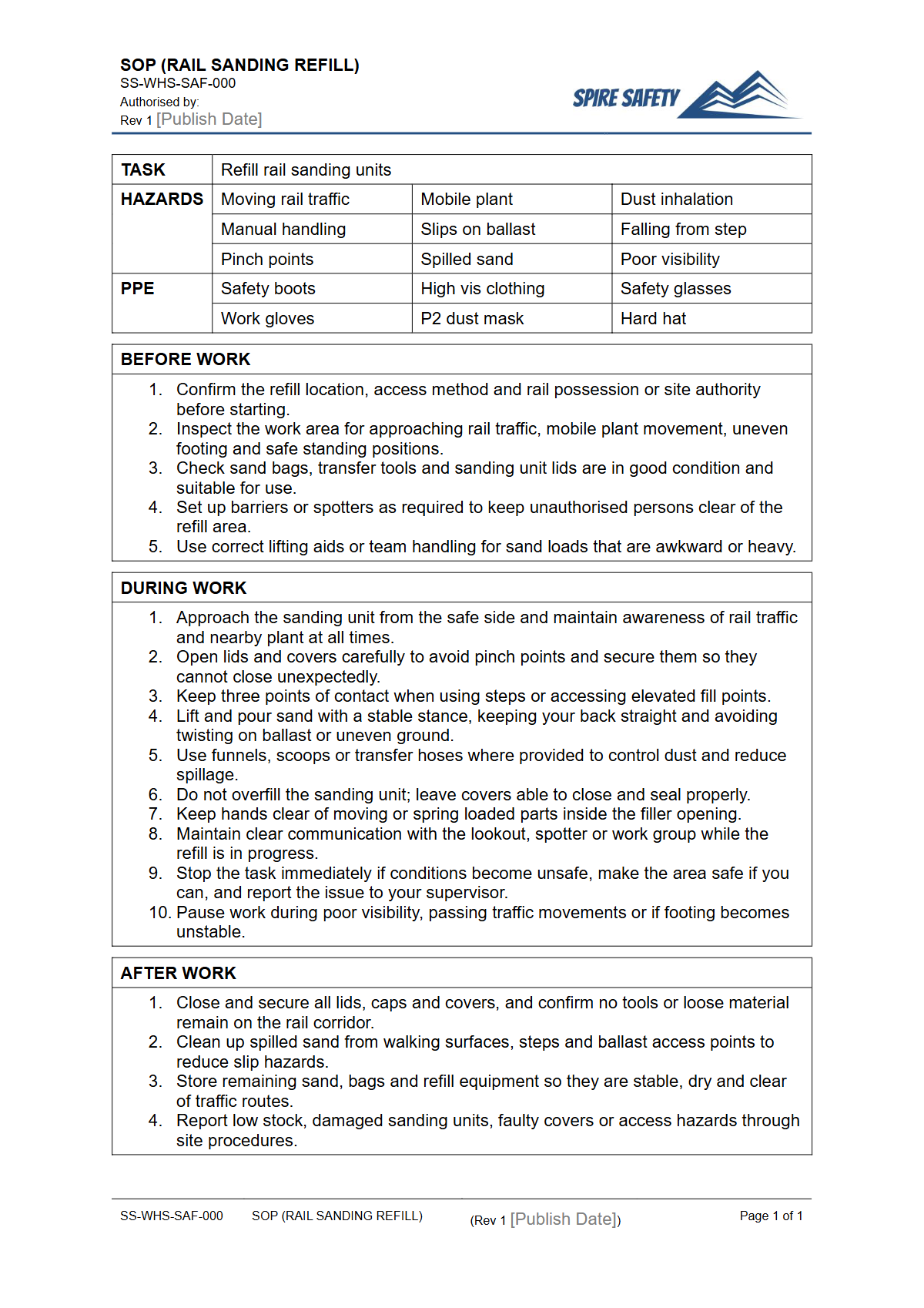
Download our free Safe Operating Procedure for rail sanding refill tasks. This customisable template helps you document safety controls for this specific job.
Free Safe Operating Procedure (Rail Sanding Refill) Template
DOCX • 126 KB + PDF
Updated Oct 2026
No signup required
Purpose of the Free Safe Operating Procedure (Rail Sanding Refill) Template
Managing the risks associated with maintenance tasks is a critical part of workplace safety, especially in the rail industry. This Safe Operating Procedure (SOP) for rail sanding refill provides a structured framework to help your organisation document the required steps for performing this task safely.
By clearly outlining procedures, potential hazards, and necessary control measures, this template helps standardise practices, train personnel, and demonstrate due diligence in managing workplace risks. A well-defined SOP is a cornerstone of effective WHS management systems, ensuring tasks are completed consistently and safely every time.
Video walkthrough
How to use the Free Safe Operating Procedure (Rail Sanding Refill) Template
This template is provided in both DOCX and PDF formats for your convenience. Download the DOCX file to edit and adapt the procedure to your specific operational context.
It is designed as a comprehensive starting point, aligned with Australian WHS principles, but it is not a finished document.
Important: You must customise this Safe Operating Procedure to reflect the unique aspects of your worksite. This includes detailing the specific types of rail vehicles, sanding equipment, sand products used, and the physical environment where the work occurs.
We have provided a robust framework, but the responsibility for ensuring the final document is accurate and suitable for your needs rests with your organisation.
Key Sections to Customise
To make this SOP effective, pay close attention to customising the following areas:
- Personal Protective Equipment (PPE): Specify the exact PPE required, such as P2/N95 respiratory protection for silica dust, safety glasses, protective gloves, and steel-capped boots.
- Equipment and Tools: List all specific tools and machinery used in the process, from hand scoops and funnels to forklifts or telehandlers used for moving bulk bags. If mobile plant is involved, you may need to reference a specific FREE Telehandler SOP Template.
- Step-by-Step Procedure: Detail your organisation’s exact process, from pre-start checks and site preparation to the filling process and clean-up. Include steps for isolating the vehicle from movement.
- Hazard Identification and Control Measures: The template lists common hazards like silica dust exposure, manual handling injuries, and slips. You must review and add any other site-specific hazards and detail your chosen control measures, such as wet-down methods for dust suppression or using specific lifting aids. If compressed air is used for cleaning, its safe use should also be documented, similar to what is outlined in our Free Air Compressor SOP (Safe Operating Procedure) Template.
- Emergency Procedures: Outline the specific steps to be taken in an emergency, including contact details for first aid officers and emergency services, and procedures for managing spills.
When to use a Safe Operating Procedure
An SOP for rail sanding refill should be used as a primary reference document for the task. It is essential for inducting and training new workers, providing refresher training for existing personnel, and for supervisors to monitor and enforce safe work practices.
It should also be reviewed as part of any post-incident investigation or when a change in equipment, materials, or process occurs. Regular reviews of SOPs are a key activity during WHS compliance auditing to ensure they remain current and effective.
Who should use it
This document is intended for a range of personnel within an organisation:
- WHS Managers and Safety Officers: To develop and formalise safe work systems as part of their overall safety framework.
- Supervisors and Team Leaders: To train their teams, conduct pre-start briefings, and ensure procedures are followed correctly on the ground.
- Rail Maintenance Workers and Operators: As a clear, step-by-step guide to performing their tasks safely and correctly.
By integrating this procedure into your daily operations, you create a clear line of communication regarding safety expectations. For businesses needing further assistance in integrating such documents into a broader safety framework, our WHS consulting services can provide expert guidance.
You can also explore our complete free WHS resources library for other useful templates.
Common mistakes
Common mistakes to avoid
- Using the template 'as is' without customising it for site-specific equipment and hazards.
- Neglecting dust control measures, leading to worker exposure to harmful respirable crystalline silica.
- Failing to adequately train all relevant workers on the finalised, site-specific SOP.
- Storing the SOP in an office instead of making it readily accessible to workers at the point of work.
Legal references
Legal considerations
The following legal requirements may be relevant to this type of work.
- Work Health and Safety Act (Harmonised) — Provides the primary duties for protecting workers and other people from work health and safety risks.
- Work Health and Safety Regulations (Harmonised) — Sets out requirements supporting the management of workplace hazards and risks.
The following codes may be relevant to this type of work.
- Managing WHS Risks Code of Practice — Provides practical guidance on identifying hazards, assessing risks and applying effective controls.
- Work Health and Safety Consultation, Cooperation and Coordination Code of Practice — Provides practical guidance on consulting workers and coordinating with other duty holders.
- Managing the Work Environment and Facilities Code of Practice — Provides practical guidance on safe work environments, workplace facilities and related controls.
Did you know
Traction, Not Braking
The sand released from a train's sanding system is primarily used to increase traction between the wheels and the track, especially in wet, icy, or leafy conditions. It helps prevent wheel slip during acceleration and maintains grip on steep gradients.
FAQ
Frequently asked questions
01What is a Safe Operating Procedure for rail sanding refill?
02Is this rail sanding refill SOP template ready to use immediately?
03What are the biggest risks when refilling rail sanders?
04How often should a Safe Operating Procedure be reviewed?
Share this resource
Free Safe Operating Procedure (Rail Sanding Refill) Template
Browse Categories
How To Use It
- 1Download and open in Word or PDF.
- 2Replace the placeholders with your business details.
- 3Get it reviewed by a WHS specialist before rollout.
Need it customised?
Our WHS consultants can adapt this template to your site, run a gap analysis, or audit what you already have in place.
Book a Free Consultation WHS consulting servicesor call 1300 156 382
Related templates
- Free Safe Operating Procedure (Rail Yard Housekeeping) Template
- Free Safe Operating Procedure (Raised Bed Maintenance) Template
- Free Safe Operating Procedure (Rangehood Cleaning) Template
- Free Safe Operating Procedure (RC Drill Rig) Template
- Free Safe Operating Procedure (RCD Testing) Template
- Free Safe Operating Procedure (Reach Truck) Template