
Free Safe Operating Procedure (Rail Yard Housekeeping) Template
Establish clear safety standards for your rail yard with our free SOP template. Download the customisable DOCX and PDF to improve your site housekeeping.
Free Safe Operating Procedure (Rail Yard Housekeeping) Template
DOCX • 126 KB + PDF
Updated Oct 2026
No signup required
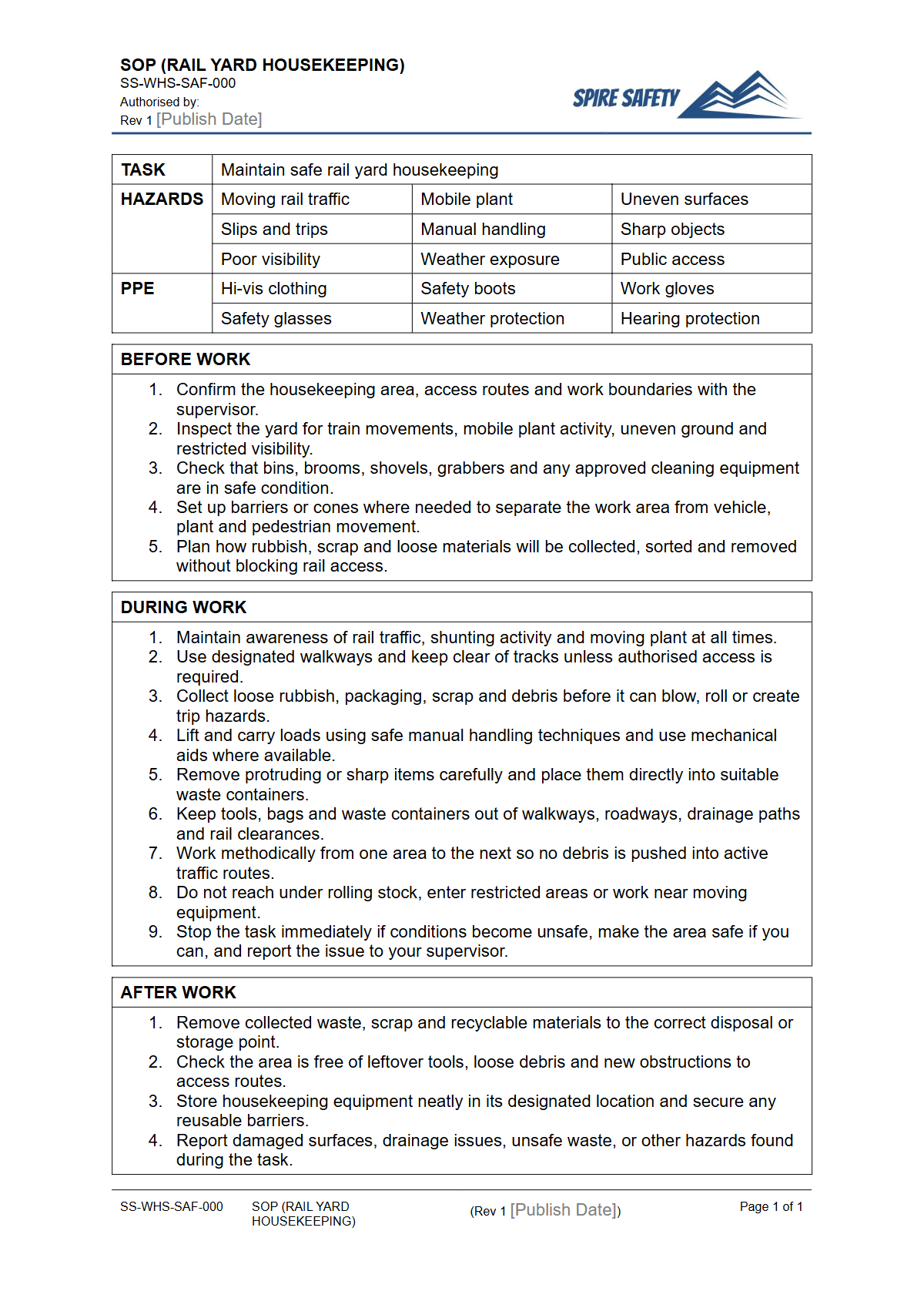
Purpose of the Free Safe Operating Procedure (Rail Yard Housekeeping) Template
Maintaining a clean and organised rail yard is a fundamental aspect of workplace health and safety. This Safe Operating Procedure (SOP) template provides a structured starting point for organisations to document the required processes for effective rail yard housekeeping.
A well-managed yard minimises the risk of slips, trips, and falls, prevents obstructions to rolling stock and vehicle pathways, reduces fire hazards, and improves overall operational efficiency. This document is designed to help you formally outline responsibilities, procedures, and safety controls for tasks such as waste management, material storage, and maintaining clear access ways.
A documented procedure ensures that housekeeping standards are applied consistently across all shifts and work groups. It forms a critical part of your safety management system by addressing common hazards at their source.
For instance, clearly defined procedures for managing equipment like those covered in a Conveyer System SOP can be reinforced by strong housekeeping rules that keep the surrounding area free of debris and trip hazards.
Key Elements of an Effective Rail Yard Housekeeping Procedure
- Waste Management: Designated bins for different types of waste (general, scrap metal, hazardous materials) that are emptied regularly.
- Material and Equipment Storage: Clearly marked areas for storing tools, components, dunnage, and other materials away from walkways and tracks.
- Walkway and Access Route Maintenance: Keeping all pedestrian paths, vehicle routes, and access points to equipment clear of obstructions, spills, and debris.
- Spill Control: Procedures and equipment for containing and cleaning up spills of oil, fuel, or other substances promptly and safely.
- Yard Inspections: A schedule for regular inspections to identify and rectify housekeeping issues before they become significant hazards.
Video walkthrough
How to use the Free Safe Operating Procedure (Rail Yard Housekeeping) Template
This template is provided in both DOCX and PDF formats for your convenience. The DOCX file is fully editable, allowing you to adapt the content to the specific layout, activities, and hazards present in your rail yard.
We strongly recommend a person with appropriate knowledge of rail operations and WHS principles leads this customisation process. You should review each section and add, remove, or modify content to reflect your site's unique requirements.
Important: This is a template, not a finished document. To be effective, it must be customised to your workplace.
We provide a structured starting point, but you are responsible for ensuring the final document accurately reflects your site-specific risks and control measures. Integrating this SOP into your broader WHS management systems is key to its successful implementation and continuous improvement.
When to use this Safe Operating Procedure
A formal housekeeping SOP should be a core component of your daily operations and training programs. It is particularly useful in several situations.
Use it as a training tool during the induction of new employees to establish safety expectations from day one. It should also be used for regular refresher training with existing staff to reinforce correct procedures and address any complacency.
Following an incident or near-miss related to poor housekeeping, the SOP should be reviewed and updated to prevent recurrence. It also serves as an operational guide when work processes change or new materials are introduced to the yard, ensuring housekeeping practices evolve accordingly.
Similar to a specific task-based document like an Air Compressor SOP, this procedure should be a living document that is readily accessible to all relevant personnel.
Who should use this Safe Operating Procedure
This Safe Operating Procedure is intended for a range of personnel within a rail organisation. WHS Managers and Site Supervisors are responsible for implementing, reviewing, and enforcing the procedures outlined in the document.
They should use it to train workers and monitor compliance. Team Leaders and front-line supervisors should use it for daily toolbox talks and to guide the work of their teams.
Most importantly, the workers who perform the housekeeping tasks, as well as those who operate equipment like forklifts or a Telehandler SOP template, must be trained on and understand the SOP to ensure they can perform their duties safely and identify potential housekeeping hazards. The effectiveness of these procedures is often a key focus during internal or external WHS compliance auditing activities.
By implementing a clear and comprehensive procedure for rail yard housekeeping, your organisation can create a safer, more efficient work environment for everyone. Explore our comprehensive library of free WHS resources for more templates to support your safety management system.
Common mistakes
Common mistakes to avoid
- Failing to designate specific, clearly marked areas for waste, tools, and materials.
- Neglecting regular inspections, allowing slip, trip, and fire hazards to accumulate over time.
- Not providing adequate training on housekeeping procedures and hazard identification to all workers.
- Assuming housekeeping is 'common sense' and not documenting formal procedures and responsibilities.
Legal references
Legal considerations
The following legal requirements may be relevant to this type of work.
- Work Health and Safety Act (Harmonised) — Provides the primary duties for protecting workers and other people from work health and safety risks.
- Work Health and Safety Regulations (Harmonised) — Sets out requirements supporting the management of workplace hazards and risks.
The following codes may be relevant to this type of work.
- Managing WHS Risks Code of Practice — Provides practical guidance on identifying hazards, assessing risks and applying effective controls.
- Work Health and Safety Consultation, Cooperation and Coordination Code of Practice — Provides practical guidance on consulting workers and coordinating with other duty holders.
- Managing the Work Environment and Facilities Code of Practice — Provides practical guidance on safe work environments, workplace facilities and related controls.
Did you know
Hidden Costs
Poor housekeeping is a leading cause of workplace slips, trips, and falls, which account for a significant portion of all serious workers' compensation claims in Australia.
Beyond Tidiness
A clean rail yard isn't just about appearance; it directly impacts the safe movement of rolling stock, vehicles, and personnel, preventing potential derailments and collisions.
FAQ
Frequently asked questions
01What is a Safe Operating Procedure for rail yard housekeeping?
02Why is housekeeping so important in a rail yard?
03How often should housekeeping SOPs be reviewed?
04Can this SOP template be used for other industries?
Share this resource
Free Safe Operating Procedure (Rail Yard Housekeeping) Template
Browse Categories
How To Use It
- 1Download and open in Word or PDF.
- 2Replace the placeholders with your business details.
- 3Get it reviewed by a WHS specialist before rollout.
Need it customised?
Our WHS consultants can adapt this template to your site, run a gap analysis, or audit what you already have in place.
Book a Free Consultation WHS consulting servicesor call 1300 156 382
Related templates
- Free Safe Operating Procedure (Raised Bed Maintenance) Template
- Free Safe Operating Procedure (Rangehood Cleaning) Template
- Free Safe Operating Procedure (RC Drill Rig) Template
- Free Safe Operating Procedure (RCD Testing) Template
- Free Safe Operating Procedure (Reach Truck) Template
- Free Safe Operating Procedure (Rebar Bender) Template