
Free Safe Operating Procedure (Rail Car Coupling Check) Template
Ensure your rail yard operations are safe and structured with our free Safe Operating Procedure for rail car coupling checks. Download the template today.
Free Safe Operating Procedure (Rail Car Coupling Check) Template
DOCX • 126 KB + PDF
Updated Oct 2026
No signup required
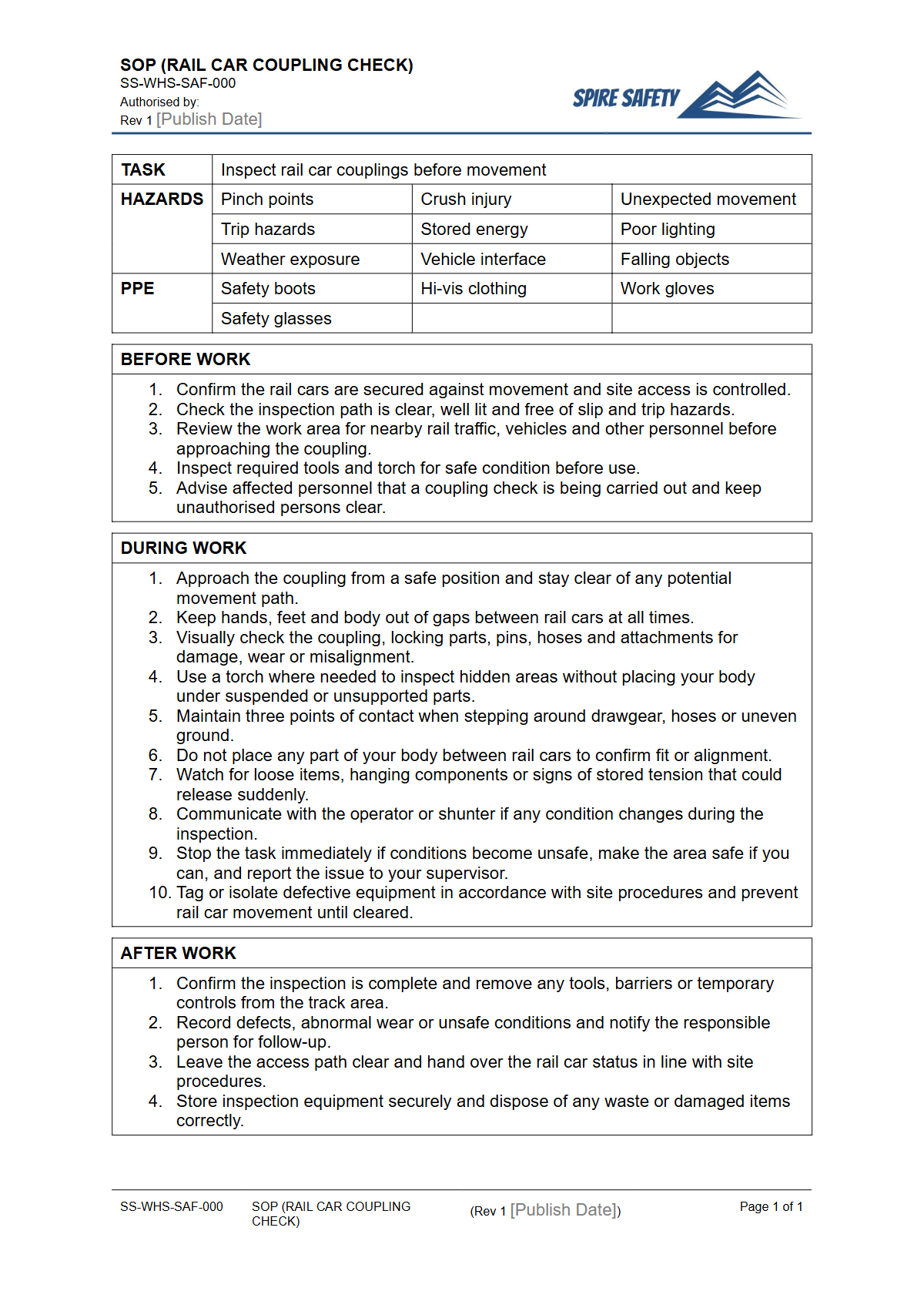
Purpose of the Free Safe Operating Procedure (Rail Car Coupling Check) Template
Rail car coupling is a high-risk activity that exposes workers to significant hazards, including crushing, entanglement, and musculoskeletal injuries. This Free Safe Operating Procedure (Rail Car Coupling Check) Template provides a structured framework for documenting the required steps to perform this task safely.
By clearly defining pre-operational checks, communication protocols, coupling techniques, and verification processes, this SOP helps organisations minimise risk and standardise safe work practices. It serves as a critical tool for managing hazards associated with moving rolling stock and ensures every operator follows a consistent, safety-focused methodology.
Implementing documented procedures is a fundamental component of effective risk management. This template is designed to integrate into your existing safety framework, helping you meet your duties under Australian WHS legislation.
A robust SOP is more than just a document; it's a vital part of your operational DNA that promotes a proactive safety culture and helps prevent serious incidents in the rail yard.
Video walkthrough
How to use the Free Safe Operating Procedure (Rail Car Coupling Check) Template
This resource is provided as a fully editable DOCX file, with a PDF version also available for easy printing and distribution. To use it, simply download the file and open it in your preferred word processing software.
The template is logically structured with sections for PPE, pre-start checks, step-by-step procedures, and emergency actions. You must systematically work through each section and populate it with information specific to your site, your equipment, and your operational context.
This includes detailing the exact types of coupling mechanisms used, site-specific communication signals, and contact information for supervisors and first aid.
Important: This is a template designed to be a starting point. We have structured it based on established safety principles, but you must adapt it to reflect the specific hazards and control measures relevant to your workplace.
Its effectiveness depends on your customisation. For assistance integrating this SOP into your broader safety framework, consider how it fits within comprehensive WHS management systems.
When to use this Safe Operating Procedure
A Safe Operating Procedure for rail car coupling should be a living document used consistently throughout your operations. It is essential for a range of activities, including the initial training and induction of new rail operators, shunters, and ground crew.
It should also be used for periodic refresher training to ensure skills and safety awareness remain high. The SOP serves as a practical, on-the-ground reference for workers before they begin a coupling task.
Furthermore, it is an invaluable reference during safety observations, incident investigations, and formal WHS compliance auditing to verify that prescribed safety protocols are being followed.
Who should use this document
This SOP template is intended for a broad range of personnel within the rail and logistics industries. Primarily, it will be used by the workers who perform the task, such as rail operators, shunters, and yard crew.
They rely on it for clear, step-by-step instructions. WHS managers and safety officers will use the template to establish and formalise safe work methods as part of their risk management responsibilities.
Supervisors and team leaders are responsible for ensuring their teams understand and adhere to the procedure. Trainers will also find it an essential tool for developing competency-based training programs.
Many sites require operators to be competent across various plant, meaning they might also need a telehandler safe operating procedure for ancillary tasks.
Key Elements of a Rail Car Coupling SOP
A comprehensive SOP for this task must cover several critical safety elements. These include specifying the mandatory Personal Protective Equipment (PPE), such as high-visibility clothing, steel-capped boots, gloves, and safety glasses.
It must detail communication protocols, including hand signals and radio procedures, to ensure there is no misunderstanding between the ground crew and the locomotive operator. Establishing clear exclusion zones or 'red zones' around moving rolling stock is another vital component.
The procedure should also integrate lock-out/tag-out protocols where applicable to prevent unexpected movement of equipment during the check. This focus on zoned areas is similar to the principles found in an SOP for a conveyer system.
Integrating SOPs with Other Safety Documentation
An SOP does not exist in a vacuum. It should be developed in conjunction with, and referenced in, other key safety documents. A thorough risk assessment should be conducted first to identify all potential hazards associated with rail car coupling; the SOP then provides the controls for those identified risks. This document should also align with emergency response plans and site traffic management plans. Properly integrating your procedural documents ensures a holistic and robust approach to workplace safety. If your organisation requires support in developing and integrating these documents, our expert WHS consulting services can provide tailored guidance. For more templates and safety resources, browse our complete free WHS resources library.
Common mistakes
Common mistakes to avoid
- Failing to establish clear, confirmed communication with the locomotive operator before approaching.
- Placing hands or any body part between coupling components before they are fully secured and the system is static.
- Neglecting to inspect coupling pins, jaws, and air hoses for wear, damage, or defects before use.
- Entering a designated 'red zone' or the area between wagons without explicit authorisation.
Legal references
Legal considerations
The following legal requirements may be relevant to this type of work.
- Work Health and Safety Act (Harmonised) — Provides the primary duties for protecting workers and other people from work health and safety risks.
- Work Health and Safety Regulations (Harmonised) — Sets out requirements supporting the management of workplace hazards and risks.
The following codes may be relevant to this type of work.
- Managing WHS Risks Code of Practice — Provides practical guidance on identifying hazards, assessing risks and applying effective controls.
- Work Health and Safety Consultation, Cooperation and Coordination Code of Practice — Provides practical guidance on consulting workers and coordinating with other duty holders.
- Managing the Work Environment and Facilities Code of Practice — Provides practical guidance on safe work environments, workplace facilities and related controls.
Did you know
Incredible Forces
The draw gear and coupling systems on rail cars are designed to handle immense forces, often exceeding 2,000 kilonewtons (or over 200 tonnes of force) during train operations. This is why defined exclusion zones are critical.
FAQ
Frequently asked questions
01What is a Safe Operating Procedure (SOP)?
02Why is a specific SOP for rail car coupling checks necessary?
03Does this template cover all rail car types and coupling mechanisms?
04Who is responsible for implementing this SOP?
Share this resource
Free Safe Operating Procedure (Rail Car Coupling Check) Template
Browse Categories
How To Use It
- 1Download and open in Word or PDF.
- 2Replace the placeholders with your business details.
- 3Get it reviewed by a WHS specialist before rollout.
Need it customised?
Our WHS consultants can adapt this template to your site, run a gap analysis, or audit what you already have in place.
Book a Free Consultation WHS consulting servicesor call 1300 156 382
Related templates
- Free Safe Operating Procedure (Rail Depot Waste) Template
- Free Safe Operating Procedure (Rail Platform Cleaning) Template
- Free Safe Operating Procedure (Rail Sanding Refill) Template
- Free Safe Operating Procedure (Rail Yard Housekeeping) Template
- Free Safe Operating Procedure (Raised Bed Maintenance) Template
- Free Safe Operating Procedure (Rangehood Cleaning) Template