
Free Safe Operating Procedure (Radial Arm Saw) Template
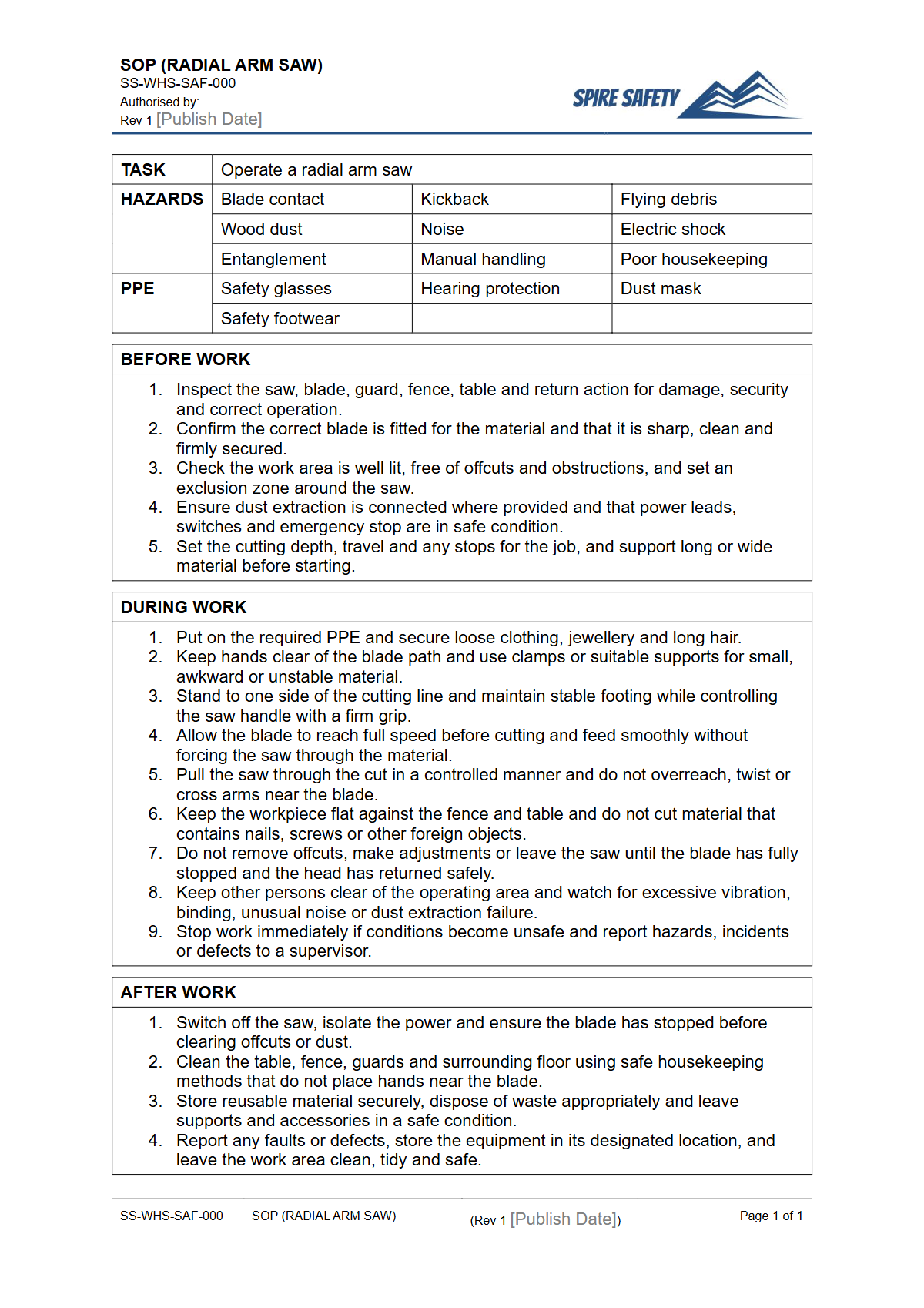
Download our free Safe Operating Procedure (Radial Arm Saw) Template to formalise workshop safety. Customise this DOCX or PDF to your workplace needs.
Free Safe Operating Procedure (Radial Arm Saw) Template
DOCX • 126 KB + PDF
Updated Oct 2026
No signup required
Purpose of the Free Safe Operating Procedure (Radial Arm Saw) Template
A radial arm saw is a powerful and versatile tool found in many workshops, but it also presents significant safety risks if not used correctly. This Safe Operating Procedure (SOP) template provides a structured framework for documenting the safe use of this equipment in your workplace.
Its purpose is to clearly outline step-by-step instructions, identify potential hazards like blade contact, kickback, and airborne dust, and specify the control measures required to mitigate these risks. Formalising these steps helps standardise safe work practices, forming a critical component of your overall safety management system.
Using a documented procedure ensures that all operators, from new trainees to experienced staff, have a clear, consistent reference for safe operation. It serves as a vital training tool and a foundation for risk assessments.
This template is designed to align with Australian WHS principles, helping your organisation meet its duty of care to provide safe systems of work. By implementing a thorough SOP, you create a safer environment and reduce the likelihood of serious incidents involving this high-risk plant.
Video walkthrough
How to Use the Free Safe Operating Procedure (Radial Arm Saw) Template
This resource is available as a fully editable DOCX file for easy customisation, as well as a print-ready PDF. To begin, download the file and open it in your preferred word processor.
Systematically work through each section, adapting the content to reflect the specific conditions of your workplace.
Important: This document is a template and must be customised. We have provided a comprehensive starting point based on common industry practices, but you must review and amend the content to suit the exact make and model of your radial arm saw, the tasks it is used for (e.g., cross-cutting, ripping, bevelling), and the unique environment of your workshop.
Always consult the manufacturer's instruction manual and incorporate its specific safety warnings and operating guidelines into your final SOP.
The process of customisation is also a valuable opportunity for consultation with your workers. Involving the people who actually use the equipment will ensure the final procedure is practical, accurate, and reflects how work is done.
This collaborative approach improves buy-in and reinforces a positive safety culture. Just as you would use a specific procedure for other equipment, such as our FREE Circular Saw SOP (Safe Operating Procedure) Template, this document must be tailored to be effective.
When to Use a Radial Arm Saw SOP
A Safe Operating Procedure for a radial arm saw should be a living document, integrated into your daily operations. It is not a document to be filed away and forgotten. It should be readily accessible near the equipment and used in several key situations:
- Worker Training and Induction: The SOP must be the central document for training any new operator. Practical demonstration should follow the steps outlined in the procedure.
- Refresher Training: Use the SOP for periodic refresher training to prevent complacency and reinforce correct techniques among experienced operators.
- Pre-operational Checks: The procedure outlines the essential safety checks that must be performed before every use, such as inspecting guards, checking blade condition, and ensuring the work area is clear.
- Incident Investigation: If an incident or near-miss occurs, the SOP should be reviewed as part of the investigation to determine if the procedure was followed and if it needs to be updated.
Effectively implemented SOPs form a cornerstone of comprehensive WHS management systems, demonstrating a proactive approach to risk control.
Who Should Use This SOP
This SOP is intended for a range of personnel within an organisation to ensure safety at multiple levels. Key users include:
- PCBU (Persons Conducting a Business or Undertaking): Business owners and managers use the SOP to fulfil their legal duty to provide safe systems of work and adequate training.
- Supervisors and Forepersons: Supervisors use the SOP to train workers, monitor compliance with safe work practices, and ensure pre-start checks are completed correctly. They are responsible for enforcing the procedures on the workshop floor.
- Workers/Operators: The individuals operating the radial arm saw must follow the SOP for every task to protect themselves and others. They should use it as their primary guide for safe operation.
- WHS Managers and Advisors: Safety professionals use the template to establish best-practice guidelines and integrate them into the broader safety framework. They may also lead the review and update process, possibly as part of routine WHS compliance auditing to verify that documented procedures are followed in practice.
For organisations that require assistance in developing and implementing site-specific procedures, our WHS consulting services can provide expert guidance.
Beyond this document, remember to explore our full free WHS resources library for other templates and guides to support your safety objectives.
Common mistakes
Common mistakes to avoid
- Performing ripping cuts without proper anti-kickback device setup.
- Using a dull or incorrect type of blade for the material being cut.
- Climbing or reaching over the saw table while the blade is spinning.
- Failing to wait for the blade to come to a complete stop before clearing offcuts.
Legal references
Legal considerations
The following legal requirements may be relevant to this type of work.
- Work Health and Safety Act (Harmonised) — Provides the primary duties for protecting workers and other people from work health and safety risks.
- Work Health and Safety Regulations (Harmonised) — Sets out requirements supporting the management of workplace hazards and risks.
The following codes may be relevant to this type of work.
- Managing WHS Risks Code of Practice — Provides practical guidance on identifying hazards, assessing risks and applying effective controls.
- Work Health and Safety Consultation, Cooperation and Coordination Code of Practice — Provides practical guidance on consulting workers and coordinating with other duty holders.
- Managing the Work Environment and Facilities Code of Practice — Provides practical guidance on safe work environments, workplace facilities and related controls.
Did you know
An Unforgiving Design
Radial arm saws are considered by many safety professionals to be one of the more hazardous woodworking machines because the blade moves towards the operator, increasing the risk of severe injury if control is lost.
The Ripping Risk
While versatile, performing 'ripping' cuts (cutting along the grain) on a radial arm saw is particularly dangerous as it has a tendency to lift the workpiece and cause violent kickback. Many modern workshops prohibit this practice entirely.
FAQ
Frequently asked questions
01What are the primary hazards associated with operating a radial arm saw?
02How often should a Safe Operating Procedure for a radial arm saw be reviewed?
03Is an SOP enough to ensure a worker is competent to use a radial arm saw?
04Can this template be used for a mitre saw or table saw?
Share this resource
Free Safe Operating Procedure (Radial Arm Saw) Template
Browse Categories
How To Use It
- 1Download and open in Word or PDF.
- 2Replace the placeholders with your business details.
- 3Get it reviewed by a WHS specialist before rollout.
Need it customised?
Our WHS consultants can adapt this template to your site, run a gap analysis, or audit what you already have in place.
Book a Free Consultation WHS consulting servicesor call 1300 156 382
Related templates
- Free Safe Operating Procedure (Radiant Heater) Template
- Free Safe Operating Procedure (Rail Car Cleaning) Template
- Free Safe Operating Procedure (Rail Car Coupling Check) Template
- Free Safe Operating Procedure (Rail Depot Waste) Template
- Free Safe Operating Procedure (Rail Platform Cleaning) Template
- Free Safe Operating Procedure (Rail Sanding Refill) Template