
Free Safe Operating Procedure (Pump Test Rig) Template
Download our Free Safe Operating Procedure (Pump Test Rig) Template to define clear safety controls for operating pump testing equipment. Get your DOCX now.
Free Safe Operating Procedure (Pump Test Rig) Template
DOCX • 126 KB + PDF
Updated Oct 2026
No signup required
Purpose of the Free Safe Operating Procedure (Pump Test Rig) Template
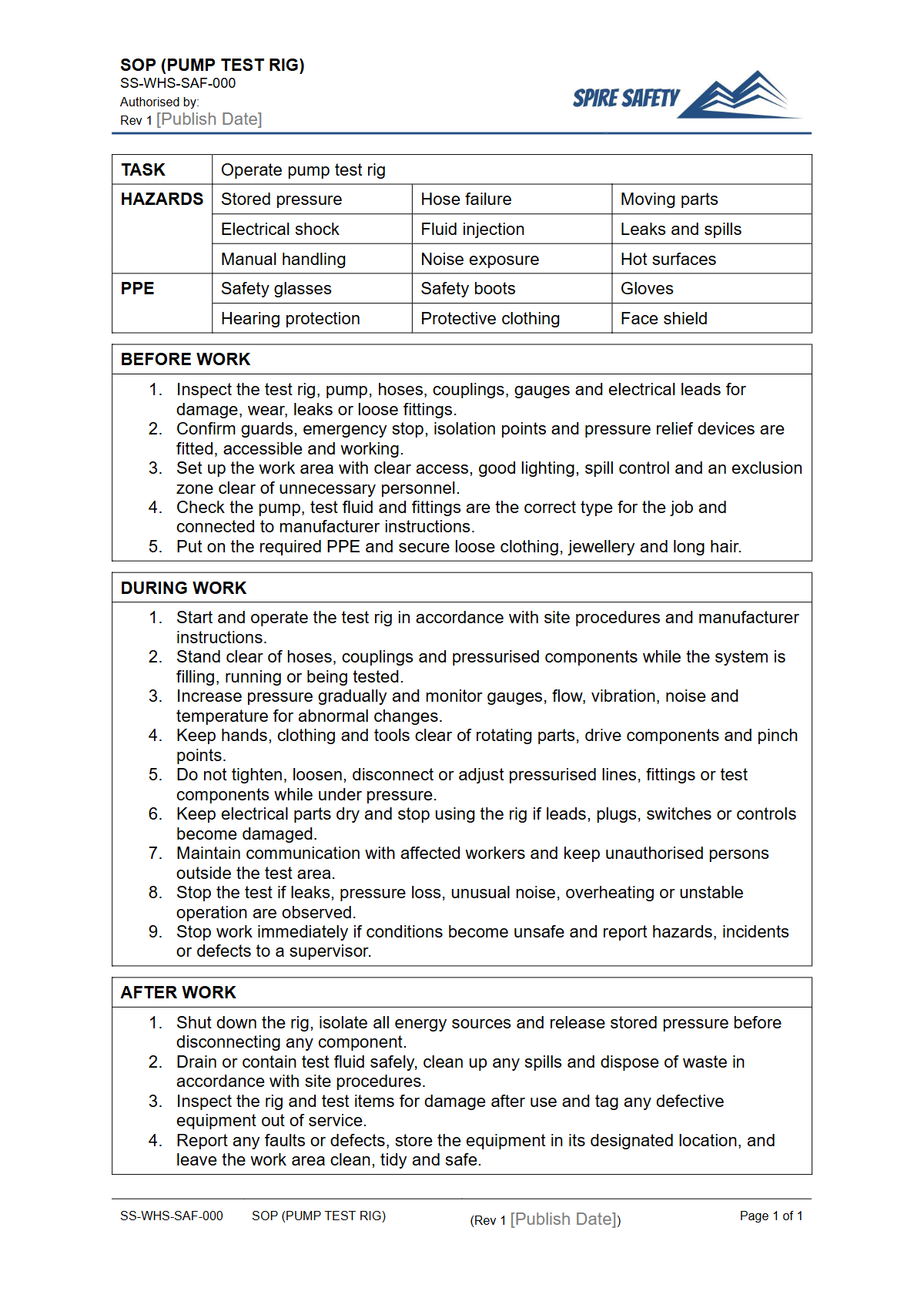
Operating a pump test rig involves managing high-pressure systems, rotating machinery, and potential fluid-related hazards. This Free Safe Operating Procedure (Pump Test Rig) Template provides a structured framework for documenting the required safety controls and step-by-step processes for this task.
It helps organisations standardise procedures, manage risks, and provide clear instructions to operators, ensuring all work is conducted safely and consistently.
Using this template as a foundation helps you address key risks such as uncontrolled pressure release, mechanical entanglement, fluid spills, and electrical hazards. It is designed to align with Australian WHS principles, providing a solid starting point for developing a site-specific document.
A well-developed SOP is a critical component of a compliant and effective WHS management system, demonstrating your organisation's commitment to worker safety.
Video walkthrough
How to use the Free Safe Operating Procedure (Pump Test Rig) Template
This template is a comprehensive starting point, but it must be adapted to the specific equipment and operational context of your workplace. To effectively use this Safe Operating Procedure for a pump test rig, follow these steps:
- Download: Select the DOCX or PDF version and save it to your system.
- Customise: Open the document and add your company name, logo, and other relevant details.
- Conduct a Risk Assessment: Identify all hazards associated with your specific pump test rig and its environment. This should be done in consultation with operators and supervisors.
- Detail Procedures: Fill in the sections with step-by-step instructions for pre-operational checks, operation, shutdown, and emergency procedures specific to your rig.
- Consult and Review: Involve the workers who will use the SOP in the drafting process. Their practical experience is invaluable for creating a useful and accurate document.
- Approve and Train: Once finalised, the SOP must be approved by management. All relevant personnel must then be trained on its contents, and records of this training should be kept.
Important: This is a template only. We are not WHS consultants for your business, and this document does not constitute legal advice.
You must customise this SOP by conducting a risk assessment and consulting with your workers to ensure it is suitable for your specific plant, tasks, and workplace environment.
When to use it
A Safe Operating Procedure for a pump test rig should be used every time the equipment is operated. It is a critical document for:
- Operator Training and Induction: Providing new and existing workers with clear instructions on how to use the equipment safely.
- Routine Operations: Guiding operators through the standard process to ensure consistency and prevent shortcuts.
- Supervision and Monitoring: Allowing supervisors to monitor work practices against an established, safe standard.
- Incident Investigations: Serving as a benchmark for safe work practices when investigating why an incident occurred.
It's also essential to review and update the SOP following any changes to the equipment, procedures, or workplace environment. Regular WHS compliance auditing can help identify when procedures like this SOP need review to reflect current practices and legislative requirements.
Who should use it
This SOP is intended for several key roles within an organisation:
- Operators and Technicians: The primary users who perform the pump testing tasks and must follow the documented procedures.
- Supervisors and Team Leaders: Responsible for ensuring their teams follow the SOP and for providing necessary training and oversight.
- WHS Managers and Advisors: Use the SOP as part of the broader safety management system to ensure risks are controlled and documented.
- Maintenance Personnel: May refer to the SOP for lockout/tagout procedures and other safety requirements before conducting maintenance.
Effectively managing safety for pressurised equipment requires clear documentation. For similar machinery, consider our Free Air Compressor SOP Template to maintain consistency in your safety systems.
Further Resources and Next Steps
Developing a single SOP is just one part of managing workplace safety. To ensure your procedures for all plant and equipment are robust, you may find other templates useful.
For instance, if your site also operates different types of pumps, our FREE Boom Pump SOP (Safe Operating Procedure) Template can provide a helpful reference for mobile plant.
For fixed plant involving mechanical movement, our FREE Conveyer System SOP Template offers another example of how to structure procedures for different equipment risks. You can explore our complete free WHS resources library for more templates to build out your safety documentation.
Common mistakes
Common mistakes to avoid
- Failing to de-pressurise the system completely before maintenance or adjustments.
- Neglecting to inspect hoses, fittings, and guards during pre-start checks.
- Using a generic SOP that doesn't account for the specific model and configuration of the test rig.
- Not training workers on the SOP's emergency shutdown procedures.
Legal references
Legal considerations
The following legal requirements may be relevant to this type of work.
- Work Health and Safety Act (Harmonised) — Provides the primary duties for protecting workers and other people from work health and safety risks.
- Work Health and Safety Regulations (Harmonised) — Sets out requirements supporting the management of workplace hazards and risks.
The following codes may be relevant to this type of work.
- Managing WHS Risks Code of Practice — Provides practical guidance on identifying hazards, assessing risks and applying effective controls.
- Work Health and Safety Consultation, Cooperation and Coordination Code of Practice — Provides practical guidance on consulting workers and coordinating with other duty holders.
- Managing the Work Environment and Facilities Code of Practice — Provides practical guidance on safe work environments, workplace facilities and related controls.
Did you know
Pressure Injection Injuries
High-pressure injection injuries from hydraulic or pneumatic systems can be extremely serious, even if the initial wound appears minor. The injected fluid can travel through tissues, causing severe damage, infection, and requiring immediate, specialised medical attention.
FAQ
Frequently asked questions
01What is a Safe Operating Procedure for a pump test rig?
02Why is a specific SOP needed for pump testing?
03Who is responsible for writing a pump test rig SOP?
04How often should a pump test rig SOP be reviewed?
Share this resource
Free Safe Operating Procedure (Pump Test Rig) Template
Browse Categories
How To Use It
- 1Download and open in Word or PDF.
- 2Replace the placeholders with your business details.
- 3Get it reviewed by a WHS specialist before rollout.
Need it customised?
Our WHS consultants can adapt this template to your site, run a gap analysis, or audit what you already have in place.
Book a Free Consultation WHS consulting servicesor call 1300 156 382
Related templates
- Free Safe Operating Procedure (Punch Press) Template
- Free Safe Operating Procedure (Quad Bike - Standard Operation) Template
- Free Safe Operating Procedure (Radial Arm Saw) Template
- Free Safe Operating Procedure (Radiant Heater) Template
- Free Safe Operating Procedure (Rail Car Cleaning) Template
- Free Safe Operating Procedure (Rail Car Coupling Check) Template