
Free Safe Operating Procedure (Punch Press) Template
Download our free Safe Operating Procedure (Punch Press) Template to outline safe work practices. This customisable DOCX and PDF is a great starting point.
Free Safe Operating Procedure (Punch Press) Template
DOCX • 126 KB + PDF
Updated Oct 2026
No signup required
Purpose of the Free Safe Operating Procedure (Punch Press) Template
Punch presses are powerful machines used for stamping, punching, and forming metal. Due to the high forces involved, they present significant risks, including severe crushing and amputation injuries.
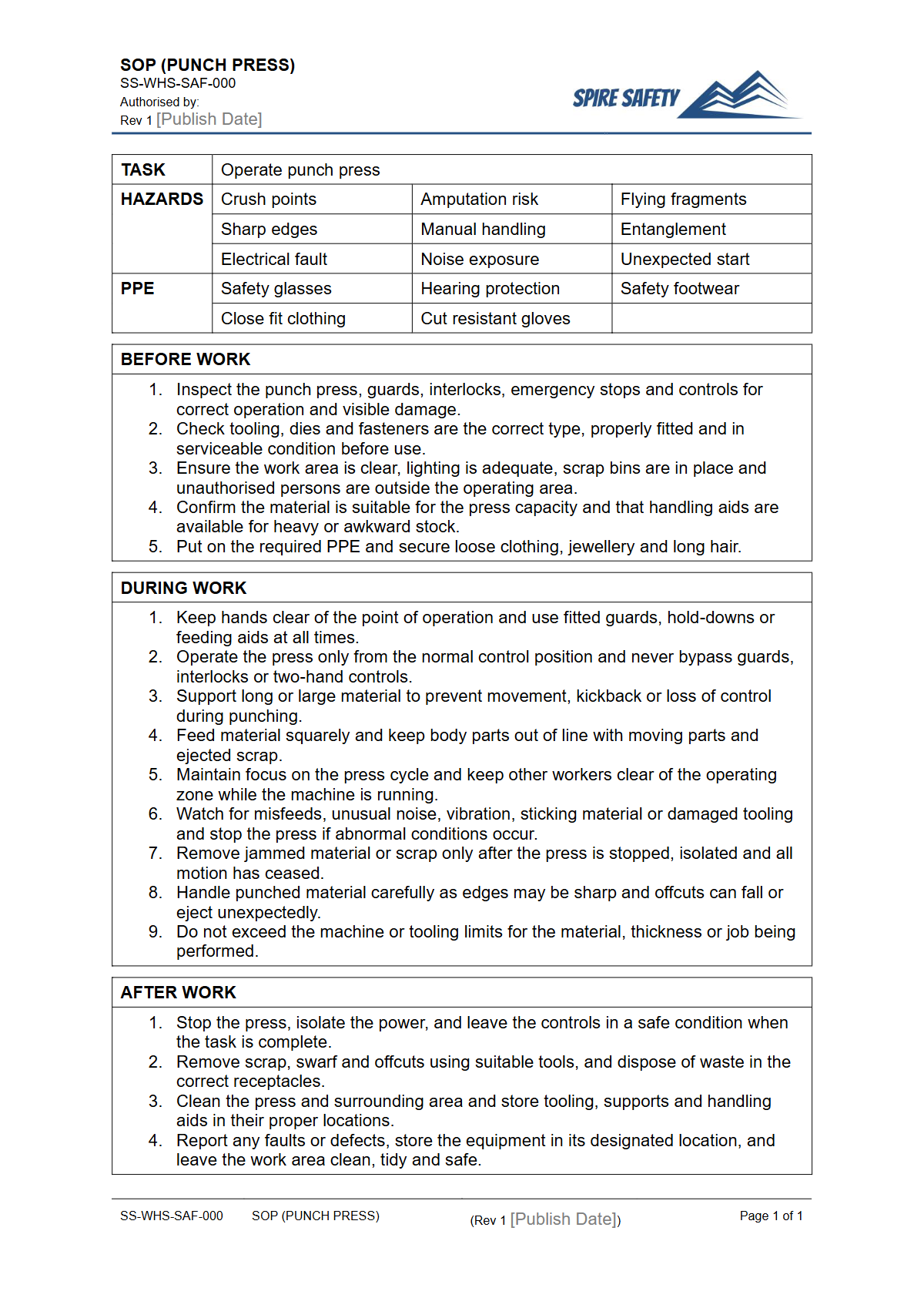
This Free Safe Operating Procedure (Punch Press) Template provides a structured framework for documenting the required steps to operate this machinery safely. An effective SOP is a critical tool for managing high-risk tasks, reducing the likelihood of incidents, and ensuring operators are aware of hazards and control measures.
It forms a vital component of a comprehensive WHS management system, helping your organisation meet its safety obligations.
Video walkthrough
How to use the Free Safe Operating Procedure (Punch Press) Template
This document is designed as a starting point. To make it effective, you must adapt it to the specific machinery and operational context of your workplace.
Generic procedures are insufficient for managing specific risks.
Follow these steps to implement the SOP:
- Download: Choose either the DOCX or PDF version.
- Customise: Review the template against your specific punch press. Add details such as the make, model, guarding mechanisms, specific personal protective equipment (PPE), and emergency stop locations.
- Consult: Involve operators, supervisors, and health and safety representatives in the drafting process. Their firsthand experience is invaluable for creating a practical and effective document.
- Approve: Finalise the document and have it formally approved by management.
- Train: Use the finalised SOP as a core part of operator training and competency assessments. Ensure all relevant workers read, understand, and sign off on it before operating the machinery.
Important: This template is a guide and must be customised to reflect the unique hazards and control measures of your workplace. We are not responsible for your WHS compliance; this responsibility lies with your organisation.
Key Hazards of Punch Press Operation
Operating a punch press involves several significant hazards that must be controlled. The SOP should detail how your workplace addresses risks such as:
- Mechanical Hazards: The primary risk is crushing or amputation at the point of operation (the die area). Other risks include shearing from moving parts and entanglement with rotating components.
- Electrical Hazards: Risk of electric shock from faulty wiring or inadequate isolation during maintenance.
- Noise: High noise levels can lead to permanent hearing damage.
- Manual Handling: Injuries from lifting and moving heavy dies, raw materials, or finished parts.
Your SOP must clearly outline the function and inspection requirements for guards, light curtains, two-hand controls, and other safety devices. While the principles are similar to other powerful machinery, the application is unique. For comparison, you can see how controls are documented in our FREE Hydraulic Press SOP.
When to use this Safe Operating Procedure
A Safe Operating Procedure for a punch press should be a living document, used consistently throughout your operations. It is essential during key activities such as worker inductions, task-specific training, and competency refreshers.
Supervisors should use it as a benchmark when observing work practices and providing feedback. The SOP must also be reviewed and updated following any incident or near miss, or when changes are made to the machinery or process.
Regular reviews during WHS compliance audits ensure the procedure remains current and effective.
Who should use it
This SOP is intended for anyone involved in the lifecycle of punch press operations. This includes:
- WHS Managers and Advisors: To establish a baseline for safe work and integrate it into the broader safety system.
- Supervisors and Team Leaders: To train workers, monitor safe work practices, and enforce controls.
- Machine Operators: As a clear, step-by-step guide for performing their tasks safely.
- Maintenance Personnel: To understand operational hazards and implement correct lockout/tagout procedures before commencing work.
The structured approach used in this document is applicable across various types of high-risk plant and equipment. For example, a circular saw SOP also focuses heavily on guarding, operator competency, and emergency procedures, demonstrating a consistent methodology for risk management.
Integrating the SOP with Your Systems
An SOP works best when it is part of a complete safety system, not a standalone document. It should be directly linked to your site's risk assessments, training records, and plant maintenance schedule.
The effectiveness of the procedure depends on proper implementation, which includes adequate supervision and a willingness to stop work if conditions are unsafe. Any ancillary equipment used with the press, such as an air compressor providing pneumatic power, must have its own procedures, like an Air Compressor SOP, to manage associated risks.
Similarly, if materials are fed to or from the press automatically, a Conveyer System SOP will be necessary. To see how this and other documents fit together, explore our complete free WHS resources library.
Common mistakes
Common mistakes to avoid
- Using the generic template without adding site-specific details for the make and model of the press.
- Failing to adequately detail the function and pre-start checks for all safety guards, interlocks, and light curtains.
- Neglecting to include clear and specific lockout/tagout (LOTO) procedures for cleaning, die changes, and maintenance.
- Treating the SOP as a one-time document instead of using it for ongoing training and regular review.
Legal references
Legal considerations
The following legal requirements may be relevant to this type of work.
- Work Health and Safety Act (Harmonised) — Provides the primary duties for protecting workers and other people from work health and safety risks.
- Work Health and Safety Regulations (Harmonised) — Sets out requirements supporting the management of workplace hazards and risks.
The following codes may be relevant to this type of work.
- Managing WHS Risks Code of Practice — Provides practical guidance on identifying hazards, assessing risks and applying effective controls.
- Work Health and Safety Consultation, Cooperation and Coordination Code of Practice — Provides practical guidance on consulting workers and coordinating with other duty holders.
- Managing the Work Environment and Facilities Code of Practice — Provides practical guidance on safe work environments, workplace facilities and related controls.
Did you know
Incredible Force
Mechanical punch presses can generate forces ranging from just a few tonnes for small benchtop models to over 2,000 tonnes for large industrial presses used in automotive manufacturing.
Machine Guarding
According to Safe Work Australia, a significant percentage of machine-related injuries occur at the point of operation. Inadequate or missing guarding is a leading cause of these preventable incidents.
FAQ
Frequently asked questions
01What should be included in a punch press SOP?
02How often should a punch press Safe Operating Procedure be reviewed?
03Is a Safe Operating Procedure a legal requirement for punch presses in Australia?
04Who is responsible for writing a punch press SOP?
Share this resource
Free Safe Operating Procedure (Punch Press) Template
Browse Categories
How To Use It
- 1Download and open in Word or PDF.
- 2Replace the placeholders with your business details.
- 3Get it reviewed by a WHS specialist before rollout.
Need it customised?
Our WHS consultants can adapt this template to your site, run a gap analysis, or audit what you already have in place.
Book a Free Consultation WHS consulting servicesor call 1300 156 382
Related templates
- Free Safe Operating Procedure (Quad Bike - Standard Operation) Template
- Free Safe Operating Procedure (Radial Arm Saw) Template
- Free Safe Operating Procedure (Radiant Heater) Template
- Free Safe Operating Procedure (Rail Car Cleaning) Template
- Free Safe Operating Procedure (Rail Car Coupling Check) Template
- Free Safe Operating Procedure (Rail Depot Waste) Template