
Free Safe Operating Procedure (Pump Alignment) Template
Download our free Safe Operating Procedure (Pump Alignment) Template to formalise safe work practices. Get started with our customisable DOCX and PDF now.
Free Safe Operating Procedure (Pump Alignment) Template
DOCX • 126 KB + PDF
Updated Oct 2026
No signup required
Purpose of the Free Safe Operating Procedure (Pump Alignment) Template
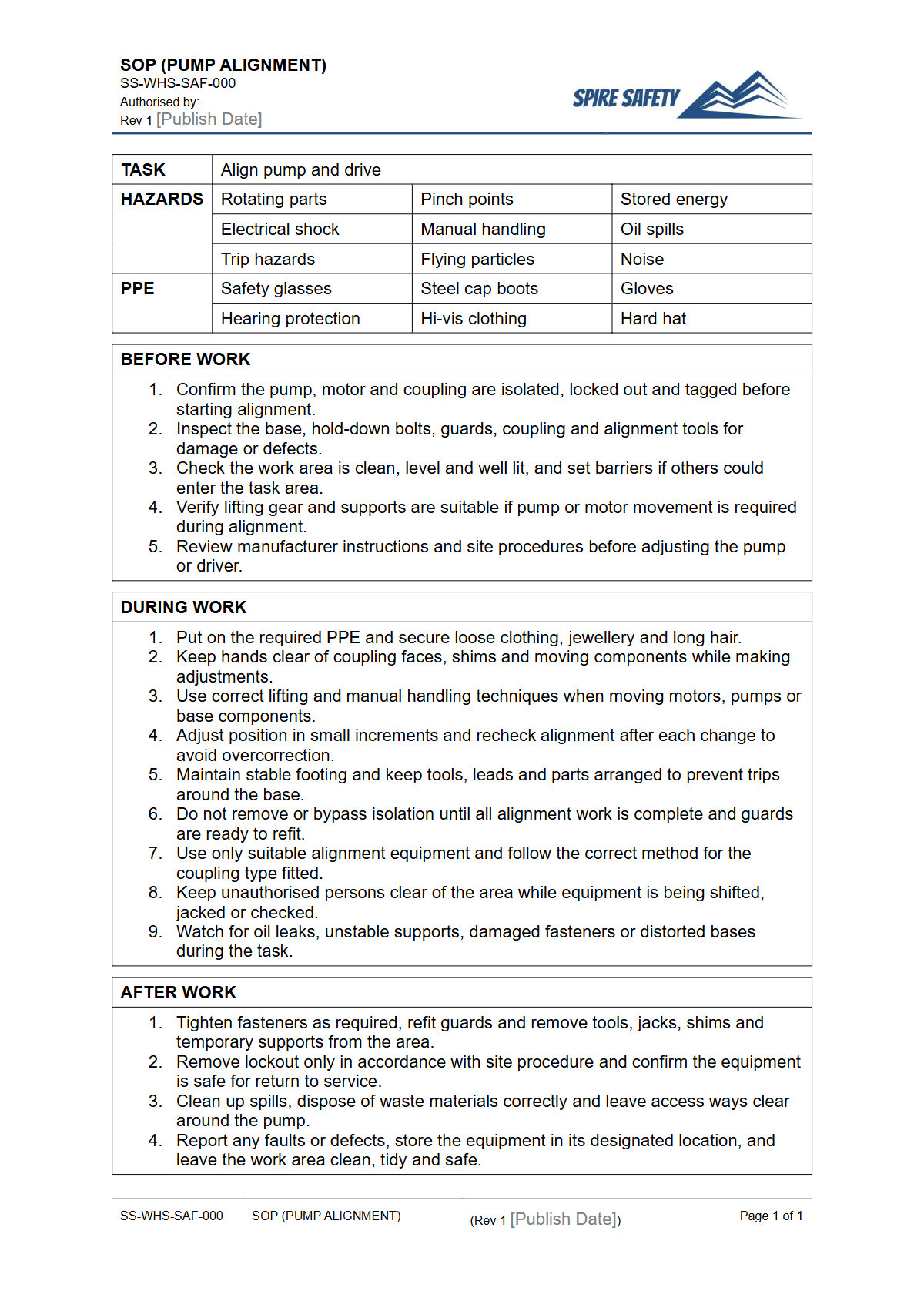
A Safe Operating Procedure (SOP) is a critical document for managing risks associated with specific tasks. This free Safe Operating Procedure (Pump Alignment) Template provides a structured framework for documenting the step-by-step process of safely aligning industrial pumps.
Proper alignment is essential for preventing premature equipment failure, reducing energy consumption, and minimising the risk of injury to personnel. Misalignment can lead to excessive vibration, bearing failure, seal damage, and coupling wear, resulting in costly downtime and repairs.
Using a standardised SOP helps ensure that every alignment task is performed consistently and safely, regardless of who is performing the work. It serves as both a guide for trained workers and a crucial training tool for new team members.
By outlining hazards and control measures, this template helps your organisation meet its duty of care under WHS legislation. Similar to how an air compressor safe operating procedure details specific risks for that equipment, this document focuses squarely on the unique challenges of pump alignment.
Video walkthrough
How to use the Free Safe Operating Procedure (Pump Alignment) Template
This template is available in both DOCX and PDF formats for your convenience. The DOCX file is fully editable, allowing you to tailor the content to the specific types of pumps, alignment tools (e.g., dial indicators, laser alignment systems), and workplace conditions unique to your site.
It is designed to be a solid foundation, not a finished product.
Important: This document is a template and requires customisation. It is a starting point that must be adapted to reflect the specific hazards, equipment, and control measures relevant to your workplace.
We are not liable for any incidents that occur from the use of this template. For the SOP to be effective, it should be integrated into your broader WHS management systems, which provide the overarching framework for safety governance.
What this Safe Operating Procedure covers
Our template provides a comprehensive structure to guide you in developing a site-specific procedure. Key sections are laid out to help you document a complete and logical workflow:
- Pre-Operational Checks: Includes steps for confirming equipment isolation (Lockout/Tagout), inspecting the work area, and verifying the condition of tools and measuring devices.
- Step-by-Step Alignment Process: A logical sequence for performing the alignment, from initial 'rough' alignment to precision adjustments and correcting for soft foot.
- Potential Hazards & Control Measures: A risk assessment matrix to identify foreseeable hazards (e.g., rotating parts, manual handling, pinch points) and specify the required controls (e.g., machine guarding, PPE, correct tool use).
- Required PPE: A section to specify the mandatory Personal Protective Equipment, such as safety glasses, gloves, and steel-capped boots.
- Post-Operational Tasks: Procedures for cleaning up the work area, restoring guarding, removing locks, and documenting final alignment values.
Effectively managing complex machinery often requires multiple specific SOPs. For instance, the process for a mobile unit like a boom pump involves different considerations for stability and public interaction than stationary equipment, which is why a dedicated safe operating procedure for a boom pump is necessary.
When to use it
A formal pump alignment SOP should be used in several key situations to maintain equipment reliability and workplace safety. It is not just for major overhauls but should be part of routine operations.
Key triggers include:
- New Pump Installation: To ensure the equipment is set up correctly from the very beginning.
- After Maintenance or Repairs: Any time a pump or motor has been disconnected, removed, or replaced.
- Preventative Maintenance Schedule: As a periodic check to detect and correct misalignment before it causes significant damage.
- In Response to Performance Issues: When symptoms like increased vibration, high bearing temperatures, or leaking seals are observed.
The principles of documenting a safe process are transferable across different types of machinery, though the specific steps will vary greatly. For example, a conveyer system SOP would focus on belt tracking and tensioning as key alignment parameters, in contrast to the rotational shaft alignment of a pump.
Who should use it
This Safe Operating Procedure is intended for use by competent and authorised personnel. The primary users include:
- Maintenance Technicians and Fitters
- Mechanical Engineers
- Reliability Engineers
- Supervisors and Team Leaders overseeing maintenance activities
All personnel using this procedure should be trained on its contents and be deemed competent in performing pump alignment tasks. Supervisors can use the SOP as a checklist to verify that work is being performed correctly and safely.
A periodic review as part of a WHS compliance auditing program can help ensure the procedure remains current and is being followed consistently.
Common mistakes
Common mistakes to avoid
- Ignoring or incorrectly diagnosing 'soft foot' conditions, where one or more feet of the machine do not make solid contact with the baseplate.
- Failing to perform pre-alignment checks, such as inspecting foundations for cracks or ensuring baseplates are clean and flat.
- Using worn, damaged, or uncalibrated alignment tools, which leads to inaccurate readings and poor results.
- Not documenting the final alignment values, which prevents tracking of machine movement over time and identifying chronic issues.
Legal references
Legal considerations
The following legal requirements may be relevant to this type of work.
- Work Health and Safety Act (Harmonised) — Provides the primary duties for protecting workers and other people from work health and safety risks.
- Work Health and Safety Regulations (Harmonised) — Sets out requirements supporting the management of workplace hazards and risks.
The following codes may be relevant to this type of work.
- Managing WHS Risks Code of Practice — Provides practical guidance on identifying hazards, assessing risks and applying effective controls.
- Work Health and Safety Consultation, Cooperation and Coordination Code of Practice — Provides practical guidance on consulting workers and coordinating with other duty holders.
- Managing the Work Environment and Facilities Code of Practice — Provides practical guidance on safe work environments, workplace facilities and related controls.
Did you know
The Cost of Misalignment
Industry studies suggest that shaft misalignment is the root cause of over 50% of all rotating machinery failures. Correct alignment can significantly extend the life of bearings, seals, and couplings.
FAQ
Frequently asked questions
01What is the difference between rough alignment and precision alignment for pumps?
02How often should pump alignment be checked?
03Is a laser alignment tool necessary for a pump alignment SOP?
04Can this SOP template be used for other types of rotating machinery?
Share this resource
Free Safe Operating Procedure (Pump Alignment) Template
Browse Categories
How To Use It
- 1Download and open in Word or PDF.
- 2Replace the placeholders with your business details.
- 3Get it reviewed by a WHS specialist before rollout.
Need it customised?
Our WHS consultants can adapt this template to your site, run a gap analysis, or audit what you already have in place.
Book a Free Consultation WHS consulting servicesor call 1300 156 382
Related templates
- Free Safe Operating Procedure (Pump Impeller Change) Template
- Free Safe Operating Procedure (Pump Priming) Template
- Free Safe Operating Procedure (Pump Seal Change) Template
- Free Safe Operating Procedure (Pump Station Check) Template
- Free Safe Operating Procedure (Pump Test Rig) Template
- Free Safe Operating Procedure (Punch Press) Template