
Free Safe Operating Procedure (Pump Impeller Change) Template
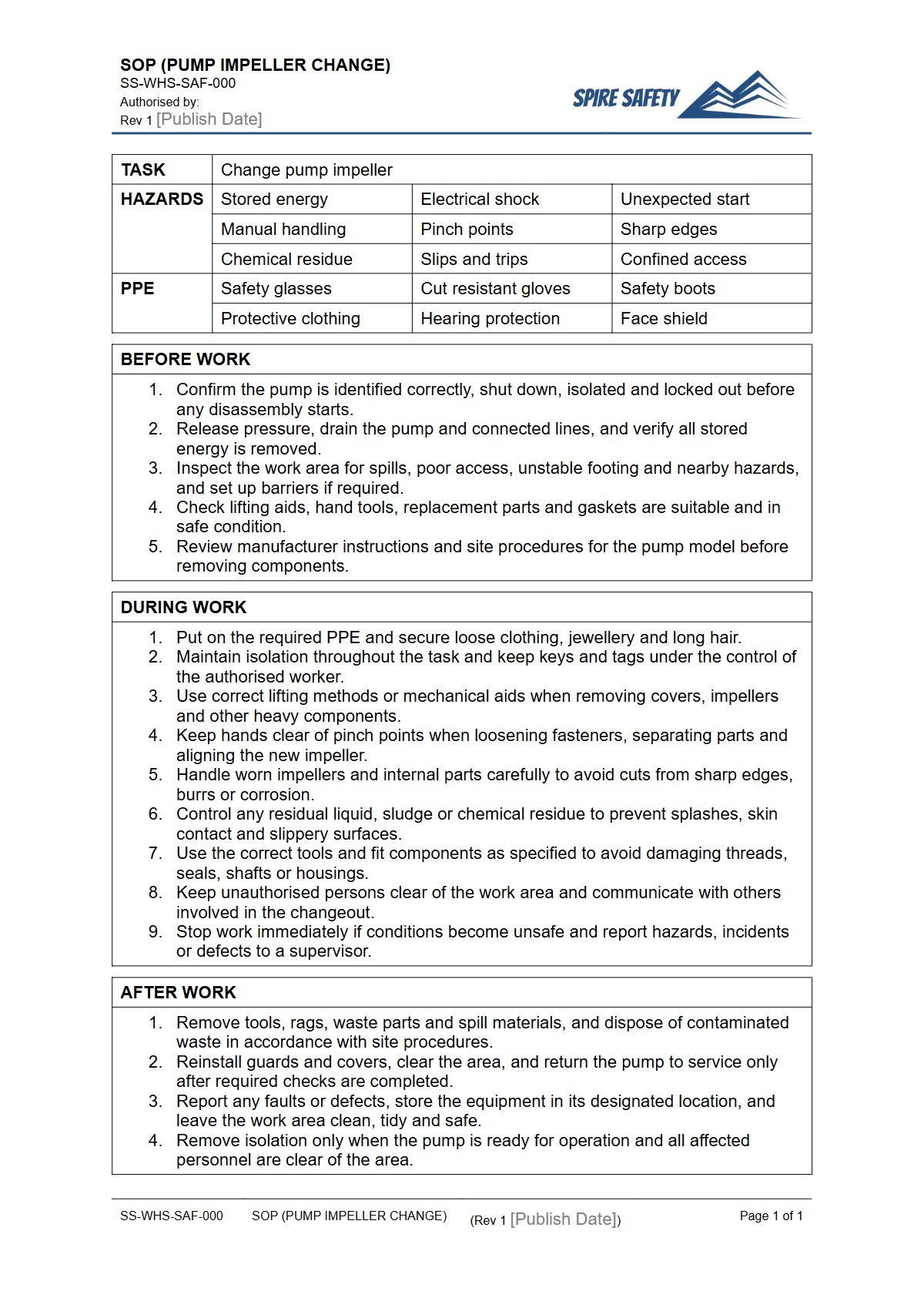
Formalise the steps for safely changing a pump impeller with our structured Safe Operating Procedure template. Download the free DOCX and PDF to adapt it.
Free Safe Operating Procedure (Pump Impeller Change) Template
DOCX • 126 KB + PDF
Updated Oct 2026
No signup required
Purpose of the Free Safe Operating Procedure (Pump Impeller Change) Template
Changing a pump impeller is a high-risk maintenance task involving multiple hazards, from stored energy and hazardous substances to manual handling and entanglement. This Free Safe Operating Procedure (Pump Impeller Change) Template provides a structured framework to document the required safety controls and work steps.
By formalising the process, organisations can ensure a consistent and safe method is followed every time, reducing the risk of injury and equipment damage. A documented SOP serves as a vital tool for worker training, competency assessment, and supervision.
Implementing clear procedures is a fundamental aspect of managing workplace safety. The SOP helps a Person Conducting a Business or Undertaking (PCBU) meet their primary duty of care by providing clear instruction on how to perform the task safely. This is particularly important for complex machinery where a sequence of operations must be followed, similar to the requirements outlined in a Conveyer System SOP.
Video walkthrough
How to use the Free Safe Operating Procedure (Pump Impeller Change) Template
This document is a template and must be customised to your specific workplace. The provided DOCX file is fully editable, allowing you to add, remove, or modify sections to reflect your unique equipment, environment, and risk profile.
To use it effectively, consult with workers and supervisors who perform the task. Their direct experience is invaluable for identifying practical hazards and effective controls. A comprehensive procedure forms one part of your overall safety framework, which should be integrated into your broader WHS management systems.
The customisation process should involve:
- Conducting a specific risk assessment for the pump impeller change task.
- Identifying all energy sources and defining a clear Lockout/Tagout (LOTO) procedure.
- Specifying the exact make and model of the pump(s).
- Listing the required tools, equipment, and personal protective equipment (PPE).
- Detailing step-by-step instructions for isolation, disassembly, replacement, and re-commissioning.
- Including emergency procedures relevant to the task.
We strongly advise that you customise this template in consultation with your team to ensure it is relevant and effective for your site. Once completed, the procedure should be approved by a competent person. For more guidance and templates, you can browse our complete free WHS resources library.
When to use this Safe Operating Procedure
A Safe Operating Procedure for a pump impeller change should be used as a primary reference document in several key situations. It is essential during any scheduled or unscheduled maintenance that requires the pump to be opened for impeller replacement.
It also serves as a critical training document for new employees or for workers being upskilled to perform this specific task. Supervisors can use the SOP as a checklist to monitor work and confirm that all safety steps are being followed correctly.
Furthermore, the SOP is an important reference after an incident or near miss. It can be reviewed as part of the investigation to determine if the procedure was adequate and if it was followed correctly.
Regular reviews and updates to the SOP ensure it remains current with any changes in equipment or process, similar to how one might manage the procedure for a free Air Compressor SOP. This is a core part of a continuous improvement cycle within a safety management system. The process of reviewing such documents often falls within the scope of WHS compliance auditing to verify that documented procedures align with actual practice.
Who should use this Safe Operating Procedure
This SOP is intended for several key roles within an organisation. Primarily, qualified and competent personnel such as maintenance fitters, mechanics, or technicians who physically perform the impeller change will use it as their guide.
They must be trained on the contents of the specific SOP before undertaking the work. Supervisors and team leaders are also key users; they are responsible for ensuring their team understands and adheres to the procedure, authorising the work, and confirming isolations are in place.
WHS managers and safety advisors will use the template to develop and formalise the procedure as part of the organisation's overall safety system. They are often responsible for facilitating the risk assessment, consulting with the workforce, and managing the document control and review process.
For organisations that need assistance developing site-specific procedures, engaging general WHS consulting services can provide the necessary expertise. The procedure also informs others who may work near the area, helping them understand the hazards involved and the exclusion zones required during the task, just as a free Trencher SOP would define safety zones for ground personnel.
Common mistakes
Common mistakes to avoid
- Forgetting to isolate all energy sources and verify isolation (Lockout/Tagout).
- Failing to release stored pressure from suction and discharge lines before disassembly.
- Using incorrect tools or unsafe lifting techniques for heavy pump casings or components.
- Neglecting to wear appropriate PPE, especially when dealing with chemical, slurry, or high-temperature pumps.
Legal references
Legal considerations
The following legal requirements may be relevant to this type of work.
- Work Health and Safety Act (Harmonised) — Provides the primary duties for protecting workers and other people from work health and safety risks.
- Work Health and Safety Regulations (Harmonised) — Sets out requirements supporting the management of workplace hazards and risks.
The following codes may be relevant to this type of work.
- Managing WHS Risks Code of Practice — Provides practical guidance on identifying hazards, assessing risks and applying effective controls.
- Work Health and Safety Consultation, Cooperation and Coordination Code of Practice — Provides practical guidance on consulting workers and coordinating with other duty holders.
- Managing the Work Environment and Facilities Code of Practice — Provides practical guidance on safe work environments, workplace facilities and related controls.
Did you know
Energy Consumption
A worn, corroded, or damaged pump impeller can significantly increase energy consumption by reducing efficiency. Regular inspection and replacement as per the manufacturer's guidelines can lead to notable energy savings and improved performance.
Stored Energy
Even after a pump is shut down and electrically isolated, it can retain stored energy as pressure, heat, or gravitational potential from fluid in the piping. Failing to release this energy is a leading cause of incidents during pump maintenance.
FAQ
Frequently asked questions
01What is a Safe Operating Procedure for a pump impeller change?
02Why is a specific SOP needed for changing a pump impeller?
03Is this pump impeller change SOP template ready to use immediately?
04Who is responsible for reviewing and approving the final SOP?
Share this resource
Free Safe Operating Procedure (Pump Impeller Change) Template
Browse Categories
How To Use It
- 1Download and open in Word or PDF.
- 2Replace the placeholders with your business details.
- 3Get it reviewed by a WHS specialist before rollout.
Need it customised?
Our WHS consultants can adapt this template to your site, run a gap analysis, or audit what you already have in place.
Book a Free Consultation WHS consulting servicesor call 1300 156 382
Related templates
- Free Safe Operating Procedure (Pump Priming) Template
- Free Safe Operating Procedure (Pump Seal Change) Template
- Free Safe Operating Procedure (Pump Station Check) Template
- Free Safe Operating Procedure (Pump Test Rig) Template
- Free Safe Operating Procedure (Punch Press) Template
- Free Safe Operating Procedure (Quad Bike - Standard Operation) Template