
Free Safe Operating Procedure (Public Garden Watering) Template
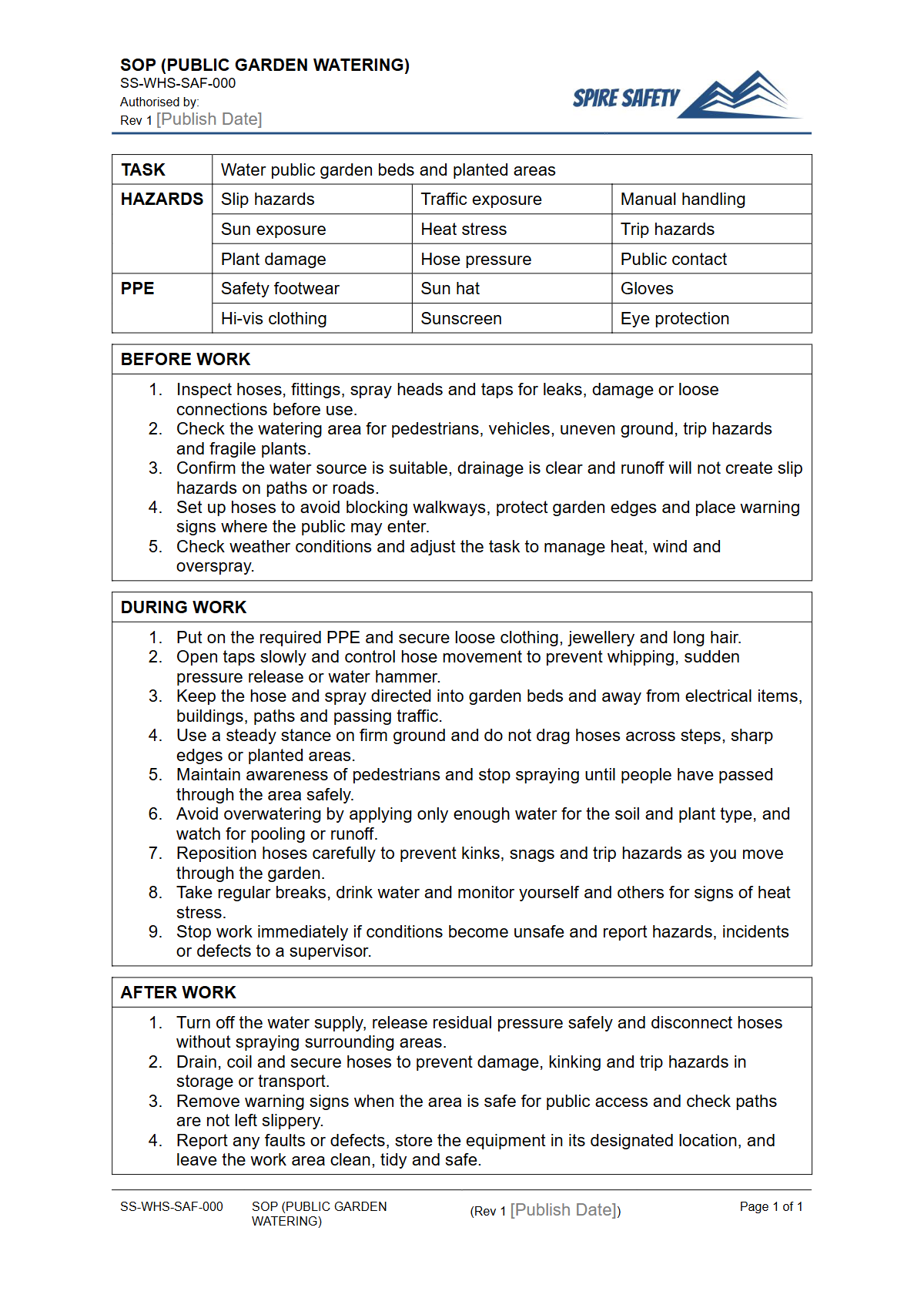
Download our free Safe Operating Procedure for public garden watering to formalise safety processes. This customisable template helps manage risks.
Free Safe Operating Procedure (Public Garden Watering) Template
DOCX • 126 KB + PDF
Updated Oct 2026
No signup required
Purpose of the Free Safe Operating Procedure (Public Garden Watering) Template
This Safe Operating Procedure (SOP) provides a structured framework for documenting the safe methods required for watering public gardens and landscaped areas. Public watering tasks, while seemingly simple, carry inherent risks such as slips, trips, and falls from wet surfaces and hoses, manual handling injuries from dragging heavy equipment, and hazards related to public interaction.
Using this free template helps your organisation formalise procedures, identify hazards, and implement effective risk controls. It is a vital component for demonstrating due diligence and forms part of broader WHS management systems.
By clearly outlining the step-by-step process, required personal protective equipment (PPE), and emergency procedures, this document assists in training workers and ensuring a consistent, safe approach to every job. It helps standardise behaviour and reduces the likelihood of incidents in public spaces.
Video walkthrough
How to use the Free Safe Operating Procedure (Public Garden Watering) Template
To get started, simply download the template in your preferred format (DOCX for easy editing or PDF). The document is designed as a comprehensive starting point aligned with Australian WHS principles.
However, it must be adapted to your specific operational context. This involves a review of your unique site conditions, the types of watering equipment used (e.g., handheld hoses, sprinklers, water trucks), and your organisation's specific safety protocols.
It's crucial to remember that this is a template, not a finished document. We've provided a solid framework, but you must customise it to reflect the specific equipment, environment, and procedures of your organisation.
This should be done in consultation with the workers who perform the task. For more complex site-specific tasks like installing new irrigation, you might also need documents like our trencher SOP to cover all activities.
When to use it
A Safe Operating Procedure for public garden watering should be integrated into your daily work systems. It is not a document to be filed away and forgotten. It should be readily accessible and used for:
- Inducting new groundskeepers, horticulturalists, or council workers.
- Providing specific training on watering tasks and associated hazards.
- Pre-start checks and toolbox talks before commencing work.
- Periodic reviews of workplace safety practices.
- Incident investigations to understand if procedures were followed.
Using the SOP consistently helps reinforce safe work habits and ensures all workers, including casual or temporary staff, understand the expected safety standards. It also provides a clear reference point during safety audits.
If your operations involve other material application tasks, you may also find our free Spreader SOP template useful for maintaining procedural consistency.
Who should use it
This template is designed for a range of personnel involved in grounds maintenance and workplace safety. Key users include:
- Groundskeepers and Horticulturalists: The primary operators who perform the watering tasks and need to follow the prescribed safe steps.
- Team Leaders and Supervisors: Responsible for ensuring their teams are trained on the SOP and adhere to it during daily operations.
- WHS/OHS Managers and Advisors: Professionals responsible for developing, implementing, and reviewing the organisation's safety management system. They will use this template as a base to create a site-specific, robust procedure.
- Council and Park Managers: Those with overall responsibility for the safety of public spaces and the workers who maintain them.
Whether you're looking to formalise existing processes or create new ones from scratch, this template provides a solid foundation. If the task involves supporting equipment, ensure you have procedures for that as well, such as an Air Compressor SOP for cleaning tools post-job.
If you need assistance tailoring this or other documents, our WHS consulting services can provide expert guidance. For more templates, feel free to browse our free WHS resources library.
Common mistakes
Common mistakes to avoid
- Leaving hoses across public pathways, creating a trip hazard for pedestrians.
- Failing to check the surrounding area for public presence before starting to spray.
- Using poor manual handling techniques to drag or carry heavy, water-filled hoses.
- Not wearing appropriate PPE, especially high-visibility clothing and non-slip footwear.
Legal references
Legal considerations
The following legal requirements may be relevant to this type of work.
- Work Health and Safety Act (Harmonised) — Provides the primary duties for protecting workers and other people from work health and safety risks.
- Work Health and Safety Regulations (Harmonised) — Sets out requirements supporting the management of workplace hazards and risks.
The following codes may be relevant to this type of work.
- Managing WHS Risks Code of Practice — Provides practical guidance on identifying hazards, assessing risks and applying effective controls.
- Work Health and Safety Consultation, Cooperation and Coordination Code of Practice — Provides practical guidance on consulting workers and coordinating with other duty holders.
- Managing the Work Environment and Facilities Code of Practice — Provides practical guidance on safe work environments, workplace facilities and related controls.
Did you know
The Weight of Water
A standard 25-metre, 19mm garden hose can weigh over 20 kilograms when full of water, creating a significant manual handling risk if workers are not trained in correct handling techniques.
Slip Statistics
Slips, trips, and falls are a leading cause of serious workplace injury claims in Australia. Wet, mossy, or uneven footpaths in public gardens are a prime location for such incidents to occur.
FAQ
Frequently asked questions
01What are the main hazards when watering public gardens?
02Does this SOP cover watering from a vehicle like a water truck?
03How often should a Safe Operating Procedure for watering be reviewed?
04Is a Safe Operating Procedure enough to ensure worker safety?
Share this resource
Free Safe Operating Procedure (Public Garden Watering) Template
Browse Categories
How To Use It
- 1Download and open in Word or PDF.
- 2Replace the placeholders with your business details.
- 3Get it reviewed by a WHS specialist before rollout.
Need it customised?
Our WHS consultants can adapt this template to your site, run a gap analysis, or audit what you already have in place.
Book a Free Consultation WHS consulting servicesor call 1300 156 382
Related templates
- Free Safe Operating Procedure (Public Toilet Servicing) Template
- Free Safe Operating Procedure (Pump Alignment) Template
- Free Safe Operating Procedure (Pump Impeller Change) Template
- Free Safe Operating Procedure (Pump Priming) Template
- Free Safe Operating Procedure (Pump Seal Change) Template
- Free Safe Operating Procedure (Pump Station Check) Template