
Free Safe Operating Procedure (Public Change Room Clean) Template
Download our free Safe Operating Procedure for cleaning public change rooms. This customisable template helps you outline step-by-step safety controls.
Free Safe Operating Procedure (Public Change Room Clean) Template
DOCX • 126 KB + PDF
Updated Oct 2026
No signup required
Purpose of the Free Safe Operating Procedure (Public Change Room Clean) Template
Cleaning public change rooms, while a routine task, exposes workers to a range of work health and safety risks. This includes slips, trips, and falls on wet floors; musculoskeletal injuries from manual tasks; exposure to hazardous cleaning chemicals; and contact with biological hazards.
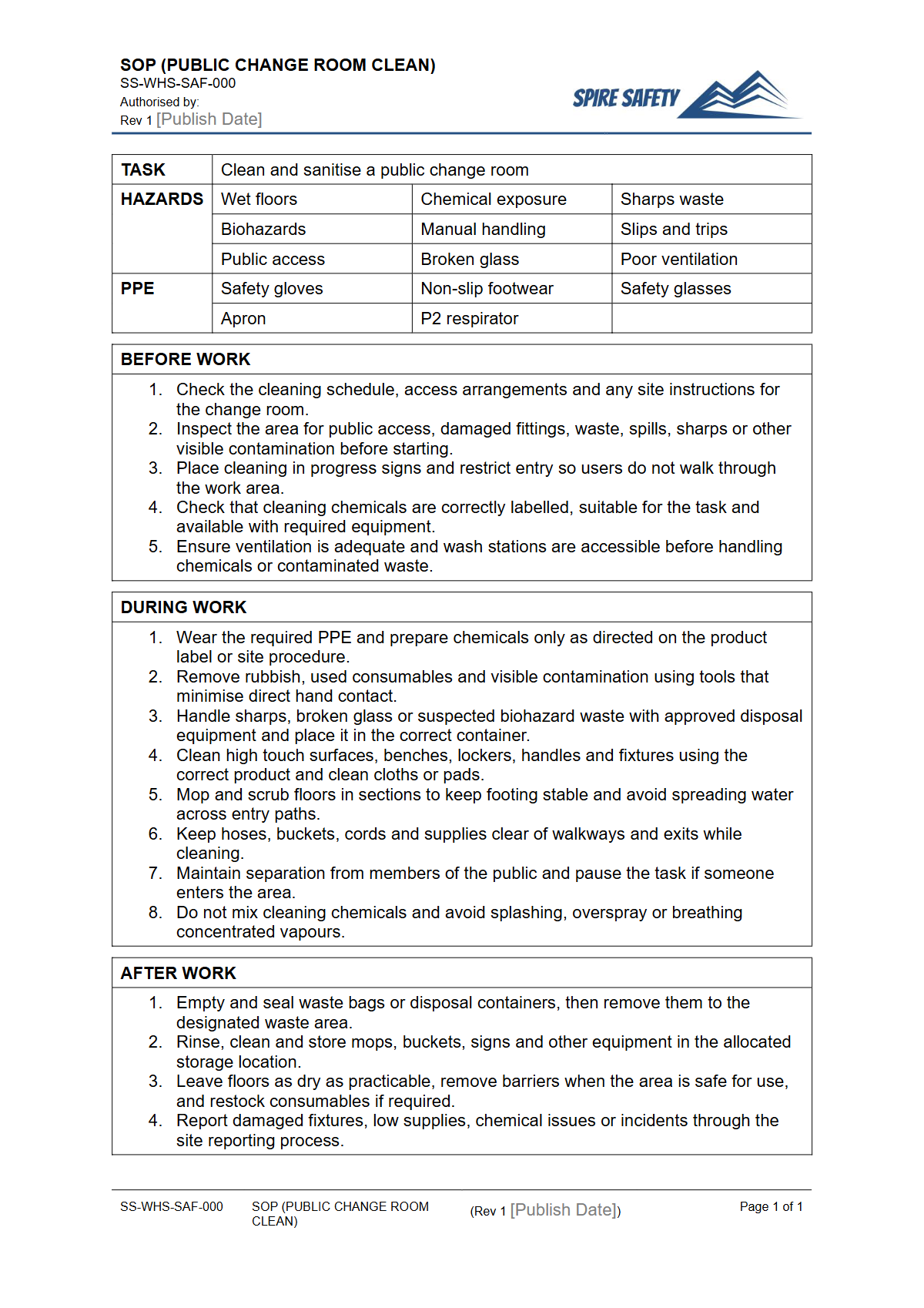
Our Free Safe Operating Procedure (Public Change Room Clean) Template provides a structured framework for documenting the safest way to perform this work. Formalising your cleaning process helps standardise safe work practices, assists in training new staff, and demonstrates a commitment to managing risks.
An effective SOP is a fundamental component of all comprehensive WHS management systems, ensuring that controls are clearly communicated and consistently applied.
Video walkthrough
How to use the Free Safe Operating Procedure (Public Change Room Clean) Template
This Safe Operating Procedure (Public Change Room Clean) template is provided as a starting point in both DOCX and PDF formats. Download the file and adapt it to the specific conditions of your workplace.
It is crucial to replace the generic placeholder text with details relevant to your site, including the exact names of cleaning chemicals used, locations of Safety Data Sheets (SDS), specific types of Personal Protective Equipment (PPE), and emergency procedures and contacts.
Important: This document is a template only. It must be customised by a competent person who understands the specific hazards of your workplace and the tasks involved.
We recommend a thorough review process to ensure the final SOP accurately reflects your operational environment. For assistance in tailoring this or other safety documents, consider engaging professional WHS consulting services.
Key Elements of a Change Room Cleaning SOP
A robust SOP for cleaning should be clear, concise, and easy for any worker to follow. It systematically breaks down the task to ensure all safety measures are addressed. Key sections to include are:
Pre-Operational Checks
Before any cleaning begins, workers should perform a series of safety checks. This includes erecting 'Cleaning in Progress' or 'Wet Floor' signs to warn others, ensuring the area is well-ventilated, gathering all necessary chemicals and equipment, and inspecting tools for any damage.
Workers should also don the correct PPE as specified in the SOP before handling any chemicals.
Step-by-Step Cleaning Process
This section outlines the cleaning sequence from start to finish. It should detail the safe method for each sub-task, such as:
- Emptying bins and disposing of waste safely.
- Applying, diluting, and using cleaning chemicals according to the manufacturer’s instructions and the relevant SDS.
- Wiping down surfaces like benches, lockers, and sinks.
- Cleaning toilets and showers.
- Mopping floors, often working from the furthest point back towards the exit to avoid walking on wet surfaces.
- Replenishing consumables like soap, paper towels, and toilet paper.
Post-Cleaning Procedures
Once the cleaning is complete, the SOP should guide the worker on how to finish safely. This involves cleaning and correctly storing all equipment, returning chemicals to a secure storage area, washing hands thoroughly, and conducting a final check of the area before removing safety signs.
Integrating with Other Procedures
A single workplace often requires multiple SOPs to cover its range of activities. This procedure for cleaning change rooms is just one example.
A venue like a recreation centre or hotel may also need task-specific procedures for its kitchen, requiring something like our deep fryer operation SOP to manage completely different hazards. Likewise, the facility maintenance team may need procedures for their tools and equipment, such as our free Air Compressor SOP. Using consistent formats across all your procedures helps build a cohesive and easy-to-understand safety system.
Review and Improvement
Safe Operating Procedures are not 'set and forget' documents. To remain effective, they must be reviewed regularly—typically on an annual basis or whenever there is a change in the workplace.
This includes the introduction of new equipment, new cleaning chemicals, or a change in the cleaning process itself. An SOP must also be reviewed after any incident or near miss. This process of review can be formalised through regular WHS compliance audits. You can explore more templates to build out your safety system in our extensive free WHS resources library.
Common mistakes
Common mistakes to avoid
- Using a generic template without customising it for site-specific hazards and chemicals.
- Failing to provide, train on, or enforce the use of correct Personal Protective Equipment (PPE).
- Neglecting to provide workers with access to Safety Data Sheets (SDS) for all chemicals used.
- Not updating the SOP after an incident or when a new cleaning product is introduced.
Legal references
Legal considerations
The following legal requirements may be relevant to this type of work.
- Work Health and Safety Act (Harmonised) — Provides the primary duties for protecting workers and other people from work health and safety risks.
- Work Health and Safety Regulations (Harmonised) — Sets out requirements supporting the management of workplace hazards and risks.
The following codes may be relevant to this type of work.
- Managing WHS Risks Code of Practice — Provides practical guidance on identifying hazards, assessing risks and applying effective controls.
- Work Health and Safety Consultation, Cooperation and Coordination Code of Practice — Provides practical guidance on consulting workers and coordinating with other duty holders.
- Managing the Work Environment and Facilities Code of Practice — Provides practical guidance on safe work environments, workplace facilities and related controls.
Did you know
Slips and Trips
According to Safe Work Australia, slips, trips, and falls are a leading cause of serious workplace injuries, with cleaning and property maintenance industries being particularly high-risk.
Chemical Safety
Never mix different cleaning chemicals, especially those containing bleach and ammonia. The combination can create toxic chloramine gas, which can cause severe respiratory damage.
FAQ
Frequently asked questions
01What are the main hazards when cleaning a public change room?
02How often should a Safe Operating Procedure for cleaning be reviewed?
03Is a Safe Work Method Statement (SWMS) required for cleaning change rooms?
04What training is needed to follow a change room cleaning SOP?
Share this resource
Free Safe Operating Procedure (Public Change Room Clean) Template
Browse Categories
How To Use It
- 1Download and open in Word or PDF.
- 2Replace the placeholders with your business details.
- 3Get it reviewed by a WHS specialist before rollout.
Need it customised?
Our WHS consultants can adapt this template to your site, run a gap analysis, or audit what you already have in place.
Book a Free Consultation WHS consulting servicesor call 1300 156 382
Related templates
- Free Safe Operating Procedure (Public Drain Cleaning) Template
- Free Safe Operating Procedure (Public Garden Watering) Template
- Free Safe Operating Procedure (Public Toilet Servicing) Template
- Free Safe Operating Procedure (Pump Alignment) Template
- Free Safe Operating Procedure (Pump Impeller Change) Template
- Free Safe Operating Procedure (Pump Priming) Template