
Free Safe Operating Procedure (Public Bin Collection) Template
Download our free Safe Operating Procedure for public bin collection to manage operational risks.
Free Safe Operating Procedure (Public Bin Collection) Template
DOCX • 126 KB + PDF
Updated Oct 2026
No signup required
Purpose of the Free Safe Operating Procedure (Public Bin Collection) Template
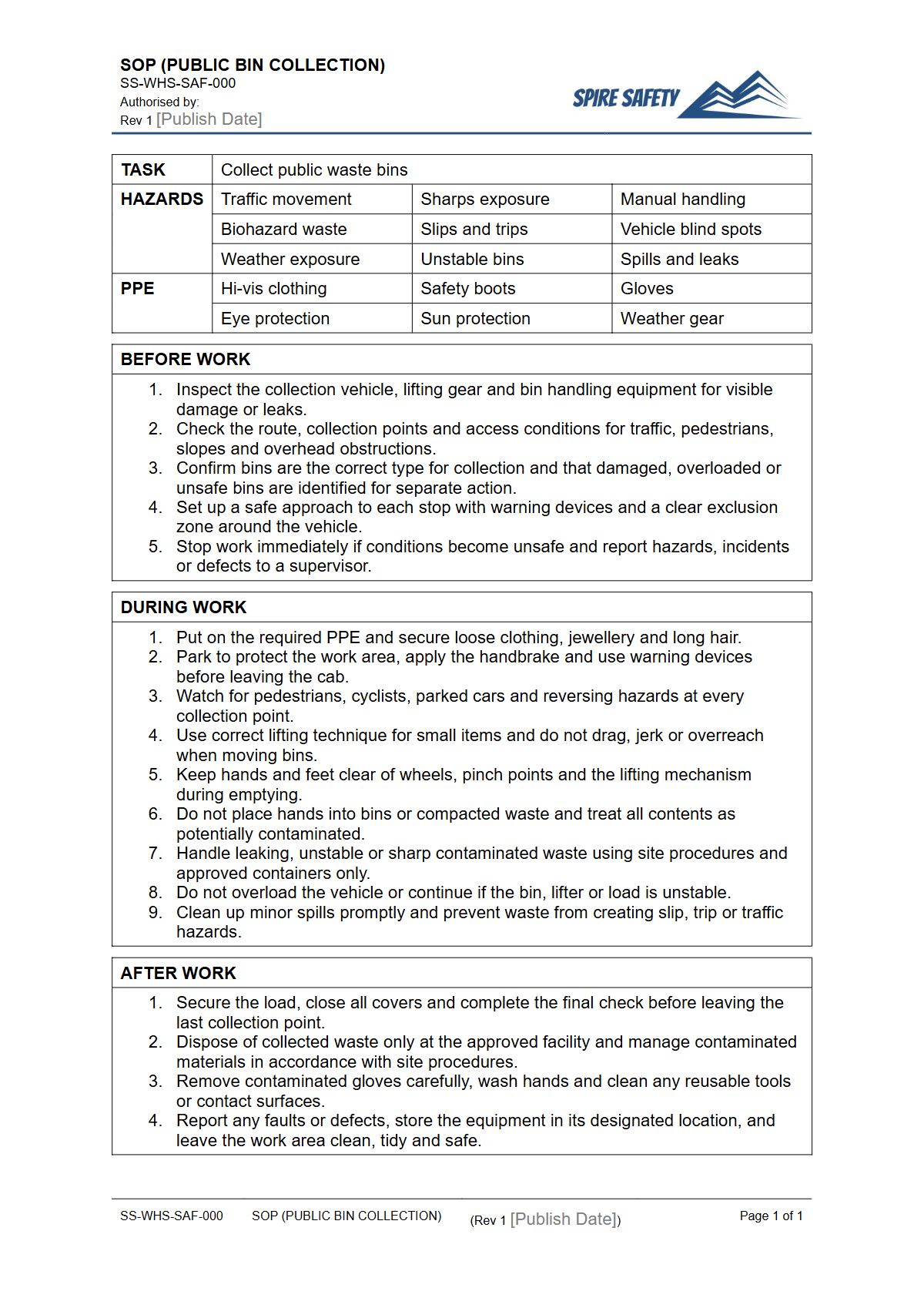
Public waste collection is an essential service that carries significant work health and safety risks. Our Free Safe Operating Procedure (Public Bin Collection) Template provides a structured framework for documenting the controls needed to protect your workers.
This task involves frequent exposure to hazards, including manual handling of heavy or awkward loads, interaction with traffic and the public, and potential contact with hazardous materials like sharps, chemicals, and biological waste.
A documented SOP helps standardise your approach to managing these risks. It outlines step-by-step instructions for tasks like emptying bins, replacing liners, operating collection vehicles, and managing spills.
By formalising these processes, you can reduce the likelihood of musculoskeletal disorders (MSDs) from improper lifting, traffic-related incidents, and injuries from hazardous waste. A clear SOP is a critical tool for demonstrating due diligence and fostering a proactive safety culture within your organisation.
The procedure also extends to the machinery used in the broader waste management cycle. While this SOP focuses on collection, the waste journey often involves larger equipment at transfer stations or sorting facilities.
For example, processes might involve the use of heavy machinery for which a specific FREE Telehandler SOP Template would be required to manage risks associated with lifting bulk waste containers.
Video walkthrough
How to use the Free Safe Operating Procedure (Public Bin Collection) Template
This template is available in both DOCX and PDF formats for your convenience. The DOCX file is fully editable, allowing you to tailor the content to your specific operational context.
We recommend downloading the Word version and working with your team—including operators and supervisors—to adapt the procedure.
To use the template effectively:
- Consult your team: Involve the workers who perform the task daily. Their firsthand experience is invaluable for identifying practical risks and effective controls.
- Customise for your site: Add details about your specific routes, bin types, collection vehicles, local traffic conditions, and emergency contacts.
- Review and approve: Once customised, the SOP should be reviewed and formally approved by a manager or Person Conducting a Business or Undertaking (PCBU).
- Train all relevant personnel: Ensure every worker who performs this task is trained on the contents of the finalised SOP.
Important: This document is a template only. You must customise it to reflect the specific equipment, environment, and risks present in your workplace.
We are not liable for any incidents that may arise from the use of this document.
Proper maintenance of collection vehicles and associated equipment is also a critical control. Procedures for cleaning equipment, often done with high-pressure tools, should also be documented.
For guidance on related equipment, you might find our Free Air Compressor SOP (Safe Operating Procedure) Template useful.
When to use it
A Safe Operating Procedure for public bin collection is not a document to be filed away and forgotten. It should be an active part of your daily operations and safety management system. Key times to use the SOP include:
- Worker Training and Induction: Use it as a foundational training document for new employees and for refresher training for existing staff.
- Pre-Start Meetings or Toolboxes: Refer to the SOP during daily briefings to highlight specific risks for the day's tasks, such as unusual weather or public events affecting a route.
- Risk Assessments: Use the steps outlined in the SOP as a baseline when conducting a WHS compliance audit or a specific risk assessment for the task.
- Incident Investigations: In the event of an incident or near miss, the SOP serves as a benchmark to determine if procedures were followed and whether they need to be updated.
Who should use it
This Safe Operating Procedure is intended for a range of personnel within an organisation responsible for public space management or waste services. The primary users are:
- Waste Collection Operators: The workers who physically perform the task must be thoroughly familiar with the SOP and follow it during their daily work.
- Supervisors and Team Leaders: They are responsible for ensuring operators understand and adhere to the SOP, providing training, and monitoring compliance.
- WHS Managers and Advisors: These professionals use the SOP to integrate the task into the broader WHS management system, ensuring it aligns with legal requirements and organisational policies.
- PCBUs (Persons Conducting a Business or Undertaking): Business owners and senior managers are ultimately responsible for providing a safe system of work, and a well-developed SOP is a key part of fulfilling that duty.
If you require other safety documents, our comprehensive free WHS resources library has a wide range of templates to support your operational needs.
Common mistakes
Common mistakes to avoid
- Using a generic template without customising it for specific routes, bin types, and local hazards.
- Failing to adequately train all workers on the finalised SOP, treating it as a 'tick-box' exercise.
- Not reviewing or updating the SOP after an incident, near miss, or change in work practice.
- Poor supervision, allowing workers to take shortcuts that bypass critical safety steps like correct lifting techniques.
Legal references
Legal considerations
The following legal requirements may be relevant to this type of work.
- Work Health and Safety Act (Harmonised) — Provides the primary duties for protecting workers and other people from work health and safety risks.
- Work Health and Safety Regulations (Harmonised) — Sets out requirements supporting the management of workplace hazards and risks.
The following codes may be relevant to this type of work.
- Managing WHS Risks Code of Practice — Provides practical guidance on identifying hazards, assessing risks and applying effective controls.
- Work Health and Safety Consultation, Cooperation and Coordination Code of Practice — Provides practical guidance on consulting workers and coordinating with other duty holders.
- Managing the Work Environment and Facilities Code of Practice — Provides practical guidance on safe work environments, workplace facilities and related controls.
Did you know
Manual Handling Risk
According to Safe Work Australia, the waste collection industry has one of the highest rates of serious claims for work-related injuries, with body stressing (manual handling) being a primary cause.
FAQ
Frequently asked questions
01What are the biggest WHS risks in public bin collection?
02How often should a Public Bin Collection SOP be reviewed?
03Is specific training required for collecting public bins?
04What PPE is essential for public bin collection?
Share this resource
Free Safe Operating Procedure (Public Bin Collection) Template
Browse Categories
How To Use It
- 1Download and open in Word or PDF.
- 2Replace the placeholders with your business details.
- 3Get it reviewed by a WHS specialist before rollout.
Need it customised?
Our WHS consultants can adapt this template to your site, run a gap analysis, or audit what you already have in place.
Book a Free Consultation WHS consulting servicesor call 1300 156 382
Related templates
- Free Safe Operating Procedure (Public Bin Emptying) Template
- Free Safe Operating Procedure (Public Change Room Clean) Template
- Free Safe Operating Procedure (Public Drain Cleaning) Template
- Free Safe Operating Procedure (Public Garden Watering) Template
- Free Safe Operating Procedure (Public Toilet Servicing) Template
- Free Safe Operating Procedure (Pump Alignment) Template