
Free Safe Operating Procedure (Public Bin Emptying) Template
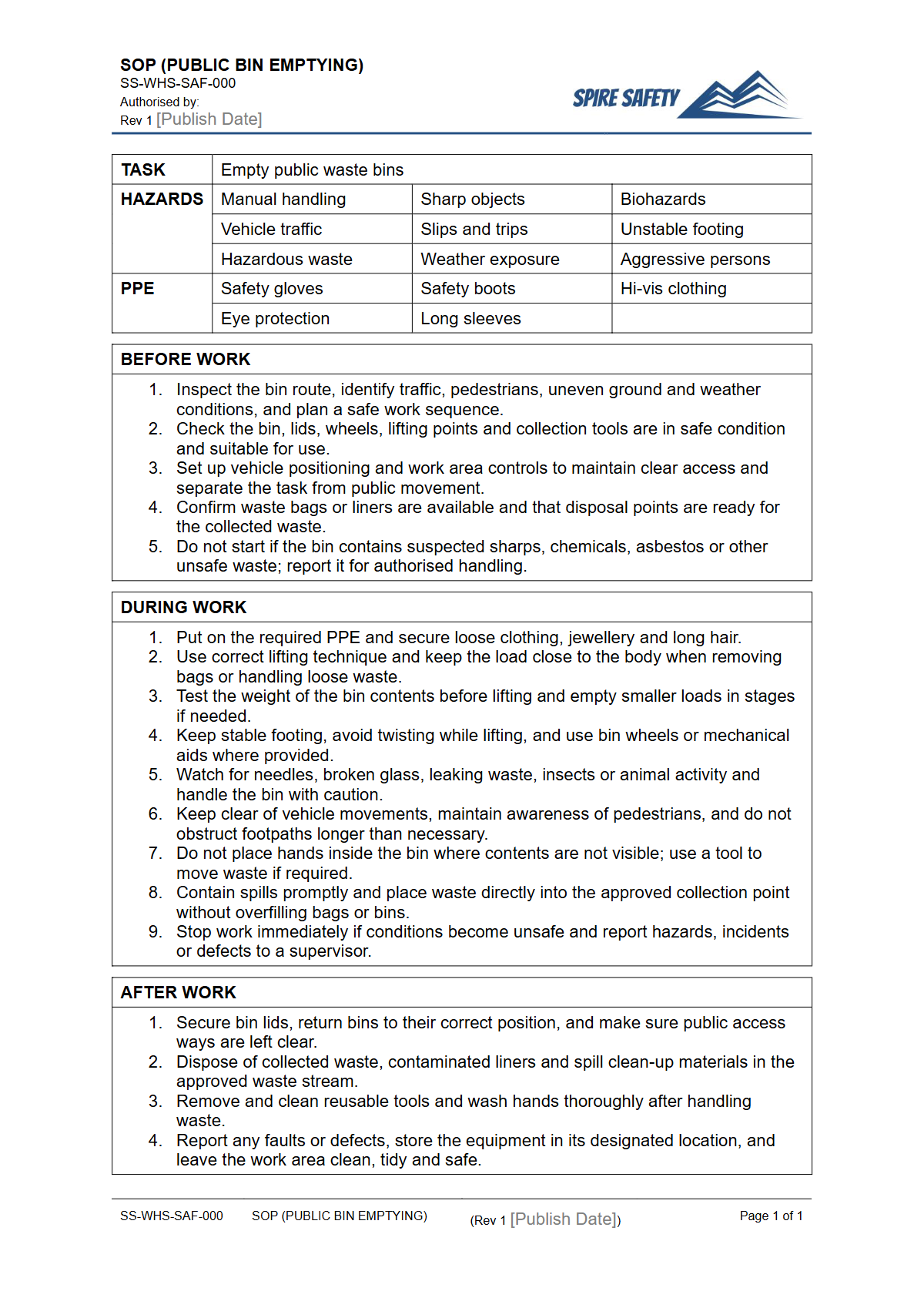
Download our free Safe Operating Procedure for public bin emptying. This customisable template helps you outline risks and controls for waste management tasks.
Free Safe Operating Procedure (Public Bin Emptying) Template
DOCX • 126 KB + PDF
Updated Oct 2026
No signup required
Purpose of the Free Safe Operating Procedure (Public Bin Emptying) Template
Effectively managing waste is a critical task for councils, facility managers, and public space operators. This Free Safe Operating Procedure (Public Bin Emptying) Template provides a structured starting point for documenting the risks and control measures associated with this common but hazardous manual task.
A well-defined SOP is a fundamental component of proactive safety management, helping your organisation meet its duty of care and reduce the likelihood of workplace injuries. It formalises the steps required to empty public bins safely, addressing hazards such as manual handling, sharps, biological waste, and environmental factors.
Integrating this procedure into your broader safety framework ensures consistency and provides a clear training resource for workers. Documented procedures are the backbone of effective WHS management systems, demonstrating a commitment to systematically managing risks.
This template helps you identify the specific PPE, pre-operational checks, and step-by-step processes needed to protect your team.
Video walkthrough
How to use the Free Safe Operating Procedure (Public Bin Emptying) Template
This document is a template, not a finished procedure. To be effective, you must customise it to reflect the specific hazards and operational realities of your workplace.
Download the DOCX file and consult with your team to identify the unique risks they face. This includes considering the types of bins used, the locations, the frequency of collection, and the equipment available for the task.
The goal is to create a practical document that workers will actually use.
Your customisation should be informed by a thorough risk assessment of the task. If you require assistance with this process, engaging expert support can ensure all relevant hazards are identified and controlled.
Professional WHS consulting can guide your team through developing site-specific procedures that are practical and aligned with Australian WHS practice. Once customised, the SOP should be used for training new workers and for regular refresher sessions with experienced staff.
Key Sections to Customise:
- Personal Protective Equipment (PPE): Specify the exact types of gloves (e.g., cut-resistant), safety glasses, footwear, and high-visibility clothing required.
- Pre-Operational Checks: Detail the inspection process for the area around the bin (e.g., checking for slip/trip hazards, unstable ground) and the collection vehicle or equipment.
- Step-by-Step Procedure: Break down the task into clear, sequential steps from approaching the bin to securing the new liner and disposing of the waste. Emphasise correct manual handling techniques for lifting and carrying.
- Emergency Procedures: Outline the specific steps to take in case of a sharps injury, exposure to hazardous substances, or other incidents.
While this SOP covers the manual task of emptying bins, your site may have other distinct processes. For example, some locations use machinery to assist with lifting larger skip bins, which would require its own documentation like our FREE Telehandler SOP Template.
When to use this Safe Operating Procedure
A Safe Operating Procedure for public bin emptying should be used every time the task is performed. It serves as a constant reference for the established safe work method.
It is particularly important during worker induction and training to establish safe behaviours from the outset. Furthermore, the SOP should be a key document referenced during toolbox talks or pre-start meetings, especially when conditions change (e.g., during large public events or adverse weather).
The procedure should also be reviewed and updated periodically. A review is necessary after any incident or near miss, when new equipment or types of bins are introduced, or if legislative requirements change.
Regular reviews are a core part of continuous improvement and can be integrated into your schedule of WHS compliance auditing to ensure ongoing effectiveness.
Who should use this SOP
This SOP is designed for any person conducting a business or undertaking (PCBU) whose workers perform waste collection from public bins. This includes local government and council workers, park maintenance staff, cleaning and facilities management contractors, and staff at event venues, shopping centres, and transport hubs. It should be used by:
- Workers: As a direct guide to performing their tasks safely.
- Supervisors and Team Leaders: To train workers, monitor safe work practices, and lead incident investigations.
- WHS Managers and Advisors: As a tool for risk management, training development, and demonstrating due diligence.
This template is one of many documents available to help your organisation build a comprehensive safety system. You can explore our complete free WHS resources library for other templates and guides to support your safety efforts across various operational tasks.
For organisations in different sectors, such as hospitality, it's important to have specific procedures for all common hazardous tasks. For instance, a commercial kitchen would require documents like a Free Safe Operating Procedure for a deep fryer in addition to general procedures like waste handling.
Common mistakes
Common mistakes to avoid
- Failing to inspect the area for slip, trip, or traffic hazards before starting.
- Using incorrect manual handling techniques, such as twisting the back while lifting.
- Not wearing or using the specified Personal Protective Equipment (PPE), especially puncture-resistant gloves.
- Neglecting to report sharps, hazardous materials, or overweight bins to a supervisor.
Legal references
Legal considerations
The following legal requirements may be relevant to this type of work.
- Work Health and Safety Act (Harmonised) — Provides the primary duties for protecting workers and other people from work health and safety risks.
- Work Health and Safety Regulations (Harmonised) — Sets out requirements supporting the management of workplace hazards and risks.
The following codes may be relevant to this type of work.
- Managing WHS Risks Code of Practice — Provides practical guidance on identifying hazards, assessing risks and applying effective controls.
- Work Health and Safety Consultation, Cooperation and Coordination Code of Practice — Provides practical guidance on consulting workers and coordinating with other duty holders.
- Managing the Work Environment and Facilities Code of Practice — Provides practical guidance on safe work environments, workplace facilities and related controls.
Did you know
Manual Handling Impact
According to Safe Work Australia, manual handling injuries are a leading cause of serious workers' compensation claims, accounting for approximately 40% of all such claims nationally.
FAQ
Frequently asked questions
01What are the main hazards when emptying public bins?
02How often should a Safe Operating Procedure for bin emptying be reviewed?
03What PPE is required for emptying public bins?
04Can I use this SOP template for commercial or industrial waste bins?
Share this resource
Free Safe Operating Procedure (Public Bin Emptying) Template
Browse Categories
How To Use It
- 1Download and open in Word or PDF.
- 2Replace the placeholders with your business details.
- 3Get it reviewed by a WHS specialist before rollout.
Need it customised?
Our WHS consultants can adapt this template to your site, run a gap analysis, or audit what you already have in place.
Book a Free Consultation WHS consulting servicesor call 1300 156 382
Related templates
- Free Safe Operating Procedure (Public Change Room Clean) Template
- Free Safe Operating Procedure (Public Drain Cleaning) Template
- Free Safe Operating Procedure (Public Garden Watering) Template
- Free Safe Operating Procedure (Public Toilet Servicing) Template
- Free Safe Operating Procedure (Pump Alignment) Template
- Free Safe Operating Procedure (Pump Impeller Change) Template