
Free Safe Operating Procedure (Pruning Waste Handling) Template
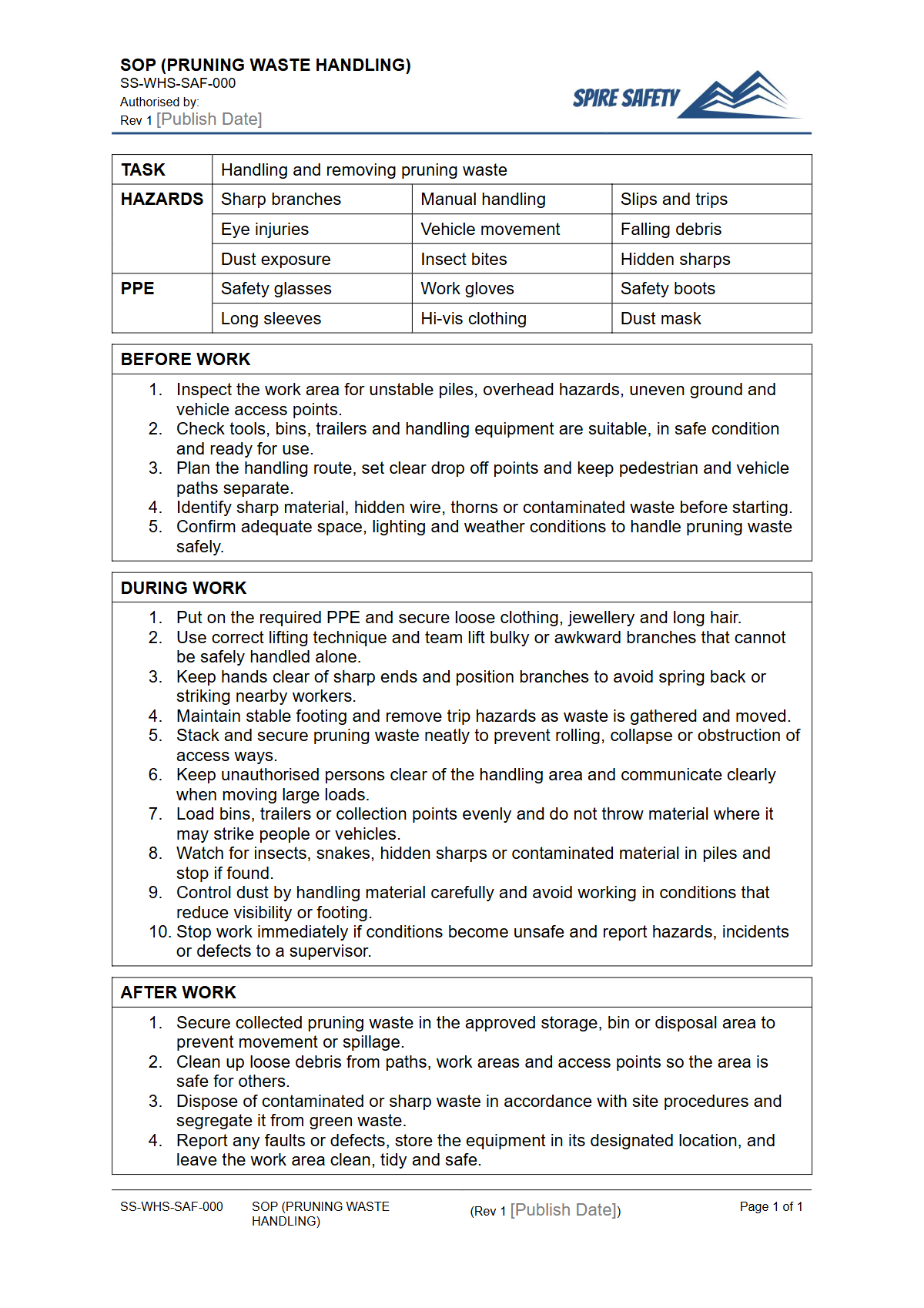
This Safe Operating Procedure template provides a framework for safely managing pruning waste. Download the DOCX or PDF to customise for your workplace.
Free Safe Operating Procedure (Pruning Waste Handling) Template
DOCX • 126 KB + PDF
Updated Oct 2026
No signup required
Purpose of the Free Safe Operating Procedure (Pruning Waste Handling) Template
Managing the waste generated from pruning activities presents numerous workplace hazards. This Free Safe Operating Procedure (Pruning Waste Handling) Template provides a structured starting point for organisations to document safe work practices.
It helps outline the step-by-step processes for collecting, processing, and disposing of green waste, addressing risks such as manual handling injuries, entanglement with machinery like wood chippers, and exposure to dust and biological hazards. Using a formalised SOP ensures all workers are aware of the expected safety standards and control measures required to perform their tasks safely.
A well-defined SOP is a critical component of a robust safety management system. It serves as a key training document for new and existing employees, ensuring consistent and safe work methods across all teams.
Implementing this procedure helps a Person Conducting a Business or Undertaking (PCBU) meet their primary duty of care under Australian WHS laws by proactively managing risks associated with grounds maintenance and arboricultural work. This SOP can be integrated into broader WHS management systems to demonstrate a commitment to workplace safety and continuous improvement.
Video walkthrough
How to use the Free Safe Operating Procedure (Pruning Waste Handling) Template
This document is available for download as a fully editable DOCX file and a print-ready PDF. The template is designed to be adapted to the specific needs of your operation.
It includes sections for detailing project information, identifying required Personal Protective Equipment (PPE), listing potential hazards, and providing a clear sequence of work steps from pre-operational checks to cleanup.
Important Note: This is a template, not a finished document. To be effective, you must customise it to reflect the specific equipment (e.g., chipper models, vehicles), personnel capabilities, and unique site conditions of your workplace.
We recommend that a competent person, such as a site supervisor or WHS manager, reviews and approves the final document before it is implemented. Regular reviews and updates are essential to keep the SOP current.
When to use this Safe Operating Procedure
A Safe Operating Procedure for handling pruning waste should be used as a primary reference tool before, during, and after any related task. It is essential for:
- Worker Training and Induction: Use the SOP to train new employees and contractors on the established safe methods for handling green waste.
- Pre-start Meetings: Review the SOP during toolbox talks or pre-start meetings to reinforce safety protocols and discuss any site-specific hazards.
- On-the-job Reference: Workers should have access to the SOP on-site to refer to if they are unsure about a particular step or safety requirement.
- Incident Investigations: The SOP provides a baseline for expected practice, which is invaluable when investigating why an incident or near-miss occurred.
For tasks that involve moving heavy loads of waste with machinery, referencing a specific equipment SOP is also crucial. For example, if a telehandler is used for loading, workers must also follow the FREE Telehandler SOP Template to manage associated risks.
Who should use this Safe Operating Procedure
This SOP is intended for a wide range of personnel involved in landscaping, arboriculture, grounds maintenance, and agriculture. Key users include:
- Groundskeepers and Gardeners: The primary users who perform the physical tasks of collecting and processing pruning waste.
- Arborists: Professionals who generate large volumes of green waste and often use specialised machinery like wood chippers.
- Site Supervisors and Team Leaders: Responsible for ensuring their teams follow the documented procedures and work safely.
- WHS Managers and Advisors: Use the SOP as part of the overall safety framework and for conducting inspections and audits. To ensure procedures like this are effectively implemented, organisations can benefit from periodic WHS compliance auditing.
If waste processing involves breaking down larger branches before chipping, it is wise to also have procedures for the tools used. You can adapt our FREE Circular Saw SOP Template for any powered saws used in this process.
Similarly, if waste is being processed into mulch for distribution, a FREE Spreader SOP (Safe Operating Procedure) Template can guide the safe operation of associated machinery. You can find these and more templates in our free WHS resources library.
Common mistakes
Common mistakes to avoid
- Failing to assess the weight and stability of green waste before lifting.
- Operating wood chippers without ensuring all guards and emergency stops are functional.
- Not wearing appropriate PPE, especially high-impact eye and hearing protection.
- Leaving waste piles in areas that create trip hazards or obstruct emergency access routes.
Legal references
Legal considerations
The following legal requirements may be relevant to this type of work.
- Work Health and Safety Act (Harmonised) — Provides the primary duties for protecting workers and other people from work health and safety risks.
- Work Health and Safety Regulations (Harmonised) — Sets out requirements supporting the management of workplace hazards and risks.
The following codes may be relevant to this type of work.
- Managing WHS Risks Code of Practice — Provides practical guidance on identifying hazards, assessing risks and applying effective controls.
- Work Health and Safety Consultation, Cooperation and Coordination Code of Practice — Provides practical guidance on consulting workers and coordinating with other duty holders.
- Managing the Work Environment and Facilities Code of Practice — Provides practical guidance on safe work environments, workplace facilities and related controls.
Did you know
Manual Handling Risk
Incorrectly lifting and carrying green waste is a leading cause of musculoskeletal injuries in the horticulture and landscaping industries in Australia.
Chipper Dangers
The Australian Work Health and Safety Strategy 2023-2033 identifies working with machinery, including wood chippers, as a key area for reducing workplace injuries and fatalities.
FAQ
Frequently asked questions
01What should be included in an SOP for pruning waste handling?
02Is using a wood chipper a high-risk activity?
03How often should this Safe Operating Procedure be reviewed?
04Can this template be used for commercial landscaping businesses?
Share this resource
Free Safe Operating Procedure (Pruning Waste Handling) Template
Browse Categories
How To Use It
- 1Download and open in Word or PDF.
- 2Replace the placeholders with your business details.
- 3Get it reviewed by a WHS specialist before rollout.
Need it customised?
Our WHS consultants can adapt this template to your site, run a gap analysis, or audit what you already have in place.
Book a Free Consultation WHS consulting servicesor call 1300 156 382
Related templates
- Free Safe Operating Procedure (Public Bin Collection) Template
- Free Safe Operating Procedure (Public Bin Emptying) Template
- Free Safe Operating Procedure (Public Change Room Clean) Template
- Free Safe Operating Procedure (Public Drain Cleaning) Template
- Free Safe Operating Procedure (Public Garden Watering) Template
- Free Safe Operating Procedure (Public Toilet Servicing) Template