
Free Safe Operating Procedure (Propeller Safety) Template
Effectively manage propeller-related hazards in your workplace with our comprehensive template. Download your free Propeller Safety SOP in DOCX today.
Free Safe Operating Procedure (Propeller Safety) Template
DOCX • 126 KB + PDF
Updated Oct 2026
No signup required
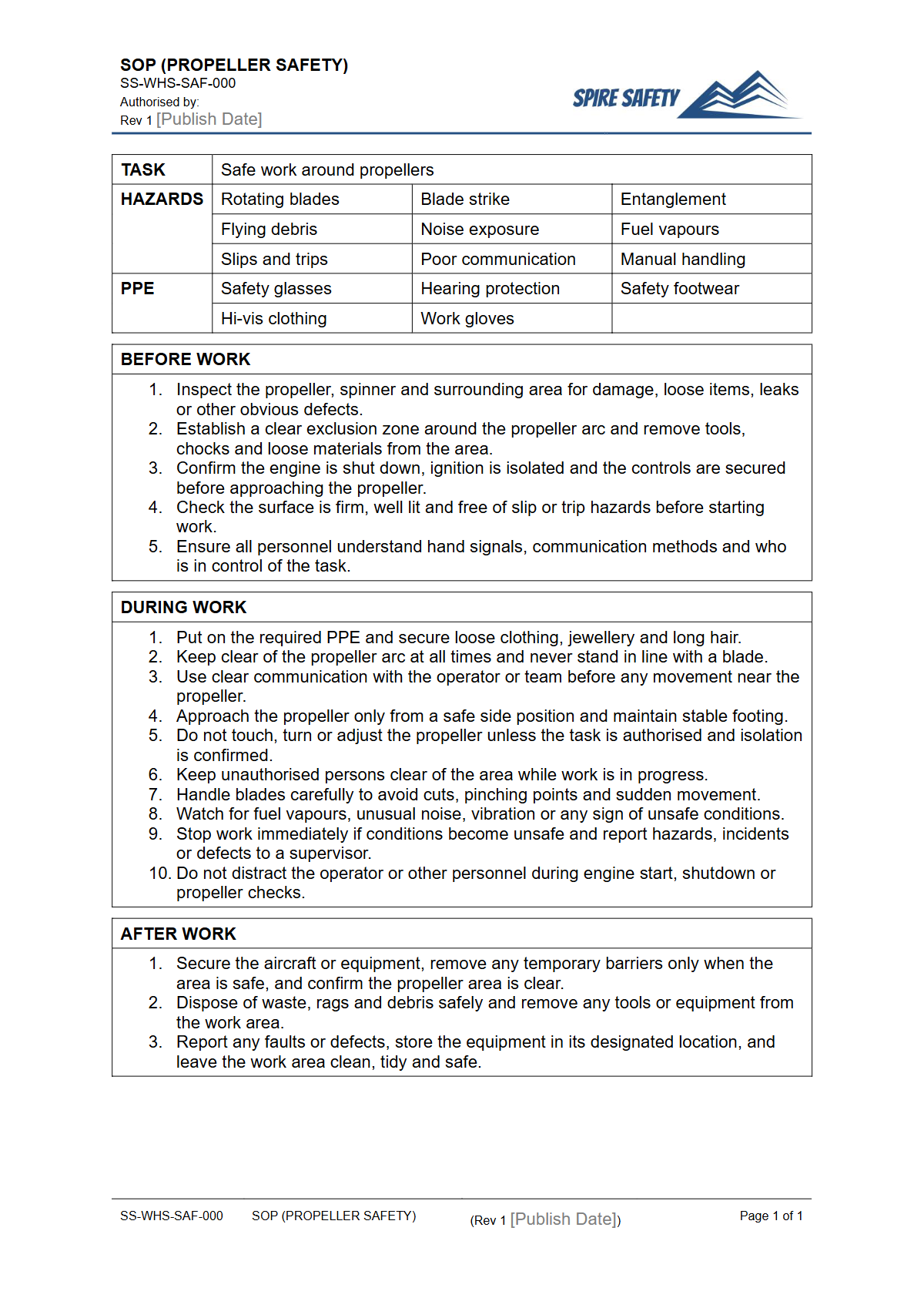
Purpose of the Free Safe Operating Procedure (Propeller Safety) Template
This Free Safe Operating Procedure (Propeller Safety) Template provides a structured starting point for documenting the safe use of equipment with propellers in your workplace. Propellers, whether on boats, aircraft, fans, or agricultural machinery, present significant risks, including severe impact injuries, entanglement, and hazards from projectiles.
A documented SOP is a critical tool for any Person Conducting a Business or Undertaking (PCBU) to meet their primary duty of care under WHS legislation. It formalises step-by-step instructions for performing tasks safely, helping to ensure all workers follow a consistent, risk-assessed process.
Implementing a clear SOP helps control risks by outlining specific requirements for pre-start checks, operation, shutdown, and maintenance. This process is a fundamental part of a proactive approach to safety, moving beyond simple hazard identification to the practical application of control measures.
By using this template, you can systematically address potential hazards and ensure that all necessary safety protocols, such as the use of personal protective equipment (PPE) and the establishment of exclusion zones, are clearly communicated and understood by all relevant personnel.
Video walkthrough
How to use the Free Safe Operating Procedure (Propeller Safety) Template
This SOP template is provided in a fully editable DOCX format, allowing for complete customisation to your specific operational needs. To use it effectively, you must identify the unique hazards associated with your equipment and workplace.
This involves conducting a thorough risk assessment and consulting with operators and other workers who interact with the machinery. The template includes sections for outlining potential hazards, required controls, PPE, and step-by-step procedures for all phases of operation.
Please note: This document is a template and must be customised to the specific machinery, environment, and tasks at your workplace. We are not responsible for the outcomes of any customisation.
Your final document should reflect a detailed analysis of your site-specific conditions. Just as procedures for a fixed air compressor SOP differ from those for mobile plant, your propeller SOP must be tailored to its unique context.
Once customised, the SOP should be used as a key training resource for new and existing employees and be readily available at the point of use.
When to use it
A Safe Operating Procedure for propeller safety should be integrated into your daily operations and formalised within your broader safety framework. It is not a document to be filed away; it is an active tool used for training, task planning, and incident investigation.
It should be referenced during worker inductions, refresher training, and whenever a task involving the propeller is about to commence. The SOP is particularly vital before, during, and after high-risk activities such as maintenance, cleaning, or when operating in close proximity to other people or structures.
Furthermore, the SOP serves as a foundational document for your overall WHS management systems. It provides clear, actionable guidance that supports a culture of safety and demonstrates a systematic approach to risk management. Regular reviews of the SOP, especially after an incident or near-miss, or when new equipment is introduced, ensure it remains relevant and effective in preventing harm.
Who should use it
This SOP is intended for a range of personnel within an organisation. Primarily, it is for the operators of the equipment, who must understand and follow the specified procedures to ensure their own safety and the safety of others.
Supervisors and managers should use the SOP to enforce safety standards, conduct safety observations, and deliver training. They are responsible for ensuring workers are competent and that the procedures outlined in the SOP are being followed correctly.
WHS managers and safety officers will also use the SOP as a key part of their safety toolkit. It serves as a benchmark during safety inspections and is a critical piece of evidence during any WHS compliance auditing activities.
The development and review process should also involve consultation with the workers who perform the tasks, as their direct experience is invaluable for creating a practical and effective procedure. This collaborative approach ensures the final SOP is both compliant and workable.
For other examples of machine-specific procedures, you can explore our free WHS resources library for templates on different types of plant and equipment.
Key Elements of an Effective Propeller Safety SOP
To ensure your SOP is robust, make certain it clearly defines several key areas. It must specify the mandatory PPE, such as high-visibility clothing, safety footwear, and eye or hearing protection.
It should detail the process for establishing and maintaining exclusion zones around the propeller's arc of rotation. Procedures for energy isolation, including lockout/tagout (LOTO), are non-negotiable for any maintenance or cleaning task to prevent unexpected start-up.
The SOP should also reference specific training and competency requirements needed to operate the equipment safely. Documenting these elements transforms a basic checklist into a powerful risk control measure, similar to the detailed steps found in a Conveyer System SOP where guarding and isolation are paramount.
Common mistakes
Common mistakes to avoid
- Failing to establish and clearly mark exclusion zones around the propeller's path.
- Neglecting pre-start inspections of the propeller, guards, and safety decals.
- Performing maintenance or cleaning without following proper lockout/tagout procedures.
- Assuming operators understand the risks without providing formal, documented training on the SOP.
Legal references
Legal considerations
The following legal requirements may be relevant to this type of work.
- Work Health and Safety Act (Harmonised) — Provides the primary duties for protecting workers and other people from work health and safety risks.
- Work Health and Safety Regulations (Harmonised) — Sets out requirements supporting the management of workplace hazards and risks.
The following codes may be relevant to this type of work.
- Managing WHS Risks Code of Practice — Provides practical guidance on identifying hazards, assessing risks and applying effective controls.
- Work Health and Safety Consultation, Cooperation and Coordination Code of Practice — Provides practical guidance on consulting workers and coordinating with other duty holders.
- Managing the Work Environment and Facilities Code of Practice — Provides practical guidance on safe work environments, workplace facilities and related controls.
Did you know
Vortex Speed
The air or water spinning off the tips of a propeller can form a powerful vortex. In some high-performance aircraft, these tip vortices can rotate at speeds of up to 300 kilometres per hour.
FAQ
Frequently asked questions
01What are the main hazards associated with propellers?
02Who is responsible for developing a Safe Operating Procedure?
03How often should an SOP for propeller safety be reviewed?
04Does this template cover both marine and aviation propellers?
Share this resource
Free Safe Operating Procedure (Propeller Safety) Template
Browse Categories
How To Use It
- 1Download and open in Word or PDF.
- 2Replace the placeholders with your business details.
- 3Get it reviewed by a WHS specialist before rollout.
Need it customised?
Our WHS consultants can adapt this template to your site, run a gap analysis, or audit what you already have in place.
Book a Free Consultation WHS consulting servicesor call 1300 156 382
Related templates
- Free Safe Operating Procedure (Pruning Shears) Template
- Free Safe Operating Procedure (Pruning Waste Handling) Template
- Free Safe Operating Procedure (Public Bin Collection) Template
- Free Safe Operating Procedure (Public Bin Emptying) Template
- Free Safe Operating Procedure (Public Change Room Clean) Template
- Free Safe Operating Procedure (Public Drain Cleaning) Template