
Free Safe Operating Procedure (Proofing Cabinet) Template
Manage the risks of commercial proofing cabinets with our free Safe Operating Procedure template. Download our customisable DOCX and PDF to start today.
Free Safe Operating Procedure (Proofing Cabinet) Template
DOCX • 126 KB + PDF
Updated Oct 2026
No signup required
Purpose of the Free Safe Operating Procedure (Proofing Cabinet) Template
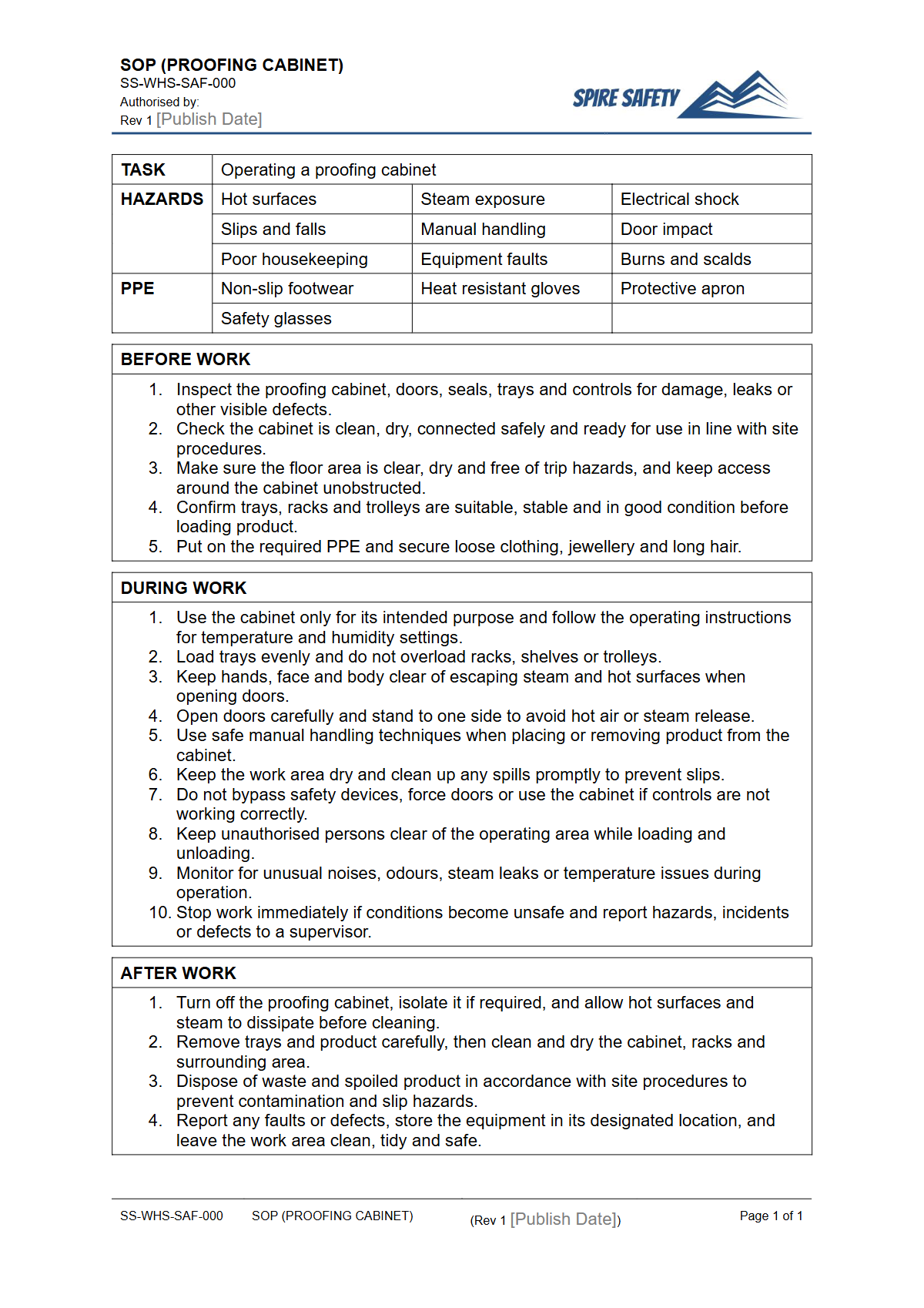
Operating a proofing cabinet involves specific hazards, including heat, steam, electricity, and manual handling. This Free Safe Operating Procedure (Proofing Cabinet) Template provides a structured framework to help you document the safest way to perform this task in your workplace.
A well-drafted SOP is a critical tool for managing risks, ensuring consistent operational standards, and demonstrating your commitment to work health and safety. It acts as a key training document for new employees and a reference for experienced staff, reducing the likelihood of incidents, injuries, and equipment damage.
By formally documenting procedures, you create a clear standard for performance and safety. This process helps to identify potential hazards that may have been overlooked in day-to-day operations.
Implementing SOPs for all key equipment is a foundational part of a robust safety framework, similar to how our deep fryer operation template addresses hazards in another common piece of kitchen equipment.
Video walkthrough
How to use the Free Safe Operating Procedure (Proofing Cabinet) Template
This template is designed as a starting point. To make it effective, you must customise it to reflect the specific proofing cabinet model you use and the unique environment of your bakery, kitchen, or facility.
Download the DOCX file and begin by consulting with the workers who actually operate the equipment. Their direct experience is invaluable for identifying practical steps and potential risks.
Customisation Steps:
- Review and Edit: Go through each section and replace the placeholder text with details relevant to your specific machinery and workplace rules. Include the make and model of the proofing cabinet.
- Incorporate Feedback: Discuss the draft with your team. Ask questions like, “Does this reflect how we actually work?” and “Are there any steps or warnings missing?”
- Add Specifics: Include details on pre-operational checks, specific temperature and humidity settings, loading/unloading techniques for your trolleys or trays, and the exact shutdown sequence.
- Finalise and Train: Once finalised, ensure all relevant workers are trained on the SOP. Keep a copy easily accessible near the equipment.
Please note: This document is a template only. We are not WHS consultants, and you are responsible for ensuring the final, customised document is suitable for your business needs and manages all identified risks. An SOP is a single document within a larger safety framework; for guidance on building a complete safety system, consider a consultation on WHS management systems.
When to use it
A Safe Operating Procedure for a proofing cabinet should be used consistently as a core part of your daily operations. It is not a document to be filed away and forgotten.
Specifically, it should be consulted or used during staff onboarding and training to ensure new team members understand the correct, safe method from day one. It also serves as the basis for regular refresher training to prevent complacency among long-term employees.
Furthermore, the SOP should be a key reference document when conducting workplace inspections or safety observations. After any incident or near miss involving the proofing cabinet, the SOP must be reviewed and updated to incorporate any learnings and prevent a recurrence. This continuous review process is a vital component of proactive safety management and is often a focus during a WHS compliance audit.
Who should use it
This template is intended for anyone responsible for safety in a commercial food preparation environment. This includes WHS Managers, Health and Safety Representatives (HSRs), supervisors, and business owners in sectors like hospitality, baking, and food manufacturing.
Line managers and supervisors will find it essential for training their teams and monitoring safe work practices on the floor.
Effectively managing plant and equipment risks is a crucial responsibility for any PCBU (Person Conducting a Business or Undertaking). This SOP provides a practical tool to help meet that duty of care for a specific piece of equipment.
The principles can be applied across your entire plant register, whether you're documenting procedures for a proofing cabinet or an air compressor SOP for a maintenance workshop. You can explore our complete free WHS resources library for more templates to support your safety system.
Common mistakes
Common mistakes to avoid
- Using a generic SOP without customising it for the specific proofing cabinet model.
- Failing to adequately train all relevant workers on the contents of the final SOP.
- Not including procedures for cleaning, maintenance, and fault reporting.
- Forgetting to review and update the SOP after an incident or when processes change.
Legal references
Legal considerations
The following legal requirements may be relevant to this type of work.
- Work Health and Safety Act (Harmonised) — Provides the primary duties for protecting workers and other people from work health and safety risks.
- Work Health and Safety Regulations (Harmonised) — Sets out requirements supporting the management of workplace hazards and risks.
The following codes may be relevant to this type of work.
- Managing WHS Risks Code of Practice — Provides practical guidance on identifying hazards, assessing risks and applying effective controls.
- Work Health and Safety Consultation, Cooperation and Coordination Code of Practice — Provides practical guidance on consulting workers and coordinating with other duty holders.
- Managing the Work Environment and Facilities Code of Practice — Provides practical guidance on safe work environments, workplace facilities and related controls.
Did you know
The Science of Proofing
A proofing cabinet creates the perfect warm and humid environment (typically 27–49°C with 80-85% humidity) to activate yeast, causing dough to rise effectively before baking. This controlled climate is essential for consistent product quality in commercial bakeries.
Kitchen Hazards
According to Safe Work Australia, the hospitality industry has a high rate of workplace injury. Slips, trips, and falls are the most common cause, but burns from hot equipment, oil, or steam are also a significant risk.
FAQ
Frequently asked questions
01What hazards are associated with a proofing cabinet?
02Is a Safe Operating Procedure a legal requirement in Australia?
03How often should I review my Proofing Cabinet SOP?
04Can I use this template for other kitchen equipment?
Share this resource
Free Safe Operating Procedure (Proofing Cabinet) Template
Browse Categories
How To Use It
- 1Download and open in Word or PDF.
- 2Replace the placeholders with your business details.
- 3Get it reviewed by a WHS specialist before rollout.
Need it customised?
Our WHS consultants can adapt this template to your site, run a gap analysis, or audit what you already have in place.
Book a Free Consultation WHS consulting servicesor call 1300 156 382
Related templates
- Free Safe Operating Procedure (Propeller Safety) Template
- Free Safe Operating Procedure (Pruning Shears) Template
- Free Safe Operating Procedure (Pruning Waste Handling) Template
- Free Safe Operating Procedure (Public Bin Collection) Template
- Free Safe Operating Procedure (Public Bin Emptying) Template
- Free Safe Operating Procedure (Public Change Room Clean) Template