
Free Safe Operating Procedure (Produce Washing Setup) Template
Establish clear, safe work instructions for your produce washing station with our customisable template. Download your free Safe Operating Procedure today.
Free Safe Operating Procedure (Produce Washing Setup) Template
DOCX • 126 KB + PDF
Updated Oct 2026
No signup required
Purpose of the Free Safe Operating Procedure (Produce Washing Setup) Template
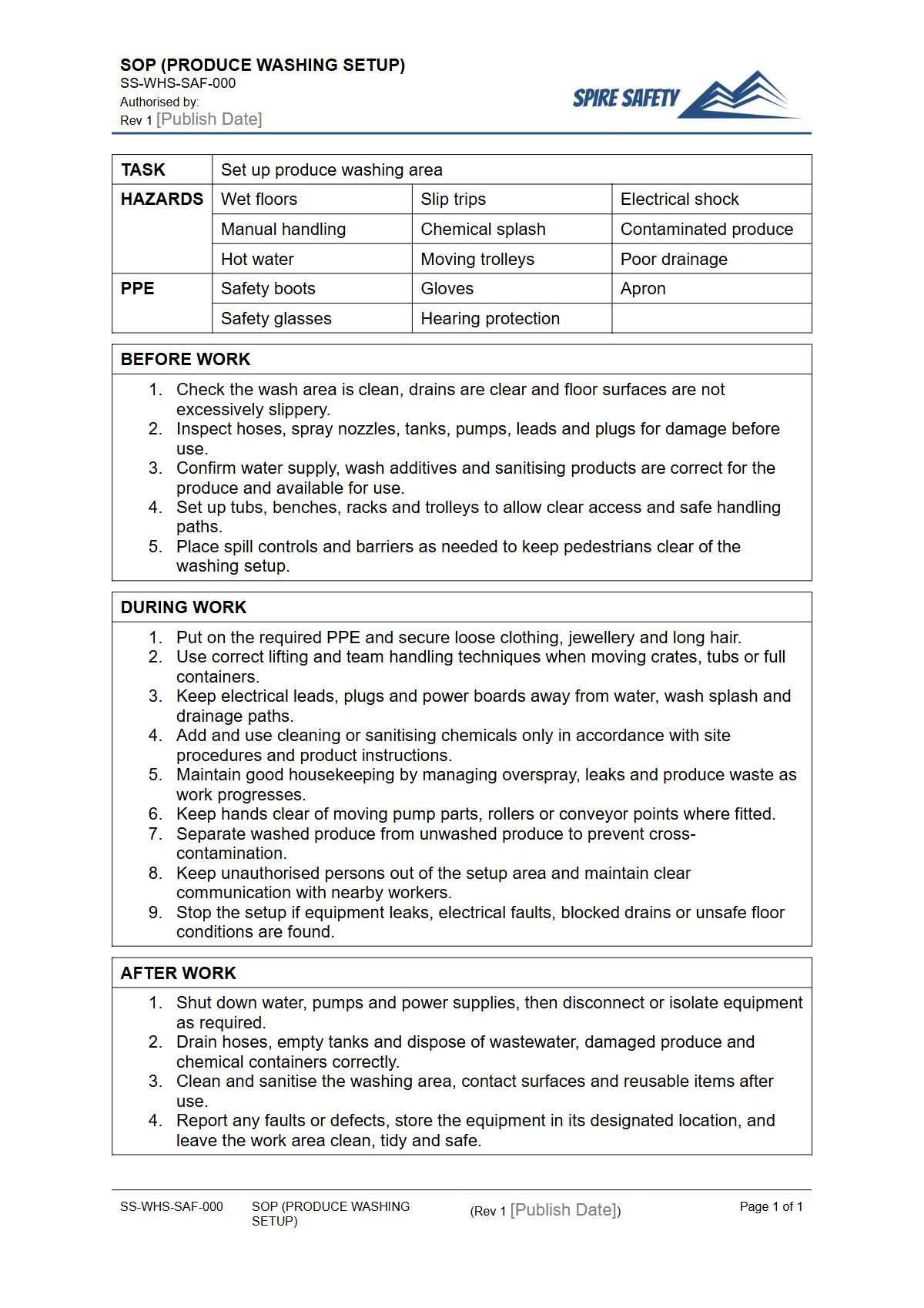
Operating a produce washing setup, whether in a large-scale agricultural facility, a commercial kitchen, or a food processing plant, involves specific health and safety risks. This Free Safe Operating Procedure (Produce Washing Setup) Template provides a structured starting point for documenting the required steps to perform this task safely.
It helps organisations standardise their process, manage hazards, and ensure workers are protected from injury or illness. The SOP guides users in controlling risks such as biological contamination, chemical exposure from sanitisers, ergonomic strains from manual handling, and slip hazards from wet floors.
By implementing a clear Safe Operating Procedure, you formalise your commitment to a safe system of work. This document is a critical component for worker training, inductions, and ongoing competency management.
It serves as a foundation for consistent, safe work practices, helping to minimise incidents and support your broader safety objectives. It is designed to be integrated into larger WHS management systems, providing operational detail for your risk management framework.
Video walkthrough
How to use the Free Safe Operating Procedure (Produce Washing Setup) Template
This resource is provided in both DOCX and PDF formats for your convenience. The DOCX file is fully editable, allowing you to tailor the content directly to the specific equipment, chemicals, layout, and processes used in your workplace.
A generic template cannot account for all site-specific variables, so customisation is essential for effectiveness and compliance.
Important: We have based this document on the model WHS framework and common industry practices, but it is a template only. You must consult with your workers and adapt the content to reflect the actual hazards and control measures relevant to your operations.
This includes adding machine-specific instructions, emergency procedures, and specifying the personal protective equipment (PPE) required. For operations involving mechanical aids, you may also need to reference a specific Conveyer System SOP.
When to use a Safe Operating Procedure
A Safe Operating Procedure for a produce washing setup should be used consistently as part of your daily operations. It is not a document to be filed away and forgotten. Key times to use the SOP include:
- Worker Training and Induction: Use the SOP as the primary training document for any new worker assigned to the produce washing task.
- Pre-operational Checks: The procedure should outline daily or pre-start checks that operators must perform on the equipment and work area.
- Supervision and Monitoring: Supervisors can use the SOP as a checklist to verify that the task is being performed correctly and safely.
- Incident Investigation: If an incident or near miss occurs, the SOP can be reviewed to determine if the documented procedure was followed and if it needs revision.
- Risk Assessment Reviews: The SOP should be reviewed and updated whenever a risk assessment is reviewed, or when changes are made to the equipment, chemicals, or process. Regular reviews are also a key part of successful WHS compliance audits.
Who should use this document
This Safe Operating Procedure is intended for use by several key roles within an organisation to ensure a comprehensive approach to safety:
- Persons Conducting a Business or Undertaking (PCBUs): To meet their primary duty of care by providing safe systems of work.
- Managers and Supervisors: To train workers, enforce safe practices, and oversee the produce washing process.
- WHS/HSE Professionals: To integrate the procedure into the overall safety management system and use it as a tool for risk management.
- Workers: As a clear, step-by-step guide on how to perform their tasks safely and correctly, minimising their exposure to hazards.
The process of customising this SOP is also a valuable opportunity for consultation with your team, ensuring the final document is practical, accurate, and understood by those who will use it most. For other food preparation tasks, you might adapt a similar process using our free deep fryer SOP template as a guide.
Key Hazards in Produce Washing
When customising your SOP, pay close attention to the specific hazards present in your setup. Common risks include:
- Biological Hazards: Cross-contamination from raw produce to ready-to-eat foods, or pathogen growth in the washing water or on equipment surfaces.
- Chemical Hazards: Incorrect dilution or handling of cleaning chemicals and sanitisers, leading to skin irritation, respiratory issues, or food contamination.
- Ergonomic Hazards: Repetitive movements, awkward postures while loading or unloading produce, and manual handling of heavy crates can lead to musculoskeletal injuries.
- Physical Hazards: Slips, trips, and falls on wet floors are a significant risk. Entanglement in moving parts of automated washing lines or conveyors is another serious hazard.
In broader agricultural settings, a produce washing station is just one part of the process. You may need to document procedures for other machinery, such as an SOP for a spreader, to ensure safety across all farm operations.
This holistic view ensures that risks are managed at every stage. You can find more templates like this in our free WHS resources library.
Common mistakes
Common mistakes to avoid
- Using incorrect concentrations of sanitising chemicals, rendering them ineffective or creating a food safety hazard.
- Failing to regularly clean and sanitise the washing equipment itself, allowing biofilm and pathogens to accumulate.
- Neglecting ergonomic risks, such as repetitive lifting from low crates or over-reaching across wide tables.
- Allowing water to pool on surrounding floors, creating significant and persistent slip and fall hazards.
Legal references
Legal considerations
The following legal requirements may be relevant to this type of work.
- Work Health and Safety Act (Harmonised) — Provides the primary duties for protecting workers and other people from work health and safety risks.
- Work Health and Safety Regulations (Harmonised) — Sets out requirements supporting the management of workplace hazards and risks.
The following codes may be relevant to this type of work.
- Managing WHS Risks Code of Practice — Provides practical guidance on identifying hazards, assessing risks and applying effective controls.
- Work Health and Safety Consultation, Cooperation and Coordination Code of Practice — Provides practical guidance on consulting workers and coordinating with other duty holders.
- Managing the Work Environment and Facilities Code of Practice — Provides practical guidance on safe work environments, workplace facilities and related controls.
Did you know
Water Temperature Matters
Washing produce in water that is significantly colder than the produce itself can cause pathogens on the surface to be absorbed into the item, a process known as infiltration. The general rule is to use water that is similar to or slightly warmer than the produce.
Cross-Contamination Hotspot
The sink or basin used for washing produce can be a major source of cross-contamination. Food safety guidelines recommend cleaning and sanitising the washing basin and surrounding surfaces before and after use to prevent the spread of harmful bacteria.
FAQ
Frequently asked questions
01What is the difference between an SOP and a Safe Work Method Statement (SWMS)?
02How often should a Safe Operating Procedure for produce washing be reviewed?
03Do I need a separate SOP for each type of produce?
04What training should be provided with this SOP?
Share this resource
Free Safe Operating Procedure (Produce Washing Setup) Template
Browse Categories
How To Use It
- 1Download and open in Word or PDF.
- 2Replace the placeholders with your business details.
- 3Get it reviewed by a WHS specialist before rollout.
Need it customised?
Our WHS consultants can adapt this template to your site, run a gap analysis, or audit what you already have in place.
Book a Free Consultation WHS consulting servicesor call 1300 156 382
Related templates
- Free Safe Operating Procedure (Proofing Cabinet) Template
- Free Safe Operating Procedure (Propeller Safety) Template
- Free Safe Operating Procedure (Pruning Shears) Template
- Free Safe Operating Procedure (Pruning Waste Handling) Template
- Free Safe Operating Procedure (Public Bin Collection) Template
- Free Safe Operating Procedure (Public Bin Emptying) Template