
Free Safe Operating Procedure (Produce Hand Sorting) Template
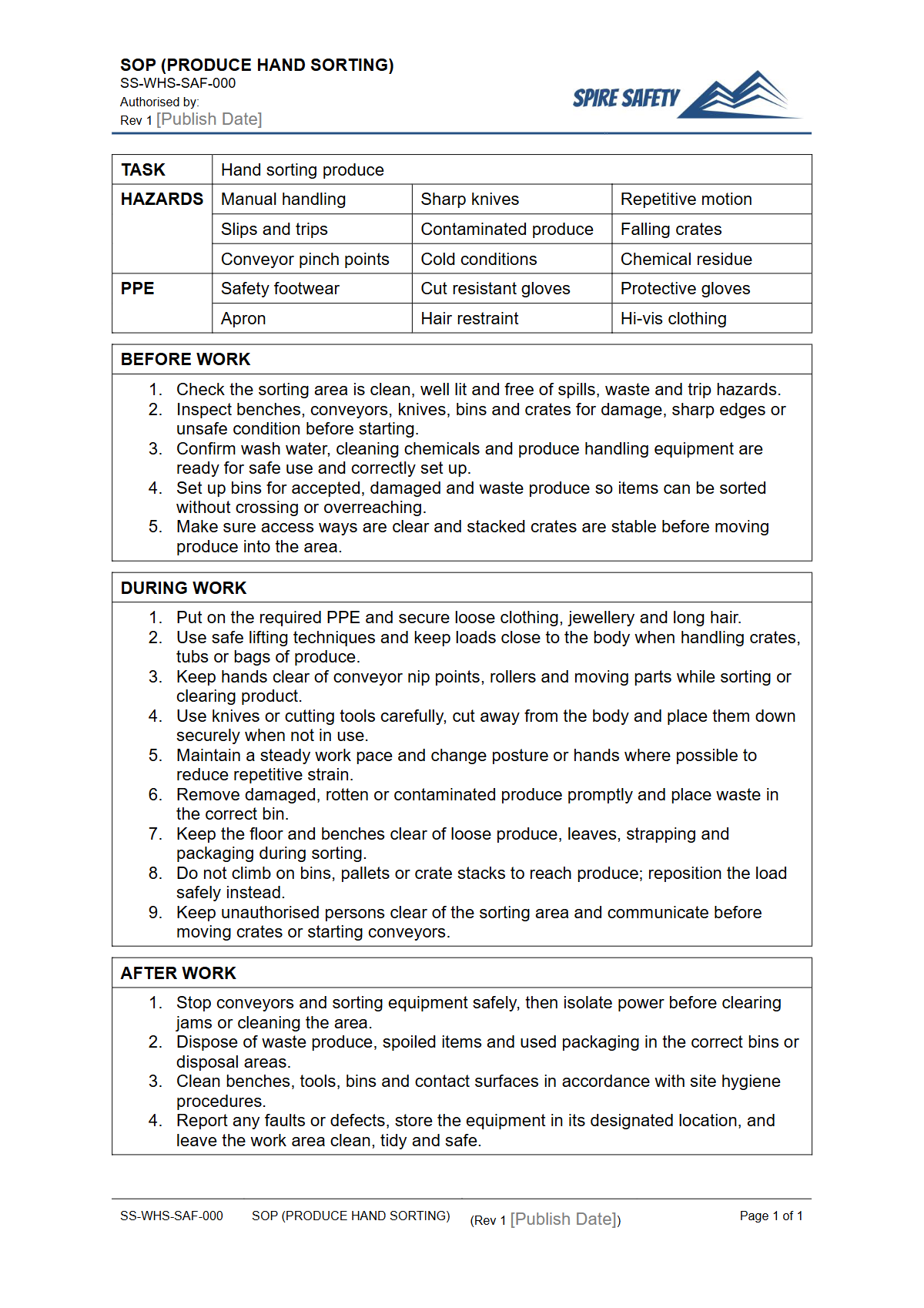
Download our free Safe Operating Procedure for produce hand sorting to formalise your safety processes.
Free Safe Operating Procedure (Produce Hand Sorting) Template
DOCX • 126 KB + PDF
Updated Oct 2026
No signup required
Purpose of the Free Safe Operating Procedure (Produce Hand Sorting) Template
Establishing clear, safe work practices is essential for any task involving manual labour, and produce hand sorting is no exception. This Free Safe Operating Procedure (Produce Hand Sorting) Template provides a structured starting point for agricultural businesses, packing houses, and food processors to document the required steps for safely sorting fruit and vegetables.
A documented SOP helps to standardise training, minimise operational risks, and demonstrate a commitment to health and safety. By outlining potential hazards and their corresponding control measures, this document becomes a vital tool in preventing workplace injuries, particularly musculoskeletal disorders and slips and falls.
Using a formal SOP ensures that all workers, regardless of their experience level, are aware of the established safety protocols. This consistency is crucial for maintaining a safe working environment and forms a key part of more comprehensive WHS management systems. It helps your organisation create a repeatable, safe process that reduces ambiguity and improves overall safety performance.
How to use the Free Safe Operating Procedure (Produce Hand Sorting) Template
This template is provided in both DOCX and PDF formats for your convenience. The DOCX file is fully editable, allowing you to tailor the content to the unique requirements of your operation.
It is critical to adapt the document to your specific context, including the type of produce being sorted, the equipment used, the layout of the work area, and the specific hazards identified through your risk assessment process.
Important Note: Before implementing this Safe Operating Procedure, you must customise it to reflect the specific equipment, environment, and processes used in your workplace. This includes adding your company branding, detailing site-specific emergency procedures, and specifying the exact Personal Protective Equipment (PPE) required.
We are not liable for any incidents that may occur from the use of this generic template.
To get the most out of this resource, involve your workers in the customisation process. Their direct experience with the task can provide invaluable insights into potential hazards and practical control measures.
Once finalised, the SOP should be used as a primary training document for new employees and for regular refresher training sessions. Conducting a periodic WHS compliance auditing process will help ensure your procedures remain current and effective.
Video walkthrough
Key Hazards in Produce Hand Sorting
The task of hand sorting produce, while seemingly straightforward, presents several significant health and safety hazards. Your customised SOP should directly address how your organisation controls these risks.
- Musculoskeletal Injuries: This is the most common risk, stemming from repetitive motions (grasping, twisting, placing), awkward postures (bending over sorting tables or conveyors), and prolonged standing. Implementing ergonomic controls like adjustable-height tables, anti-fatigue matting, and scheduled task rotation is crucial.
- Manual Handling: Lifting and moving crates, bags, or bins of produce can lead to sprains and strains if not done correctly. The SOP should specify safe lifting techniques and weight limits.
- Slips, Trips, and Falls: Wet floors from washing processes, discarded produce, or packaging materials can create serious slip hazards. Good housekeeping procedures are a critical control measure.
- Interaction with Machinery: Sorting is often done on or near mechanised equipment. If sorting lines use automated belts, workers need to be trained on the safe operation and emergency stop procedures, as detailed in a specific free Conveyer System SOP template.
- Biological Hazards: Handling spoiled or mouldy produce can expose workers to bacteria and fungi. Appropriate PPE, such as gloves, and good hygiene practices are essential.
On a broader agricultural site, workers may be exposed to numerous types of machinery, each requiring its own documented procedure. For example, in addition to sorting, a farm may need a Safe Operating Procedure for a planter to manage risks during seasonal planting operations.
When to Use This SOP
A Safe Operating Procedure is a dynamic document that should be integrated into your daily operations. It is not a document to be filed away and forgotten.
Use it during worker induction and onboarding to establish safety expectations from day one. It should also be a central resource for periodic refresher training to reinforce correct procedures.
Furthermore, the SOP must be reviewed and updated following any incident or near miss, or whenever there is a change in the work process, equipment, or materials used. If you need assistance developing or reviewing your safety documentation, our expert WHS consulting services can provide tailored support.
Who Should Use This SOP
This SOP is intended for use by multiple groups within an organisation. Persons Conducting a Business or Undertaking (PCBUs) and managers can use it to fulfil their duty of care by providing a safe system of work. Supervisors should use the SOP to train workers and monitor compliance on the floor. WHS officers and representatives will find it a useful tool for conducting risk assessments and incident investigations. Most importantly, the workers performing the produce sorting task should use it as a guide to perform their duties safely and consistently. Find more templates and checklists like this one in our free WHS resources library to build out your safety management framework.
Common mistakes
Common mistakes to avoid
- Using a generic SOP without customising it for specific workplace conditions and produce types.
- Failing to adequately train workers on the procedure or neglecting to document the training.
- Not reviewing or updating the SOP after an incident, near miss, or process change.
- Neglecting ergonomic controls like job rotation or adjustable workstations, leading to preventable injuries.
Legal references
Legal considerations
The following legal requirements may be relevant to this type of work.
- Work Health and Safety Act (Harmonised) — Provides the primary duties for protecting workers and other people from work health and safety risks.
- Work Health and Safety Regulations (Harmonised) — Sets out requirements supporting the management of workplace hazards and risks.
The following codes may be relevant to this type of work.
- Managing WHS Risks Code of Practice — Provides practical guidance on identifying hazards, assessing risks and applying effective controls.
- Work Health and Safety Consultation, Cooperation and Coordination Code of Practice — Provides practical guidance on consulting workers and coordinating with other duty holders.
- Managing the Work Environment and Facilities Code of Practice — Provides practical guidance on safe work environments, workplace facilities and related controls.
Did you know
The Silent Hazard
Work-related musculoskeletal disorders (MSDs) account for a significant portion of serious workers' compensation claims in Australia, with hazardous manual tasks being a primary cause.
Hygiene is Safety
Proper hand hygiene and cleaning procedures in produce sorting aren't just for food safety; they also protect workers from biological hazards like bacteria and mould on spoiled items.
FAQ
Frequently asked questions
01What are the main ergonomic risks in produce hand sorting?
02How often should a produce sorting SOP be reviewed?
03Is this template suitable for all types of produce?
04Who is responsible for enforcing the Safe Operating Procedure?
Share this resource
Free Safe Operating Procedure (Produce Hand Sorting) Template
Browse Categories
How To Use It
- 1Download and open in Word or PDF.
- 2Replace the placeholders with your business details.
- 3Get it reviewed by a WHS specialist before rollout.
Need it customised?
Our WHS consultants can adapt this template to your site, run a gap analysis, or audit what you already have in place.
Book a Free Consultation WHS consulting servicesor call 1300 156 382
Related templates
- Free Safe Operating Procedure (Produce Packing) Template
- Free Safe Operating Procedure (Produce Pallet Loading) Template
- Free Safe Operating Procedure (Produce Shed Cleaning) Template
- Free Safe Operating Procedure (Produce Washer) Template
- Free Safe Operating Procedure (Produce Washing Setup) Template
- Free Safe Operating Procedure (Proofing Cabinet) Template