
Free Safe Operating Procedure (Produce Shed Cleaning) Template
Download our free Safe Operating Procedure for Produce Shed Cleaning to formalise your safety protocols. This customisable template helps you manage risks.
Free Safe Operating Procedure (Produce Shed Cleaning) Template
DOCX • 126 KB + PDF
Updated Oct 2026
No signup required
Purpose of the Free Safe Operating Procedure (Produce Shed Cleaning) Template
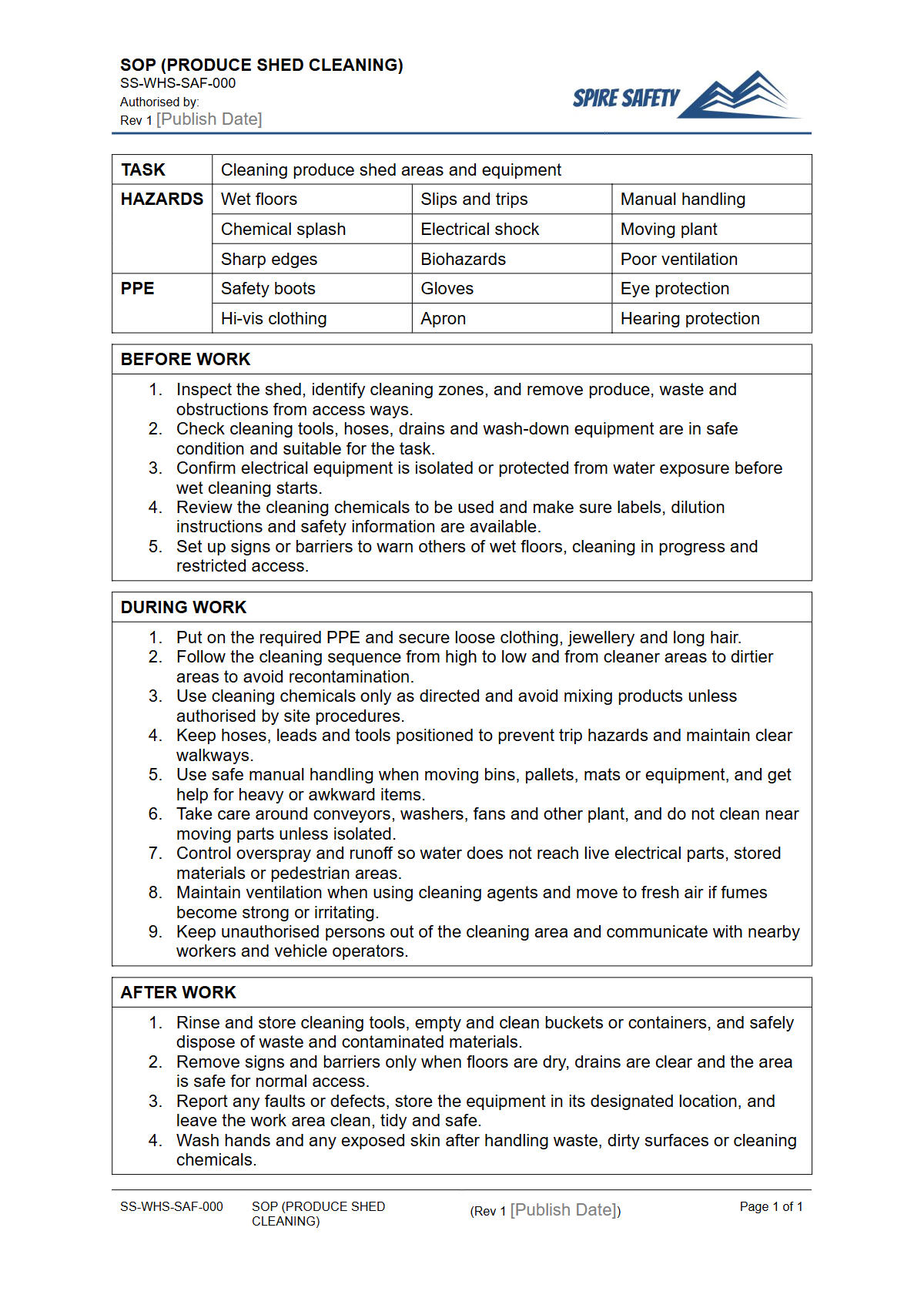
A produce shed is a dynamic environment with numerous hazards, many of which are amplified during cleaning operations. This free Safe Operating Procedure (Produce Shed Cleaning) Template provides a structured framework for documenting the required safety measures for this common but high-risk task.
Using a formal SOP helps a Person Conducting a Business or Undertaking (PCBU) meet their primary duty of care by managing risks associated with slips from wet floors, exposure to cleaning chemicals, manual handling, and interaction with plant and equipment.
By clearly outlining pre-operational checks, the step-by-step cleaning process, and post-cleaning procedures, this template helps standardise safe work practices. It ensures that all workers, regardless of experience, follow a consistent, safety-focused method.
This reduces the likelihood of incidents and demonstrates a commitment to a proactive safety culture. It is particularly important where cleaning occurs around equipment like sorting lines, which may have their own specific safety requirements detailed in a conveyer system SOP.
Video walkthrough
How to use the Free Safe Operating Procedure (Produce Shed Cleaning) Template
This template is provided in both DOCX and PDF formats for your convenience. The DOCX file is fully editable, allowing you to tailor the content to the unique context of your operation.
To use it effectively, download the document and methodically work through each section, replacing the placeholder text with information specific to your site.
This includes detailing the exact types of cleaning agents used (and referencing their Safety Data Sheets), the specific personal protective equipment (PPE) required, the models of any machinery involved (like pressure washers or floor scrubbers), and the layout of your shed. Integrating this SOP is a critical component of building a comprehensive WHS management system.
IMPORTANT: This document is a template, not a finished procedure. At Spire Safety, we provide a structured starting point aligned with Australian WHS principles, but you must customise it to reflect the specific equipment, chemicals, processes, and risks present in your workplace.
Generic procedures are insufficient for ensuring worker safety.
When to use it
The Produce Shed Cleaning SOP should be a core part of your operational documentation. It must be consulted and followed every time cleaning tasks are performed.
Its primary use is as a practical guide for workers to ensure they complete the job safely. Beyond daily operations, the SOP is a critical tool for several other key activities.
Use it for inducting new employees and for training existing team members on correct procedure. It should also be a reference point during refresher training sessions and toolbox talks.
It is vital to review and, if necessary, update the SOP after any incident or near-miss, when new equipment or chemicals are introduced, or as part of a regular WHS compliance audit to ensure it remains current and effective.
Who should use it
This Safe Operating Procedure is intended for use by all personnel involved in the cleaning of a produce shed. This includes agricultural workers, farmhands, maintenance staff, and cleaners.
It provides them with clear, step-by-step instructions to follow to minimise risks to themselves and others.
Supervisors, team leaders, and farm managers should use the SOP to oversee cleaning tasks, enforce safety standards, and conduct training. WHS officers and managers will also use this document as part of the broader risk management framework for the site.
It serves as evidence of risk assessment and control implementation, forming part of a library of procedures that might also include our free Spreader SOP template for other common agricultural tasks.
Key Hazards in Produce Shed Cleaning
While customising your SOP, pay close attention to the following common hazards:
- Slips, Trips & Falls: Wet floors are the most obvious hazard. The SOP should mandate signage, proper drainage, and the use of non-slip footwear.
- Hazardous Chemicals: Cleaning agents can cause skin irritation, respiratory issues, or severe chemical burns. Your procedure must specify PPE (e.g., gloves, goggles), ventilation requirements, and first aid measures for exposure.
- Electrical Hazards: Using electrical equipment like pressure washers in a wet environment creates a high risk of electric shock. The SOP must include checks for faulty leads, use of residual-current devices (RCDs), and keeping electrical connections dry. Procedures for equipment like compressors should be detailed in their own document, such as an Air Compressor SOP.
- Manual Handling: Moving equipment, buckets of water, or bins of waste can lead to musculoskeletal injuries. The procedure should encourage the use of mechanical aids and outline safe lifting techniques.
- Plant & Equipment: Cleaning around machinery like forklifts, packing lines, or a Telehandler SOP involves risks of entanglement, crushing, or impact. The SOP must include lockout/tagout procedures to ensure equipment is de-energised and cannot start unexpectedly.
By thoroughly addressing these areas, your customised SOP becomes a powerful tool for preventing harm. For more templates and safety resources, feel free to explore our complete free WHS resources library.
Common mistakes
Common mistakes to avoid
- Failing to customise the template for site-specific equipment, chemicals, and layout.
- Neglecting to provide practical training to workers on the finalised SOP.
- Using generic chemical handling information instead of referencing specific Safety Data Sheets (SDS).
- Forgetting to include clear emergency procedures for chemical spills, electrical incidents, or personal injury.
Legal references
Legal considerations
The following legal requirements may be relevant to this type of work.
- Work Health and Safety Act (Harmonised) — Provides the primary duties for protecting workers and other people from work health and safety risks.
- Work Health and Safety Regulations (Harmonised) — Sets out requirements supporting the management of workplace hazards and risks.
The following codes may be relevant to this type of work.
- Managing WHS Risks Code of Practice — Provides practical guidance on identifying hazards, assessing risks and applying effective controls.
- Work Health and Safety Consultation, Cooperation and Coordination Code of Practice — Provides practical guidance on consulting workers and coordinating with other duty holders.
- Managing the Work Environment and Facilities Code of Practice — Provides practical guidance on safe work environments, workplace facilities and related controls.
Did you know
Slips, Trips, and Falls
According to Safe Work Australia, slips, trips, and falls are a leading cause of serious injury in the Australian agriculture industry. Wet and contaminated floors during cleaning operations are a significant contributing factor.
FAQ
Frequently asked questions
01What is a Safe Operating Procedure (SOP)?
02Why is an SOP specifically for produce shed cleaning important?
03Does this template cover the use of specific cleaning chemicals?
04How often should we review our Produce Shed Cleaning SOP?
Share this resource
Free Safe Operating Procedure (Produce Shed Cleaning) Template
Browse Categories
How To Use It
- 1Download and open in Word or PDF.
- 2Replace the placeholders with your business details.
- 3Get it reviewed by a WHS specialist before rollout.
Need it customised?
Our WHS consultants can adapt this template to your site, run a gap analysis, or audit what you already have in place.
Book a Free Consultation WHS consulting servicesor call 1300 156 382
Related templates
- Free Safe Operating Procedure (Produce Washer) Template
- Free Safe Operating Procedure (Produce Washing Setup) Template
- Free Safe Operating Procedure (Proofing Cabinet) Template
- Free Safe Operating Procedure (Propeller Safety) Template
- Free Safe Operating Procedure (Pruning Shears) Template
- Free Safe Operating Procedure (Pruning Waste Handling) Template