
Free Safe Operating Procedure (Produce Pallet Loading) Template
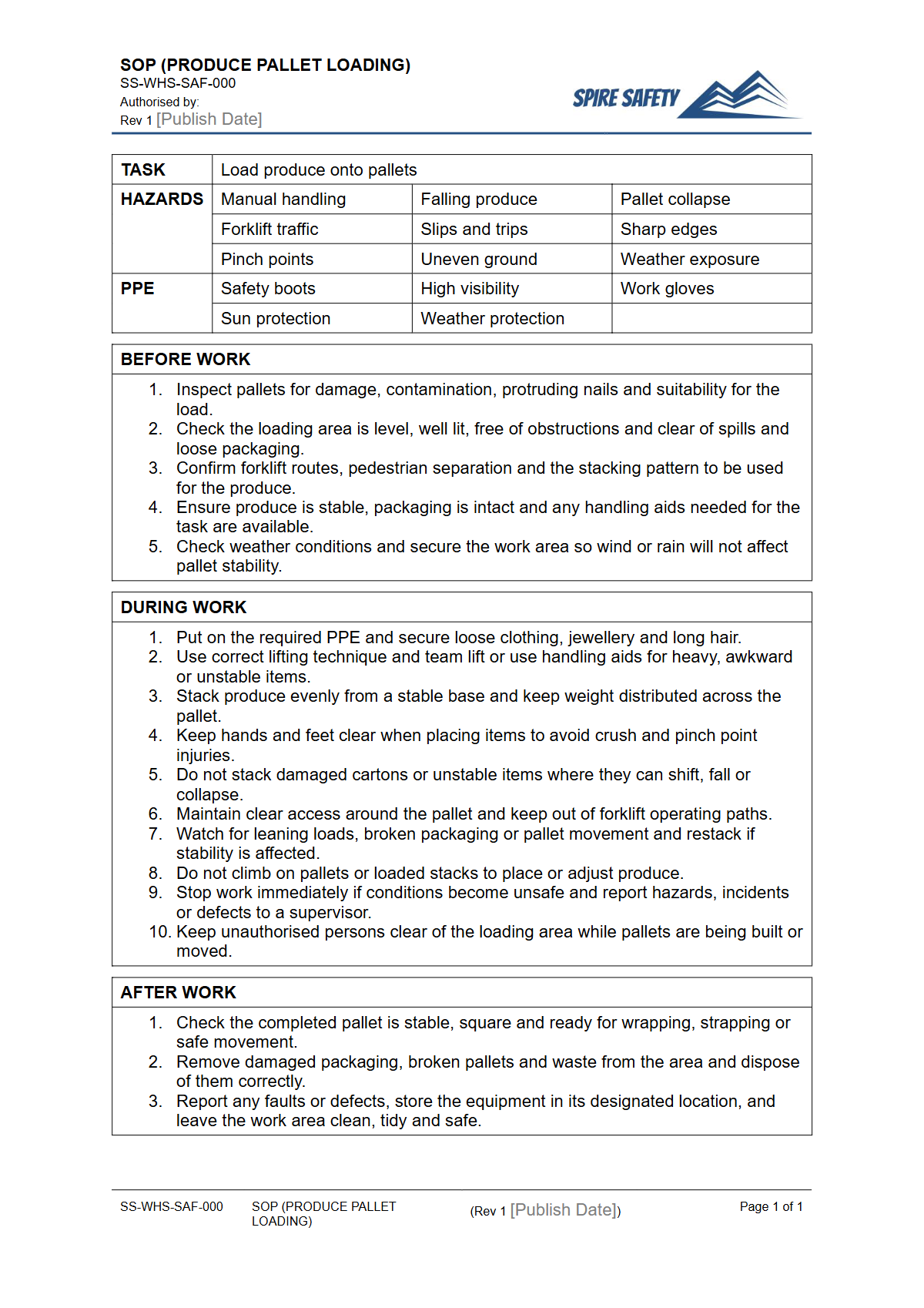
Formalise your workplace safety protocols for loading produce pallets. Download our free Safe Operating Procedure template to get started today.
Free Safe Operating Procedure (Produce Pallet Loading) Template
DOCX • 126 KB + PDF
Updated Oct 2026
No signup required
Purpose of the Free Safe Operating Procedure (Produce Pallet Loading) Template
Loading produce onto pallets presents unique manual handling and stability risks. This task requires a clear, documented process to protect workers from injury and prevent costly product damage.
Our Free Safe Operating Procedure (Produce Pallet Loading) Template provides a structured starting point for your organisation to formalise these critical steps. It is designed to help you manage hazards associated with manual handling, unstable loads, and equipment use in agricultural and logistics settings.
A well-defined SOP is a cornerstone of a safe system of work. It helps you meet your primary duty of care under Australian WHS legislation by systematically addressing risks.
By using this template, you can standardise training, ensure consistent performance of the task, and create a clear reference point for workers and supervisors. It also serves as crucial documentation, demonstrating your commitment to safety by integrating it into your broader WHS management systems.
Video walkthrough
How to use the Free Safe Operating Procedure (Produce Pallet Loading) Template
This resource is available in both DOCX and PDF formats. The DOCX file is fully editable, allowing you to tailor the procedure to your specific operational context.
It is essential that you customise this template to reflect the specific equipment (e.g., pallet jacks, forklifts), types of produce, pallet configurations, and unique environmental factors of your workplace. We have included placeholder text [LIKE THIS] to guide you on where to add your site-specific details.
The PDF version is useful for quick distribution or printing once your SOP is finalised.
Effective customisation involves consulting with the workers who actually perform the task. Their input is invaluable for identifying practical hazards and effective controls. A comprehensive SOP should cover pre-operational checks, step-by-step loading instructions, weight limits, and emergency procedures, especially when interacting with machinery like forklifts or as part of a workflow that includes our FREE Telehandler SOP Template.
When to use a Produce Pallet Loading SOP
A Safe Operating Procedure for produce pallet loading should be a living document, used consistently across your operations. It is not a document to be filed away and forgotten. Key times to use and refer to the SOP include:
- During the induction and training of new employees.
- As a basis for refresher training for existing workers.
- Before starting any pallet loading task as a pre-work reminder.
- When conducting risk assessments for manual tasks.
- During incident investigations to review if procedures were followed.
- Whenever a process changes, such as the introduction of new packaging, different produce types, or when integrating with other equipment like those covered in our FREE Conveyer System SOP Template.
Who should use this SOP?
The development and implementation of this SOP involves several key roles within an organisation. While the procedure is ultimately for the workers performing the task, its management is a shared responsibility:
- Managers and Supervisors: Responsible for ensuring the SOP is developed, customised, implemented, and that workers are adequately trained to follow it. They must also enforce its use.
- WHS/HSE Advisors: Provide technical expertise during the development and review of the SOP to ensure it aligns with WHS legislation and best practices.
- Workers: Must be trained on the SOP and are required to follow the documented steps to ensure their own safety and the safety of others. They should also be encouraged to provide feedback for continuous improvement.
Ultimately, a robust SOP helps all personnel understand their responsibilities and contributes to fostering a proactive safety culture. For guidance on developing these broader frameworks, consider engaging with expert WHS consulting services.
Verifying that procedures are followed correctly is a key part of maintaining safety, often confirmed through formal WHS compliance auditing. This ensures the SOP remains effective and relevant to the actual work being performed.
This document forms just one part of a comprehensive safety framework. For other agricultural tasks, you may find our FREE Grain Drill SOP Template useful for documenting other hazardous procedures on site.
Explore our complete free WHS resources library for more templates and guides to support your safety management system.
Common mistakes
Common mistakes to avoid
- Ignoring or exceeding the rated capacity of the pallet, leading to structural failure.
- Using damaged, splintered, or poor-quality pallets that cannot support the load securely.
- Creating unstable loads with poor stacking patterns (e.g., not interlocking boxes or building too high).
- Failing to account for the specific characteristics of the produce, such as placing heavy items on top of delicate ones.
Legal references
Legal considerations
The following legal requirements may be relevant to this type of work.
- Work Health and Safety Act (Harmonised) — Provides the primary duties for protecting workers and other people from work health and safety risks.
- Work Health and Safety Regulations (Harmonised) — Sets out requirements supporting the management of workplace hazards and risks.
The following codes may be relevant to this type of work.
- Managing WHS Risks Code of Practice — Provides practical guidance on identifying hazards, assessing risks and applying effective controls.
- Work Health and Safety Consultation, Cooperation and Coordination Code of Practice — Provides practical guidance on consulting workers and coordinating with other duty holders.
- Managing the Work Environment and Facilities Code of Practice — Provides practical guidance on safe work environments, workplace facilities and related controls.
Did you know
Manual Handling Risk
Musculoskeletal disorders arising from hazardous manual tasks are a leading cause of serious workers' compensation claims in Australia. Proper pallet loading techniques are a key control measure to prevent these injuries.
Pallet Weight
A standard Australian hardwood pallet (1165mm x 1165mm) can weigh between 30-40 kg on its own. This 'tare weight' must be factored into the total load calculation to avoid exceeding equipment and racking limits.
FAQ
Frequently asked questions
01What key hazards are involved in loading produce onto pallets?
02Is a Safe Operating Procedure a legal requirement in Australia?
03How often should a Produce Pallet Loading SOP be reviewed?
04Can this template be used for loading non-produce items?
Share this resource
Free Safe Operating Procedure (Produce Pallet Loading) Template
Browse Categories
How To Use It
- 1Download and open in Word or PDF.
- 2Replace the placeholders with your business details.
- 3Get it reviewed by a WHS specialist before rollout.
Need it customised?
Our WHS consultants can adapt this template to your site, run a gap analysis, or audit what you already have in place.
Book a Free Consultation WHS consulting servicesor call 1300 156 382
Related templates
- Free Safe Operating Procedure (Produce Shed Cleaning) Template
- Free Safe Operating Procedure (Produce Washer) Template
- Free Safe Operating Procedure (Produce Washing Setup) Template
- Free Safe Operating Procedure (Proofing Cabinet) Template
- Free Safe Operating Procedure (Propeller Safety) Template
- Free Safe Operating Procedure (Pruning Shears) Template