
Free Safe Operating Procedure (Privacy Curtain Change) Template
Formalise your process for changing privacy curtains in healthcare or aged care settings. Download our free Safe Operating Procedure template to get started.
Free Safe Operating Procedure (Privacy Curtain Change) Template
DOCX • 126 KB + PDF
Updated Oct 2026
No signup required
Purpose of the Free Safe Operating Procedure (Privacy Curtain Change) Template
Changing privacy curtains in healthcare, aged care, or clinical environments is a routine task with significant underlying risks. Our Free Safe Operating Procedure (Privacy Curtain Change) Template provides a structured framework to help you document a safe and consistent process.
This SOP helps control hazards associated with manual tasks, working at heights, and infection control. By clearly defining the steps, required personal protective equipment (PPE), and safety checks, you can minimise the risk of musculoskeletal injuries from over-reaching, falls from ladders, and the cross-contamination of pathogens.
A well-drafted SOP is a key operational document within your overall safety framework. It serves as a practical tool for training staff and provides a clear standard for task performance, ensuring everyone follows the same safe method every time.
Integrating task-specific procedures like this one is a fundamental part of building robust WHS management systems that protect workers and patients alike.
Video walkthrough
How to use the Free Safe Operating Procedure (Privacy Curtain Change) Template
This resource is provided as a fully editable DOCX file, with a PDF version also available for easy printing and distribution. It is designed as a comprehensive starting point based on Australian WHS principles.
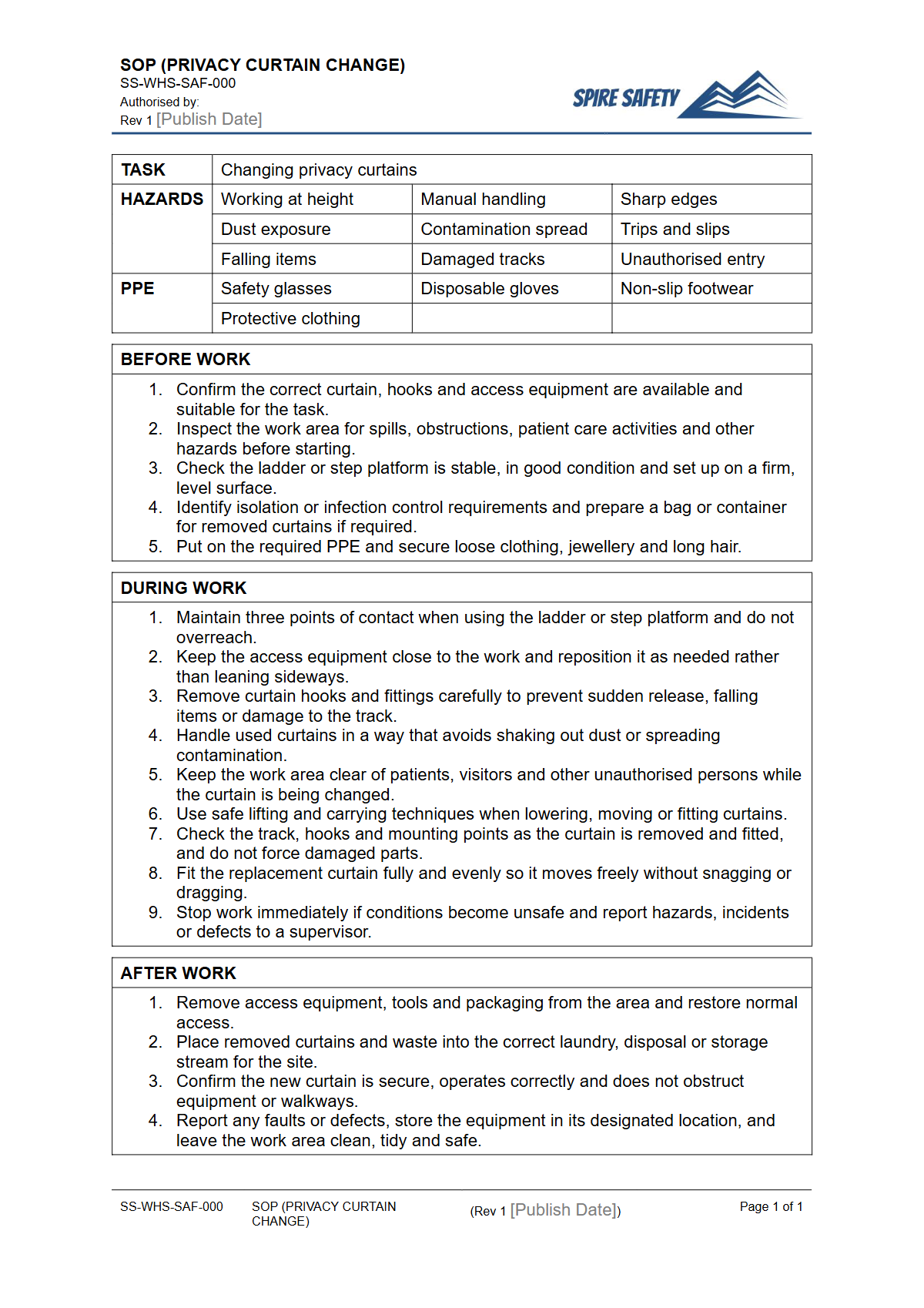
The procedure outlines key steps including pre-task checks, the process for removing old curtains, installing new ones, and post-task clean-up. You will find sections covering required PPE, risk controls, and emergency procedures.
Important: This is a template, not a finished document. To be effective, you must customise it to reflect the specific equipment, environment, and policies of your workplace.
We have included comments and prompts within the document to guide you. Consider factors like the type of ladders used, the specific design of your curtain tracks, your facility’s infection control protocols, and the physical layout of your rooms.
Getting these details right is crucial, and if you need assistance, our WHS consulting services can provide expert guidance on tailoring safety documentation.
When to use it
This Safe Operating Procedure should be used every time a privacy curtain is changed, regardless of the reason. Common triggers for using the SOP include:
- Scheduled changes: As part of a routine cleaning and infection control schedule (e.g., weekly, fortnightly, or monthly).
- After contamination: Immediately following any known soiling or contamination event involving bodily fluids or other biohazards.
- Patient discharge: In high-risk areas, curtains may be changed between patients as a terminal cleaning step.
- Damage or wear: When a curtain is visibly torn, stained, or the runners are damaged.
Regularly reviewing the SOP's application and effectiveness is also important. Incorporating checks on procedural adherence into your internal safety reviews or formal WHS compliance auditing schedule helps ensure the documented process remains practical and is being followed correctly by all relevant personnel.
Who should use it
This SOP is intended for any worker tasked with changing privacy curtains. This may include:
- Environmental services or cleaning staff
- Maintenance and facilities management personnel
- In some settings, nurses or patient care assistants
Supervisors and managers should use the SOP as a tool for training, competency assessment, and incident investigation. It creates a clear benchmark for expected safe performance. Having documented procedures for all common high-risk tasks demonstrates a commitment to health and safety. Just as specific instructions are vital for operating equipment like that detailed in our deep fryer standard operation template, a dedicated SOP for curtain changes ensures this manual task is also performed with a high degree of care and consistency. You can find more templates for various workplace tasks in our free WHS resources library.
Common mistakes
Common mistakes to avoid
- Using an unsuitable or unstable ladder, or overreaching from the top steps.
- Neglecting infection control measures, such as performing hand hygiene before and after the task.
- Poor manual handling techniques, like twisting the back while pulling or lifting heavy curtains.
- Failing to inspect the curtain, runners, and track for damage before installing the clean curtain.
Legal references
Legal considerations
The following legal requirements may be relevant to this type of work.
- Work Health and Safety Act (Harmonised) — Provides the primary duties for protecting workers and other people from work health and safety risks.
- Work Health and Safety Regulations (Harmonised) — Sets out requirements supporting the management of workplace hazards and risks.
The following codes may be relevant to this type of work.
- Managing WHS Risks Code of Practice — Provides practical guidance on identifying hazards, assessing risks and applying effective controls.
- Work Health and Safety Consultation, Cooperation and Coordination Code of Practice — Provides practical guidance on consulting workers and coordinating with other duty holders.
- Managing the Work Environment and Facilities Code of Practice — Provides practical guidance on safe work environments, workplace facilities and related controls.
Did you know
A Hotbed for Bacteria
Studies have shown that hospital privacy curtains can become contaminated with potentially dangerous bacteria, including MRSA, within days of being cleaned. This highlights the importance of regular changes and proper handling procedures to prevent cross-contamination.
FAQ
Frequently asked questions
01What are the main risks involved in changing privacy curtains?
02How often should hospital privacy curtains be changed?
03Is an SOP legally required for changing privacy curtains in Australia?
04What key information should be in a privacy curtain change SOP?
Share this resource
Free Safe Operating Procedure (Privacy Curtain Change) Template
Browse Categories
How To Use It
- 1Download and open in Word or PDF.
- 2Replace the placeholders with your business details.
- 3Get it reviewed by a WHS specialist before rollout.
Need it customised?
Our WHS consultants can adapt this template to your site, run a gap analysis, or audit what you already have in place.
Book a Free Consultation WHS consulting servicesor call 1300 156 382
Related templates
- Free Safe Operating Procedure (Produce Bin Cleaning) Template
- Free Safe Operating Procedure (Produce Crate Handling) Template
- Free Safe Operating Procedure (Produce Display Clean) Template
- Free Safe Operating Procedure (Produce Hand Sorting) Template
- Free Safe Operating Procedure (Produce Packing) Template
- Free Safe Operating Procedure (Produce Pallet Loading) Template