
Free Safe Operating Procedure (Produce Bin Cleaning) Template
Maintaining clean produce bins is critical for food safety and preventing workplace injuries.
Free Safe Operating Procedure (Produce Bin Cleaning) Template
DOCX • 126 KB + PDF
Updated Oct 2026
No signup required
Purpose of the Free Safe Operating Procedure (Produce Bin Cleaning) Template
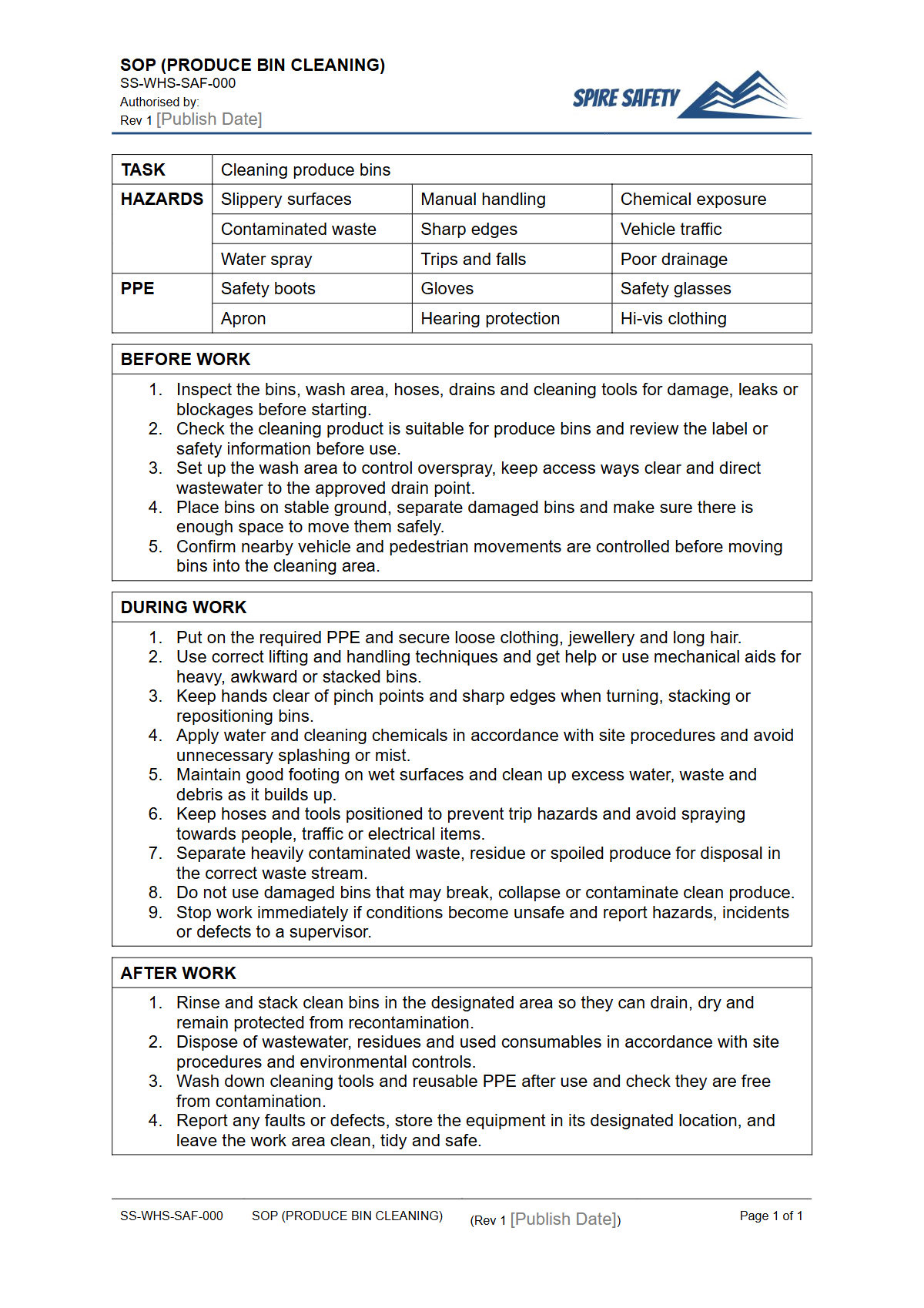
This Free Safe Operating Procedure (Produce Bin Cleaning) Template provides a structured framework for businesses to document a safe and consistent method for cleaning produce bins. Proper cleaning is essential not only for food hygiene and quality control but also for protecting workers from a range of hazards.
These include manual handling injuries from lifting heavy or awkward bins, slips and trips on wet floors, chemical exposure from cleaning agents, ergonomic strain from repetitive scrubbing, and exposure to biological hazards like bacteria and mould.
A documented SOP helps standardise the task, ensuring every worker follows the same safe steps, every time. It serves as a vital training tool for new employees and for refresher training, forming a key component of your risk management process. Implementing clear procedures demonstrates a commitment to safety and helps your organisation build more robust WHS management systems.
Video walkthrough
How to use the Free Safe Operating Procedure (Produce Bin Cleaning) Template
This downloadable document is a template, not a finished procedure. It must be customised to reflect the specific circumstances of your workplace.
To adapt it correctly, you should consult with your workers and incorporate details about your unique environment, equipment, and processes.
Important Note: We provide this template as a starting point. It is your responsibility to ensure it is adapted to cover all hazards and control measures relevant to your specific site. Key areas for customisation include:
- The specific types and sizes of produce bins used.
- The layout of the dedicated cleaning area.
- The exact cleaning chemicals used (reference their Safety Data Sheets).
- The required Personal Protective Equipment (PPE), such as chemical-resistant gloves, safety glasses or goggles, aprons, and non-slip footwear.
- The specific equipment used, such as high-pressure washers, hoses, and brushes.
- Emergency procedures for chemical spills or personal injury.
- Waste water and residue disposal methods.
Once customised, the SOP should be reviewed and approved by a competent person. Periodic checks, including WHS compliance auditing, can help verify that documented procedures are being followed correctly in practice.
When to use it
A Safe Operating Procedure for produce bin cleaning should be used as a primary reference document in several situations. It is essential during the induction and training of new staff who will be performing the task.
It should also be used for regular refresher training to prevent complacency and reinforce safe work habits. Supervisors can use it for pre-start meetings or toolbox talks to review the key risks and controls before work begins.
Furthermore, the SOP is a critical document following any incident or near miss involving the cleaning process, helping to guide the investigation and identify any procedural gaps. In agricultural or large-scale food production environments, this SOP would be used alongside others, such as a FREE Telehandler SOP Template for moving stacks of bins.
Who should use it
This template is designed for use by a Person Conducting a Business or Undertaking (PCBU), WHS managers, supervisors, and team leaders responsible for health and safety in industries like agriculture, food processing, logistics, and retail grocery. It is their responsibility to develop, implement, and review safe systems of work.
The finalised procedure is for the workers who perform the cleaning task. It must be written in clear, simple language and be easily accessible to them at all times in the work area.
The process is critical for roles handling cleaning in food preparation settings, much like the requirement for a Safe Operating Procedure for deep fryer cleaning in a commercial kitchen.
Certain cleaning workflows might incorporate equipment that requires its own procedure. For instance, if compressed air is used for drying bins post-wash, a separate Free Air Compressor SOP should also be developed and referenced.
This document is just one of many useful templates and guides available to help you manage workplace safety. You can explore our complete free WHS resources library to find more tools to support your safety management system.
Common mistakes
Common mistakes to avoid
- Using a generic SOP without customising it for site-specific equipment, chemicals, and hazards.
- Failing to adequately train workers on the finalised procedure and confirm their understanding.
- Not providing the correct Personal Protective Equipment (PPE) specified in the SOP, or not enforcing its use.
- Neglecting to make the Safety Data Sheet (SDS) for each cleaning chemical readily available to workers.
Legal references
Legal considerations
The following legal requirements may be relevant to this type of work.
- Work Health and Safety Act (Harmonised) — Provides the primary duties for protecting workers and other people from work health and safety risks.
- Work Health and Safety Regulations (Harmonised) — Sets out requirements supporting the management of workplace hazards and risks.
The following codes may be relevant to this type of work.
- Managing WHS Risks Code of Practice — Provides practical guidance on identifying hazards, assessing risks and applying effective controls.
- Work Health and Safety Consultation, Cooperation and Coordination Code of Practice — Provides practical guidance on consulting workers and coordinating with other duty holders.
- Managing the Work Environment and Facilities Code of Practice — Provides practical guidance on safe work environments, workplace facilities and related controls.
Did you know
Bacterial Resilience
Some harmful bacteria, such as Listeria monocytogenes, can survive and even grow at refrigeration temperatures, making the thorough cleaning and sanitisation of produce bins a critical food safety control point.
Manual Tasks Risk
According to Safe Work Australia, manual handling injuries are a leading cause of serious workers' compensation claims, highlighting the importance of proper procedures for lifting, carrying, and handling items like produce bins.
FAQ
Frequently asked questions
01What are the main hazards when cleaning produce bins?
02Is this produce bin cleaning SOP template ready to use immediately?
03Who is responsible for developing a Safe Operating Procedure?
04How often should an SOP for produce bin cleaning be reviewed?
Share this resource
Free Safe Operating Procedure (Produce Bin Cleaning) Template
Browse Categories
How To Use It
- 1Download and open in Word or PDF.
- 2Replace the placeholders with your business details.
- 3Get it reviewed by a WHS specialist before rollout.
Need it customised?
Our WHS consultants can adapt this template to your site, run a gap analysis, or audit what you already have in place.
Book a Free Consultation WHS consulting servicesor call 1300 156 382
Related templates
- Free Safe Operating Procedure (Produce Crate Handling) Template
- Free Safe Operating Procedure (Produce Display Clean) Template
- Free Safe Operating Procedure (Produce Hand Sorting) Template
- Free Safe Operating Procedure (Produce Packing) Template
- Free Safe Operating Procedure (Produce Pallet Loading) Template
- Free Safe Operating Procedure (Produce Shed Cleaning) Template