
Free Safe Operating Procedure (Printing Press) Template
Download our Free Safe Operating Procedure (Printing Press) Template to formalise safety protocols for your machinery. Get your customisable DOCX and PDF now.
Free Safe Operating Procedure (Printing Press) Template
DOCX • 126 KB + PDF
Updated Oct 2026
No signup required
Purpose of the Free Safe Operating Procedure (Printing Press) Template
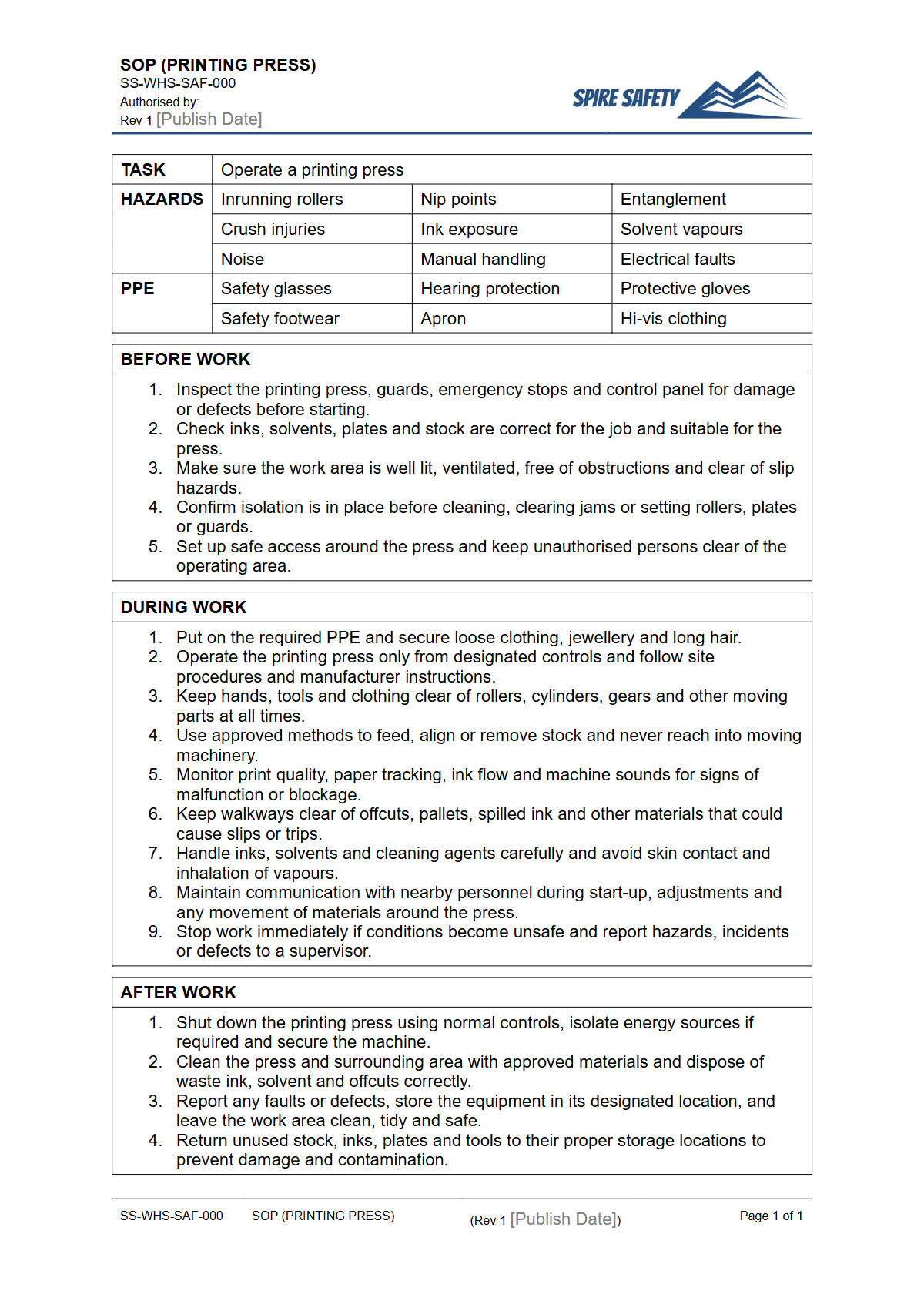
This Free Safe Operating Procedure (Printing Press) Template provides a structured framework for documenting the safe use of printing machinery in your workplace. Operating a printing press involves significant risks, including entanglement in moving parts, crush and nip points, exposure to hazardous chemicals like inks and solvents, high noise levels, and manual handling injuries.
An SOP is a critical administrative control that outlines step-by-step instructions to help workers perform their tasks safely and consistently, minimising the risk of incidents.
This template is designed as a starting point, aligned with Australian WHS principles, to help your organisation meet its duty of care obligations. By clearly defining procedures, you establish a benchmark for safe work performance and training.
For equipment with similar mechanical hazards, you might also find our FREE Hydraulic Press SOP a useful reference.
Video walkthrough
How to use the Free Safe Operating Procedure (Printing Press) Template
Using the Free Safe Operating Procedure (Printing Press) Template is straightforward. After downloading the DOCX file, you can edit it to reflect the specific machinery and processes in your facility.
A non-editable PDF version is also included for easy distribution once finalised. It's crucial to adapt the content to your unique operational context.
Important: This is a template, not a finished document. We strongly advise you consult with experienced operators, supervisors, and safety professionals to tailor this document to your specific printing press model, associated tasks, and workplace environment. Key sections you must customise include:
- Personal Protective Equipment (PPE) requirements (e.g., safety glasses, gloves, hearing protection).
- Pre-operational checks, including guarding, emergency stops, and ancillary systems. For related equipment, an Air Compressor SOP may also be necessary.
- Step-by-step instructions for setup, operation, and clearing minor jams.
- Procedures for safe shutdown, cleaning, and maintenance, including lockout-tagout (LOTO).
- Emergency procedures for incidents or malfunctions.
Once customised, this SOP becomes a key element in your safety framework. Effective SOPs are often integrated into comprehensive WHS management systems to ensure they are consistently applied and reviewed.
When to use a Safe Operating Procedure
A Safe Operating Procedure for a printing press should be used in several key situations. It serves as a primary training document for new employees or workers being trained on new equipment.
It should also be readily available in the work area as a quick reference for operators during their daily tasks. SOPs are valuable tools for conducting refresher training to prevent complacency and reinforce safe behaviour.
Furthermore, they are essential reference points when conducting risk assessments or investigating an incident, helping to identify any procedural gaps or non-conformance. Documented procedures like this are often reviewed during formal WHS compliance audits.
Who should use this template
This template is intended for use by Persons Conducting a Business or Undertaking (PCBUs), print shop managers, supervisors, and WHS personnel. Managers and supervisors are responsible for developing, implementing, and enforcing the SOP. They use it to train staff and monitor compliance. Operators are the end-users who must follow the procedure to ensure their own safety and the safety of others. In many manufacturing environments, printing presses are part of a larger production line that may include automated transport of materials, requiring a separate Conveyer System SOP to manage associated risks. For businesses needing expert assistance in developing and implementing site-specific procedures, engaging specialist WHS consulting services can be highly beneficial. Explore our entire free WHS resources library for more templates to support your safety management system.
Common mistakes
Common mistakes to avoid
- Failing to perform a full lockout-tagout (LOTO) procedure before maintenance or clearing a major jam.
- Wearing loose clothing, jewellery, or untied long hair that can get caught in moving rollers.
- Bypassing or disabling safety guards and interlock switches to save time.
- Using incorrect cleaning solvents or failing to ensure adequate ventilation, leading to chemical exposure.
Legal references
Legal considerations
The following legal requirements may be relevant to this type of work.
- Work Health and Safety Act (Harmonised) — Provides the primary duties for protecting workers and other people from work health and safety risks.
- Work Health and Safety Regulations (Harmonised) — Sets out requirements supporting the management of workplace hazards and risks.
The following codes may be relevant to this type of work.
- Managing WHS Risks Code of Practice — Provides practical guidance on identifying hazards, assessing risks and applying effective controls.
- Work Health and Safety Consultation, Cooperation and Coordination Code of Practice — Provides practical guidance on consulting workers and coordinating with other duty holders.
- Managing the Work Environment and Facilities Code of Practice — Provides practical guidance on safe work environments, workplace facilities and related controls.
Did you know
Noise Hazard
The noise from a single large printing press can exceed the Australian workplace exposure standard of 85 dB(A), making engineered noise controls and mandatory hearing protection essential for preventing permanent hearing damage.
Nip Points
The rollers on a printing press create powerful 'nip points' that can draw in objects in a fraction of a second. Effective guarding is the most critical control to prevent severe entanglement and crush injuries.
FAQ
Frequently asked questions
01What are the main hazards of operating a printing press?
02Is a Safe Operating Procedure a legal requirement in Australia?
03How often should a printing press SOP be reviewed?
04Can this template be used for any type of printing press?
Share this resource
Free Safe Operating Procedure (Printing Press) Template
Browse Categories
How To Use It
- 1Download and open in Word or PDF.
- 2Replace the placeholders with your business details.
- 3Get it reviewed by a WHS specialist before rollout.
Need it customised?
Our WHS consultants can adapt this template to your site, run a gap analysis, or audit what you already have in place.
Book a Free Consultation WHS consulting servicesor call 1300 156 382
Related templates
- Free Safe Operating Procedure (Privacy Curtain Change) Template
- Free Safe Operating Procedure (Produce Bin Cleaning) Template
- Free Safe Operating Procedure (Produce Crate Handling) Template
- Free Safe Operating Procedure (Produce Display Clean) Template
- Free Safe Operating Procedure (Produce Hand Sorting) Template
- Free Safe Operating Procedure (Produce Packing) Template