
Free Safe Operating Procedure (Pressure Cleaning Setup) Template
Download our free Safe Operating Procedure for pressure cleaning setup. This template helps outline key steps and controls for safe equipment preparation.
Free Safe Operating Procedure (Pressure Cleaning Setup) Template
DOCX • 126 KB + PDF
Updated Oct 2026
No signup required
Purpose of the Free Safe Operating Procedure (Pressure Cleaning Setup) Template
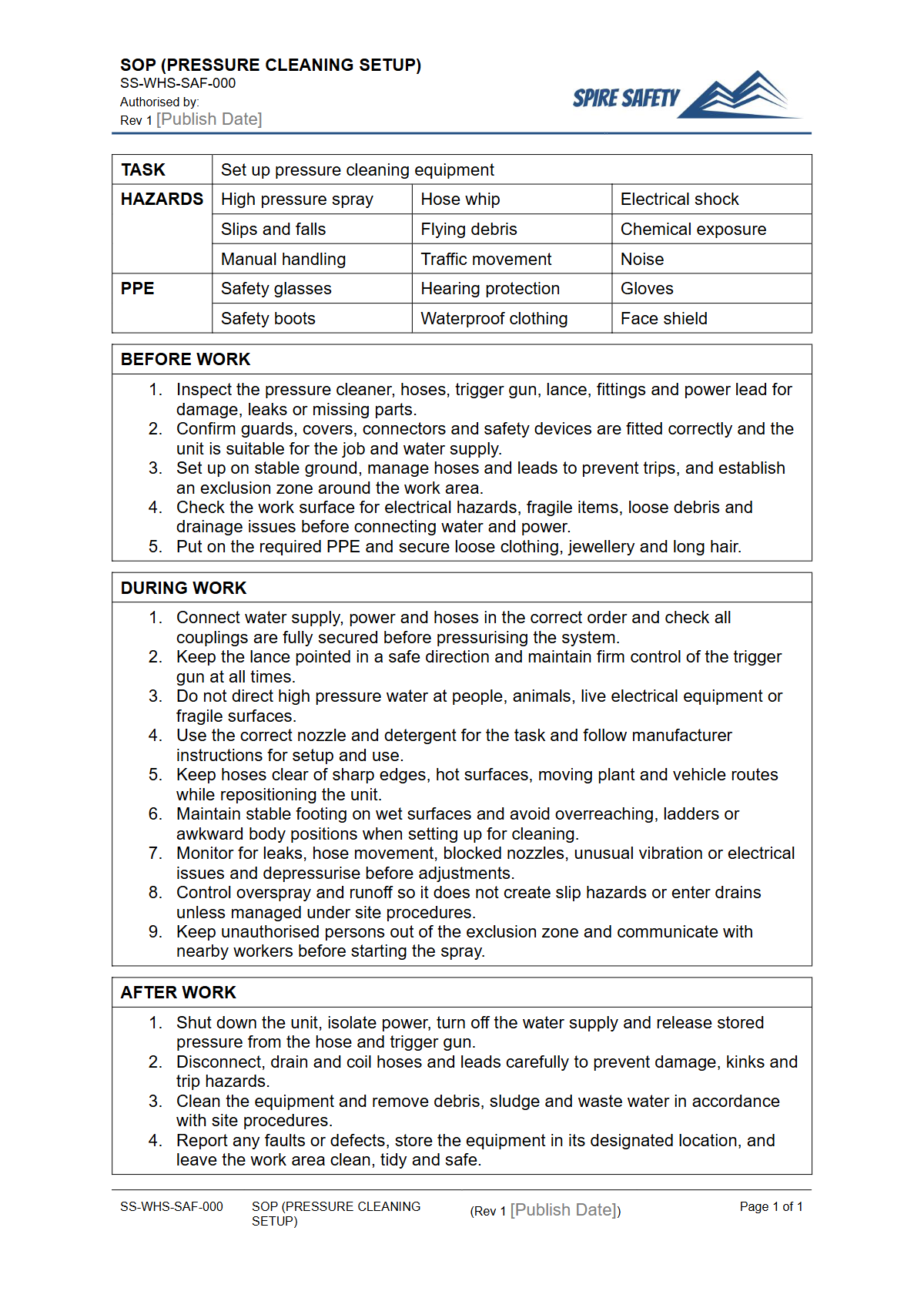
Effectively managing workplace risks starts with clear, documented processes. This free Safe Operating Procedure (Pressure Cleaning Setup) Template provides a structured framework for outlining the step-by-step requirements to safely prepare high-pressure cleaning equipment for use.
Using a standardised procedure helps control hazards associated with pressure cleaners, such as high-pressure water injection, electric shock, slips from wet surfaces, and musculoskeletal injuries from manual handling.
A Safe Operating Procedure (SOP) is a critical administrative control that formalises safe work practices, ensuring tasks are performed consistently and safely by all personnel. It supports operator training and reinforces your organisation's commitment to health and safety.
Similar to procedures for other common workplace equipment, like the process outlined in our Free Air Compressor SOP, this document helps standardise pre-operational checks and setup activities to minimise the likelihood of incidents.
Video walkthrough
How to use the Free Safe Operating Procedure (Pressure Cleaning Setup) Template
This template is provided in both an easily editable DOCX format and a print-ready PDF. The DOCX file allows you to add your company branding and tailor the content to your specific operational needs.
A well-developed SOP should detail the required Personal Protective Equipment (PPE), pre-start checks, step-by-step setup instructions, and emergency procedures.
Important Note: This document is a template and must be customised to your workplace. We have provided a structured starting point aligned with Australian WHS principles, but you must adapt it to reflect the specific models of pressure cleaners you use, the unique environment they are operated in, and your internal risk assessment findings.
Integrating site-specific details is essential for creating a truly effective safety document. If you require assistance with this process, our expert WHS consulting services can provide tailored support.
What's included in the template?
The template is designed to be comprehensive and includes sections for:
- Designated responsible persons
- Required PPE (e.g., safety glasses, gloves, waterproof boots)
- A detailed list of potential hazards and their controls
- Step-by-step instructions for pre-operational inspection and setup
- Procedures for nozzle selection and connection
- Emergency shutdown and first aid response
- Post-operation cleaning and storage steps
When to use a Safe Operating Procedure
A Safe Operating Procedure for pressure cleaning setup should be used as a primary reference document in several key situations. It is essential for inducting and training new operators, ensuring they understand the approved method for preparing the equipment from day one.
It also serves as a valuable refresher tool for experienced workers and a benchmark during competency assessments. Furthermore, this SOP should be reviewed and referenced after any incident or near-miss, or when new equipment is introduced, to ensure it remains relevant and effective.
This procedure should be readily accessible in the work area where pressure cleaners are stored and prepared. Integrating SOPs into your broader safety framework is a key component of robust WHS management systems, demonstrating a systematic approach to risk control.
Who should use this template
This template is designed for use by anyone responsible for health and safety management. This includes WHS Managers, Site Supervisors, and Team Leaders who are tasked with developing and implementing safe work documents.
It is also a practical tool for business owners in smaller organisations who need to formalise their safety processes to meet their duty of care. By providing a clear and logical format, the template simplifies the task of documenting safe procedures for common plant and equipment.
Periodically checking that documented procedures are being followed on the ground is also crucial. A formal WHS compliance audit can help verify that your SOPs are not just paperwork, but are actively being used to control risks in practice. For more templates covering different types of equipment, explore our complete free WHS resources library.
Common mistakes
Common mistakes to avoid
- Failing to inspect hoses, fittings, and lances for damage or wear before each use.
- Using the incorrect nozzle for the surface or task, leading to surface damage or dangerous kickback.
- Neglecting to wear appropriate PPE, particularly safety glasses or a face shield to protect against spray and debris.
- Not properly managing hoses and electrical cords, creating significant trip hazards in the work area.
Legal references
Legal considerations
The following legal requirements may be relevant to this type of work.
- Work Health and Safety Act (Harmonised) — Provides the primary duties for protecting workers and other people from work health and safety risks.
- Work Health and Safety Regulations (Harmonised) — Sets out requirements supporting the management of workplace hazards and risks.
The following codes may be relevant to this type of work.
- Managing WHS Risks Code of Practice — Provides practical guidance on identifying hazards, assessing risks and applying effective controls.
- Work Health and Safety Consultation, Cooperation and Coordination Code of Practice — Provides practical guidance on consulting workers and coordinating with other duty holders.
- Managing the Work Environment and Facilities Code of Practice — Provides practical guidance on safe work environments, workplace facilities and related controls.
Did you know
Injection Injury Risk
High-pressure water injection injuries can occur at pressures as low as 700 kPa (100 psi). The fluid can penetrate the skin and cause severe internal damage that may not be immediately visible.
FAQ
Frequently asked questions
01What is the difference between a Safe Operating Procedure (SOP) and a Safe Work Method Statement (SWMS)?
02Is this pressure cleaning setup SOP suitable for both electric and petrol-powered models?
03How often should our Safe Operating Procedures be reviewed?
04Do I still need a SOP if the manufacturer's instruction manual is available?
Share this resource
Free Safe Operating Procedure (Pressure Cleaning Setup) Template
Browse Categories
How To Use It
- 1Download and open in Word or PDF.
- 2Replace the placeholders with your business details.
- 3Get it reviewed by a WHS specialist before rollout.
Need it customised?
Our WHS consultants can adapt this template to your site, run a gap analysis, or audit what you already have in place.
Book a Free Consultation WHS consulting servicesor call 1300 156 382
Related templates
- Free Safe Operating Procedure (Pressure Cushion Check) Template
- Free Safe Operating Procedure (Pressure Gauge Test) Template
- Free Safe Operating Procedure (Pressure Mattress Check) Template
- Free Safe Operating Procedure (Pressure Transmitter) Template
- Free Safe Operating Procedure (Price Gun Use) Template
- Free Safe Operating Procedure (Printing Press) Template