
Free Safe Operating Procedure (Pressure Cushion Check) Template
Establish clear safety protocols with our free Safe Operating Procedure (Pressure Cushion Check) template. Download the customisable DOCX to get started.
Free Safe Operating Procedure (Pressure Cushion Check) Template
DOCX • 126 KB + PDF
Updated Oct 2026
No signup required
Purpose of the Free Safe Operating Procedure (Pressure Cushion Check) Template
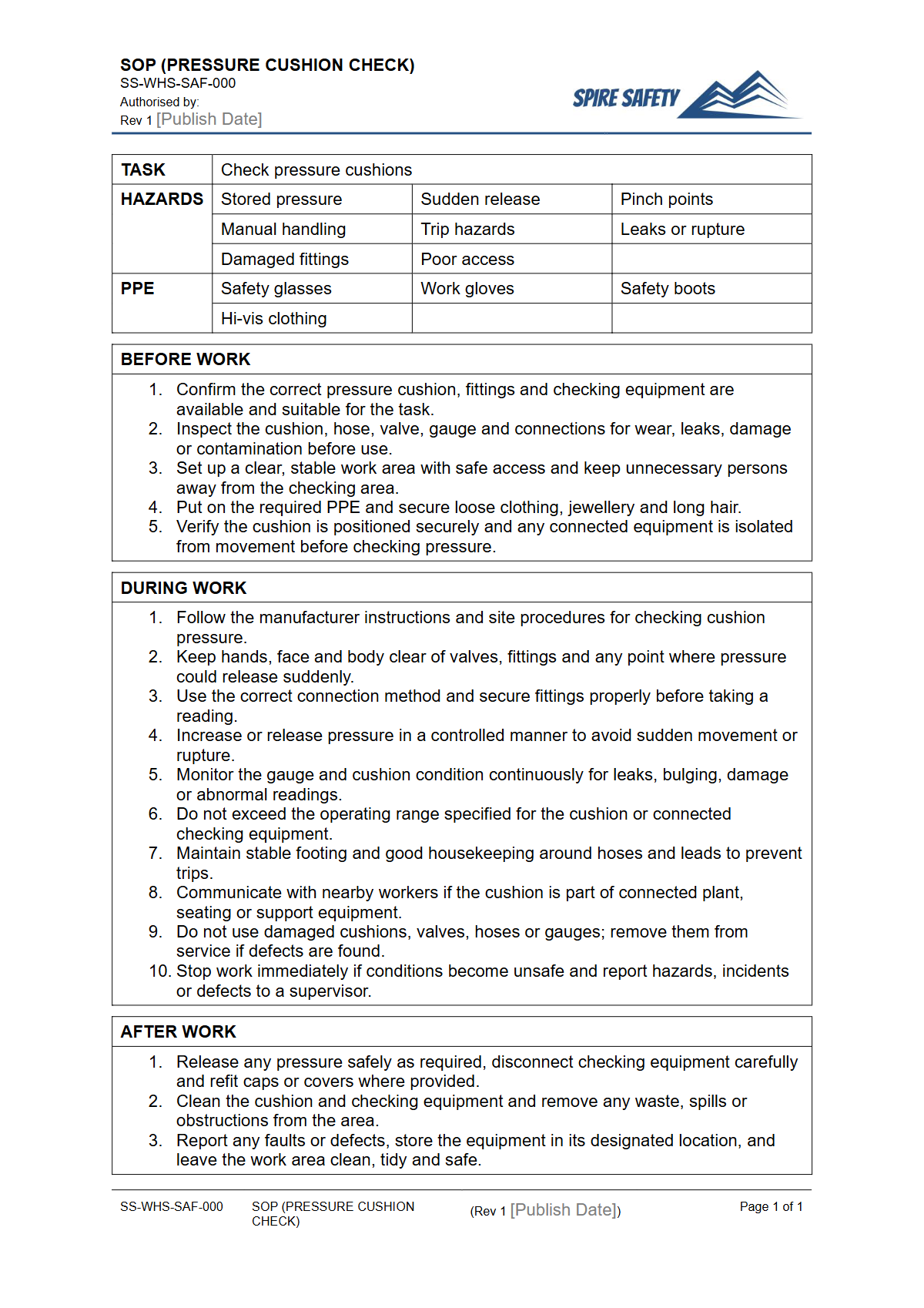
This Free Safe Operating Procedure (Pressure Cushion Check) Template provides a structured framework for ensuring pressure-relieving cushions are safe, functional, and effective. Pressure cushions are critical medical devices used to prevent pressure injuries (also known as pressure sores or bedsores) for individuals with limited mobility, particularly in hospital and aged care settings.
An SOP formalises the inspection process, ensuring that every check is performed consistently and thoroughly by all staff.
By documenting the step-by-step process for visual and physical inspections, this SOP helps organisations meet their duty of care obligations. It ensures that potential defects, such as leaks in air cushions, hardening of gel, or damage to covers, are identified and rectified promptly.
This proactive approach not only protects patients and residents but also creates an auditable record of equipment maintenance. A well-defined SOP is a critical component of your overall safety framework, and its effectiveness can be verified through periodic WHS compliance auditing.
Video walkthrough
How to use the Free Safe Operating Procedure (Pressure Cushion Check) Template
This template is available for download as a DOCX file, which can be easily edited in Microsoft Word or other word-processing software. A PDF version is also provided for easy printing and distribution.
The primary purpose of this document is to serve as a solid starting point, which you must then adapt to your specific operational context.
Please note: This document is a template and not a complete Safe Operating Procedure. You must customise it with your specific workplace details, including site information, equipment models, personnel roles, and any state-specific WHS regulations.
We are not responsible for the outcomes of a document that has not been correctly adapted to your unique environment.
Customisation Steps:
- Review and Edit: Go through the entire document and identify sections that require site-specific information.
- Add Details: Insert the names of your facility, specific models of pressure cushions in use, and the roles of personnel responsible for conducting the checks (e.g., Registered Nurse, Care Assistant).
- Consultation: Share the draft SOP with the workers who will be using it. Their direct feedback is invaluable for creating a practical and effective procedure. Also consult with supervisors and health and safety representatives.
- Approval: Finalise the document and have it formally approved by management or the relevant person with health and safety authority.
- Training: Use the finalised SOP as a basis for training all relevant staff. Ensure everyone understands their responsibilities and the importance of each step.
Integrating this SOP into your broader WHS management systems ensures that procedures are consistently applied, reviewed, and improved over time, contributing to a culture of safety and continuous improvement.
When to use this Safe Operating Procedure
The pressure cushion check SOP should be integrated into your facility's regular clinical and maintenance workflows. It should be used at several key moments to ensure equipment integrity and patient safety:
- Upon Receipt: Before a new pressure cushion is put into service for the first time.
- Routine Inspections: As part of a regular, scheduled checking protocol. The frequency (e.g., daily visual check, weekly physical check) should be determined by a risk assessment and aligned with the manufacturer's recommendations.
- Between Users: When a cushion is being re-allocated from one person to another, it must be thoroughly inspected and cleaned.
- Post-Incident: After any event that could have damaged the cushion, such as a fluid spill, a drop, or being stored incorrectly.
- In Response to Concerns: Whenever a patient, resident, or staff member reports discomfort, a change in performance, or a suspected fault with the cushion.
This systematic approach to safety is crucial across all departments, from patient care to kitchen operations, which might use a Safe Operating Procedure for a deep fryer.
Who should use this Safe Operating Procedure
This SOP is designed for use by various personnel within a healthcare or residential care organisation. The responsibility for performing checks should be clearly assigned to ensure accountability. Key users include:
- Nurses and Clinical Staff: As part of their daily care routines, they are often the first to notice issues with patient equipment.
- Care and Support Workers: Staff who assist with patient mobility and daily living activities should be trained to perform routine visual checks.
- Maintenance or Equipment Officers: Personnel responsible for the facility's equipment inventory may conduct more in-depth, scheduled inspections and manage repairs or replacements.
- Supervisors and Managers: Team leaders and facility managers should use the SOP to oversee compliance, conduct audits, and ensure staff are adequately trained.
For complex environments or for assistance in developing a full suite of safety documents, engaging with professional WHS consulting services can provide expert guidance. You can also find templates for other common tasks and equipment in our free WHS resources library.
Common mistakes
Common mistakes to avoid
- Forgetting to check the cushion cover for stains, tears, or zipper damage.
- Only performing a visual check without physically palpating the cushion to feel for deflation or hardening.
- Failing to document the check, leaving no record of the equipment's condition for auditing purposes.
- Not cross-referencing checks against the manufacturer's specific guidelines for that model.
Legal references
Legal considerations
The following legal requirements may be relevant to this type of work.
- Work Health and Safety Act (Harmonised) — Provides the primary duties for protecting workers and other people from work health and safety risks.
- Work Health and Safety Regulations (Harmonised) — Sets out requirements supporting the management of workplace hazards and risks.
The following codes may be relevant to this type of work.
- Managing WHS Risks Code of Practice — Provides practical guidance on identifying hazards, assessing risks and applying effective controls.
- Work Health and Safety Consultation, Cooperation and Coordination Code of Practice — Provides practical guidance on consulting workers and coordinating with other duty holders.
- Managing the Work Environment and Facilities Code of Practice — Provides practical guidance on safe work environments, workplace facilities and related controls.
Did you know
The Cost of Pressure Injuries
Pressure injuries are a significant healthcare challenge in Australia, costing the health and aged care system over $983 million annually. The vast majority of these injuries are preventable with appropriate care and effective equipment management.
Cushion Lifespan
The effective lifespan of a pressure cushion can vary from 1 to 5 years depending on its material, construction, and usage intensity. Regular checks as outlined in an SOP help identify when a cushion is nearing the end of its life and needs replacement.
FAQ
Frequently asked questions
01What is a pressure cushion and why does it need an SOP?
02How often should a pressure cushion check be performed?
03Can I use this template for any type of pressure cushion?
04Who is responsible for training staff on this Safe Operating Procedure?
Share this resource
Free Safe Operating Procedure (Pressure Cushion Check) Template
Browse Categories
How To Use It
- 1Download and open in Word or PDF.
- 2Replace the placeholders with your business details.
- 3Get it reviewed by a WHS specialist before rollout.
Need it customised?
Our WHS consultants can adapt this template to your site, run a gap analysis, or audit what you already have in place.
Book a Free Consultation WHS consulting servicesor call 1300 156 382
Related templates
- Free Safe Operating Procedure (Pressure Gauge Test) Template
- Free Safe Operating Procedure (Pressure Mattress Check) Template
- Free Safe Operating Procedure (Pressure Transmitter) Template
- Free Safe Operating Procedure (Price Gun Use) Template
- Free Safe Operating Procedure (Printing Press) Template
- Free Safe Operating Procedure (Privacy Curtain Change) Template