
Free Safe Operating Procedure (Powered Respirator) Template
Download our free Safe Operating Procedure for powered respirators. This template helps you document safe work methods and controls for respiratory protection.
Free Safe Operating Procedure (Powered Respirator) Template
DOCX • 126 KB + PDF
Updated Oct 2026
No signup required
Purpose of the Free Safe Operating Procedure (Powered Respirator) Template
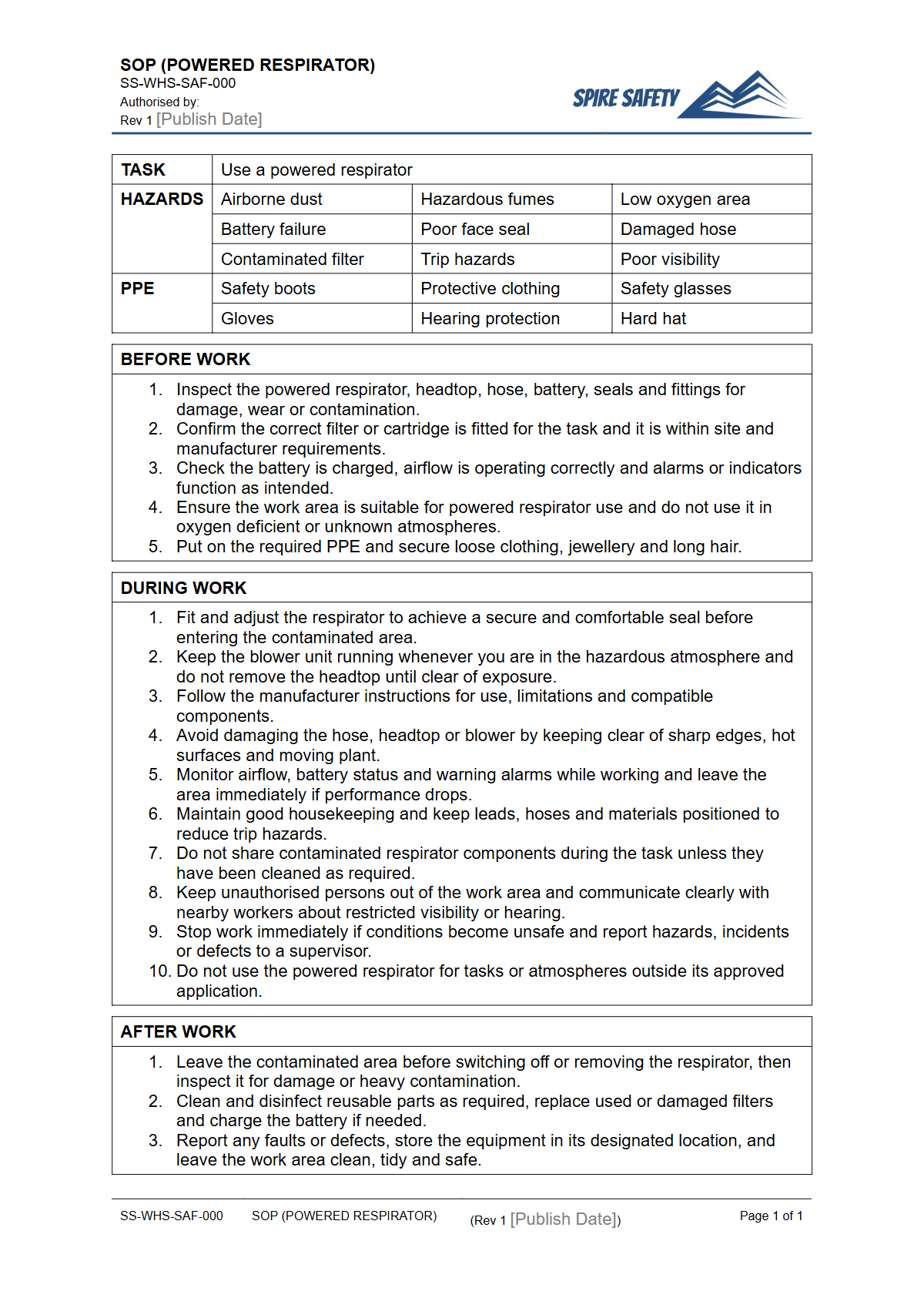
A powered respirator, often a Powered Air-Purifying Respirator (PAPR), is a critical piece of personal protective equipment (PPE) for protecting workers from airborne contaminants. This Free Safe Operating Procedure (Powered Respirator) Template provides a structured framework for documenting the essential steps for its safe use, maintenance, and storage.
An SOP is a formal document that details a logical sequence of actions to perform a task safely and correctly, minimising risks to health and safety. Using this template helps ensure all operators receive consistent, clear instructions, reducing the chance of user error and exposure to hazardous substances like dust, fumes, or vapours. It forms a vital component of your broader respiratory protection program and demonstrates a commitment to robust WHS management systems.
Video walkthrough
How to use the Free Safe Operating Procedure (Powered Respirator) Template
This resource is available as a DOCX file for easy editing and a PDF for stable distribution. To effectively implement this Safe Operating Procedure for powered respirators, you should first download the customisable Word document.
Then, in consultation with workers who use the equipment and their supervisors, adapt the content to match your specific operational context. This includes detailing the exact models of respirators used, the specific workplace hazards, and established procedures for tasks like battery charging and filter changes.
Tasks that generate airborne contaminants, such as those covered in our FREE Circular Saw SOP, often necessitate the use of effective respiratory protection documented in this manner.
Note: This document is a template and must be customised to your workplace. We are not responsible for the outcomes of its use.
You must adapt the content to reflect the specific equipment, chemicals, risks, and control measures present in your work environment. The final document should be reviewed and approved by a competent person before implementation.
When to use it
A documented SOP for powered respirators should be in place whenever this type of equipment is issued as a control measure against respiratory hazards. It is particularly important in environments where airborne contaminant levels exceed the relevant workplace exposure standard and other higher-order controls are not reasonably practicable.
Common industries include construction, manufacturing, welding, spray painting, pharmaceuticals, and healthcare. This procedure should be used as a primary training tool during worker induction and for refresher training.
It also serves as a critical reference for supervisors monitoring work and for investigators analysing any health and safety incidents. Similar procedural discipline is required for other specialised equipment, as outlined in our Free Air Compressor SOP.
Who should use it
The completed Safe Operating Procedure is intended for all personnel required to wear, clean, or maintain powered respirators. This includes operators, maintenance staff, and cleaners.
The development and review process, however, should involve a broader group. WHS managers, site supervisors, and the Person Conducting a Business or Undertaking (PCBU) are responsible for ensuring the procedure is accurate, comprehensive, and effectively implemented.
Critically, direct consultation with the workers who will be using the respirators is not just good practice—it's a fundamental part of ensuring the SOP is practical and addresses the real-world challenges they face. The existence and proper use of such procedures are often a key focus during a WHS compliance auditing process.
Key elements of an effective respirator procedure
A robust SOP for powered respirators goes beyond simple operating instructions. It should be a comprehensive guide covering the full lifecycle of the equipment's use.
Our template prompts you to include several key sections to ensure completeness.
Pre-Operational Checks
Before every use, operators must inspect the equipment. This includes checking the battery is fully charged, ensuring the correct filter type is installed and is within its service life, inspecting the breathing tube for damage, and checking the hood or facepiece for tears or defects.
Donning and Doffing
The procedure must detail the correct sequence for putting on (donning) and taking off (doffing) the respirator. A correct donning sequence ensures an effective seal and proper function, while a correct doffing sequence is vital to prevent contaminating the user or their environment.
Maintenance and Storage
Clear instructions for cleaning, disinfection, and storage are essential. The SOP should specify cleaning agents, battery charging protocols, and the filter replacement schedule based on manufacturer recommendations and workplace conditions.
Proper storage in a clean, dry location prevents damage and ensures the respirator is ready for the next use. Documenting procedures for all high-risk plant is critical, as shown in resources like our FREE Trencher SOP.
Common mistakes
Common mistakes to avoid
- Forgetting to perform pre-use checks on the battery, filters, and hoses.
- Using the incorrect type of filter for the specific airborne contaminant.
- Improper donning or doffing, which can compromise protection or lead to self-contamination.
- Neglecting scheduled cleaning, maintenance, and proper storage, reducing the equipment's effectiveness and lifespan.
Legal references
Legal considerations
The following legal requirements may be relevant to this type of work.
- Work Health and Safety Act (Harmonised) — Provides the primary duties for protecting workers and other people from work health and safety risks.
- Work Health and Safety Regulations (Harmonised) — Sets out requirements supporting the management of workplace hazards and risks.
The following codes may be relevant to this type of work.
- Managing WHS Risks Code of Practice — Provides practical guidance on identifying hazards, assessing risks and applying effective controls.
- Work Health and Safety Consultation, Cooperation and Coordination Code of Practice — Provides practical guidance on consulting workers and coordinating with other duty holders.
- Managing the Work Environment and Facilities Code of Practice — Provides practical guidance on safe work environments, workplace facilities and related controls.
Did you know
Positive Pressure
The positive pressure inside a powered respirator's hood means that if a small leak occurs, clean filtered air is more likely to leak out than contaminated air is to leak in. This provides a higher assigned protection factor (APF) than many other respirator types.
FAQ
Frequently asked questions
01Is a Safe Operating Procedure a legal requirement for powered respirators in Australia?
02How often should a powered respirator SOP be reviewed?
03What's the difference between a PAPR and a regular respirator?
04Do workers need fit testing for all powered respirators?
Share this resource
Free Safe Operating Procedure (Powered Respirator) Template
Browse Categories
How To Use It
- 1Download and open in Word or PDF.
- 2Replace the placeholders with your business details.
- 3Get it reviewed by a WHS specialist before rollout.
Need it customised?
Our WHS consultants can adapt this template to your site, run a gap analysis, or audit what you already have in place.
Book a Free Consultation WHS consulting servicesor call 1300 156 382
Related templates
- Free Safe Operating Procedure (Pressure Calibrator) Template
- Free Safe Operating Procedure (Pressure Cleaning Setup) Template
- Free Safe Operating Procedure (Pressure Cushion Check) Template
- Free Safe Operating Procedure (Pressure Gauge Test) Template
- Free Safe Operating Procedure (Pressure Mattress Check) Template
- Free Safe Operating Procedure (Pressure Transmitter) Template