
Free Safe Operating Procedure (Powered Pallet Mover) Template
Establish clear guidelines for using powered pallet movers with our free SOP template. Download this customisable resource to improve workplace safety.
Free Safe Operating Procedure (Powered Pallet Mover) Template
DOCX • 126 KB + PDF
Updated Oct 2026
No signup required
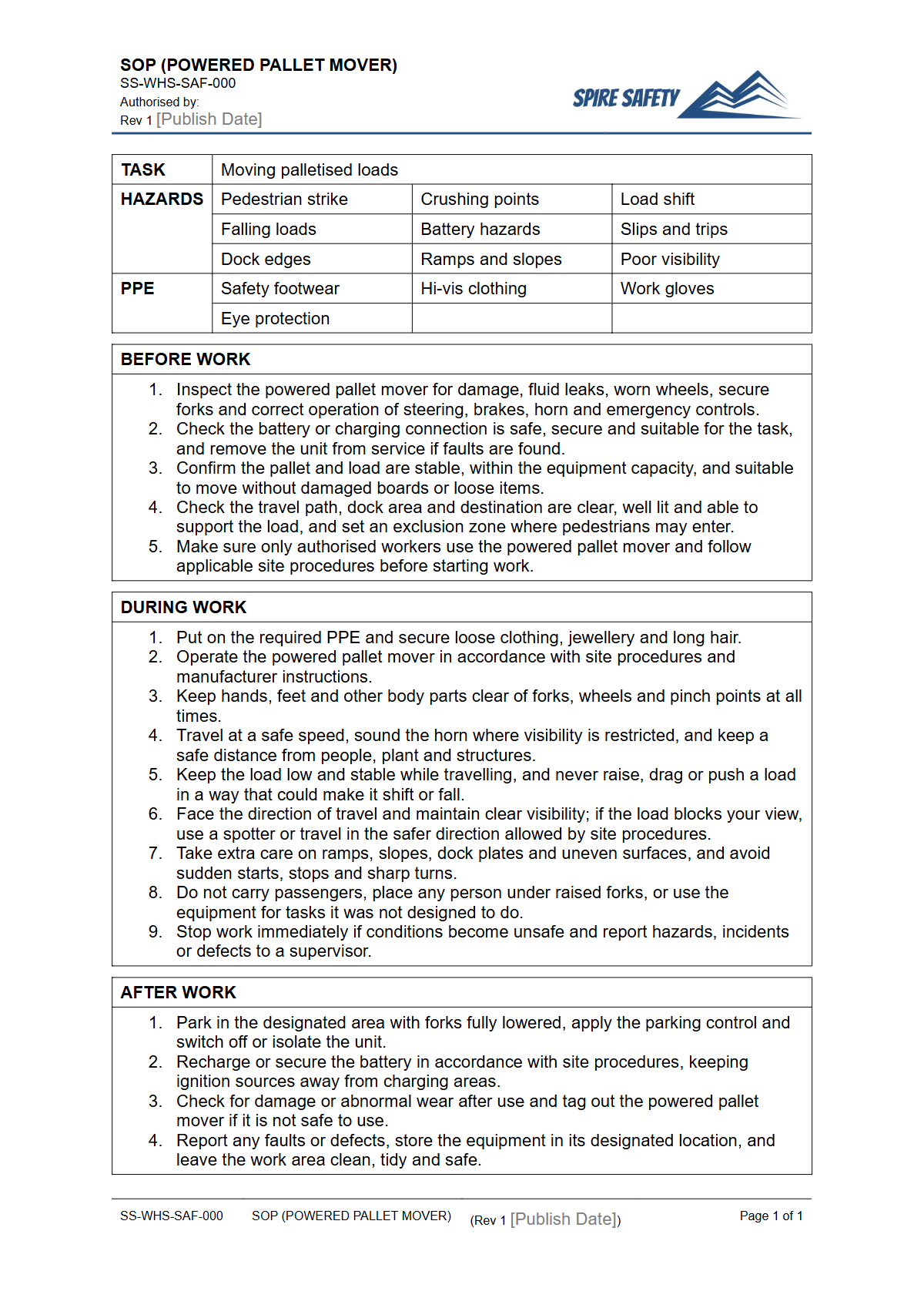
Purpose of the Free Safe Operating Procedure (Powered Pallet Mover) Template
This Free Safe Operating Procedure (Powered Pallet Mover) Template provides a structured framework for documenting the safe use of electric pallet movers, also known as walkie stackers or electric pallet jacks. A comprehensive SOP is a fundamental tool for managing risks in any workplace where this equipment is used, forming a key part of your overall safety management approach.
It clearly outlines the step-by-step processes required to operate the machinery safely, helping to prevent injuries to operators and other personnel in the vicinity.
By implementing a detailed SOP, you can standardise operating protocols, ensuring every worker follows a consistent, pre-approved method. This document serves as an essential reference during worker training, inductions, and competency assessments.
Properly developed and implemented, this procedure helps your organisation meet its primary duty of care under WHS legislation by controlling risks associated with powered mobile plant. Integrating this SOP into your broader safety framework is a practical step towards building robust WHS management systems that protect your workers and your business.
Video walkthrough
How to use the Free Safe Operating Procedure (Powered Pallet Mover) Template
To get started, simply download the template in your preferred format (DOCX for easy editing or PDF). The document is structured to guide you through detailing all necessary safety stages, including pre-operational checks, hazard identification, specific operating instructions, and shutdown procedures.
It contains sections for you to define the required personal protective equipment (PPE), list potential hazards, and specify the control measures relevant to your site.
Important: This template is a starting point. To be effective and assist with your safety obligations, you must customise it to reflect the specific equipment models, environmental conditions, and unique risks present in your workplace.
We've included prompts and sections for you to fill in with site-specific information. Consultation with your workers during this customisation process is critical to ensure the final SOP is practical and reflects on-the-ground realities.
For businesses using various types of mobile plant, you may find our FREE Telehandler SOP Template a useful companion document.
When to use a Powered Pallet Mover SOP
A Safe Operating Procedure for a powered pallet mover should be developed and implemented before any worker is authorised to operate the equipment. It is a foundational document that underpins all related safety activities.
It should be actively used as the primary training document for all new operators to ensure they understand the established safe work method from day one. The pre-start inspection checklist within the SOP should be completed by the operator before every shift to verify the equipment is safe to use.
The SOP also serves as a critical reference tool for supervisors conducting safety observations or for workers who need to refresh their knowledge. Furthermore, it should be a key document reviewed during safety meetings and incident investigations.
Regular reviews of your procedures are a core part of continuous improvement and can be validated through internal or external WHS compliance auditing to ensure they remain current and effective.
Who should use this Safe Operating Procedure
This SOP is intended for a range of personnel within an organisation. The Person Conducting a Business or Undertaking (PCBU), along with their managers and supervisors, are responsible for ensuring the SOP is developed, customised, and properly implemented.
They use it to train workers, enforce safe practices, and meet their WHS obligations. Supervisors will find it invaluable for conducting toolbox talks and verifying that correct procedures are being followed on the floor.
Operators of powered pallet movers are the primary end-users of the SOP. They must be trained on its contents and are expected to follow the prescribed steps during their daily tasks, from pre-start checks to parking and charging the unit.
Health and Safety Representatives (HSRs) and committee members will also use the document as a benchmark when conducting workplace inspections and reviewing risk controls. For workplaces with integrated logistics, this procedure can work alongside other documents like our FREE Conveyer System SOP to create a cohesive safety system for materials handling.
By providing a clear, accessible guide, this template helps foster a proactive safety culture where everyone understands their role in preventing incidents. To discover more templates and checklists for other common workplace hazards, explore our complete free WHS resources library.
Common mistakes
Common mistakes to avoid
- Using a generic, non-customised template without a site-specific risk assessment.
- Failing to train operators on the specific SOP and verify their competency before use.
- Neglecting to include procedures for battery charging, maintenance, and emergency situations.
- Not reviewing or updating the SOP after an incident or when changes occur in the work environment.
Legal references
Legal considerations
The following legal requirements may be relevant to this type of work.
- Work Health and Safety Act (Harmonised) — Provides the primary duties for protecting workers and other people from work health and safety risks.
- Work Health and Safety Regulations (Harmonised) — Sets out requirements supporting the management of workplace hazards and risks.
The following codes may be relevant to this type of work.
- Managing WHS Risks Code of Practice — Provides practical guidance on identifying hazards, assessing risks and applying effective controls.
- Work Health and Safety Consultation, Cooperation and Coordination Code of Practice — Provides practical guidance on consulting workers and coordinating with other duty holders.
- Managing the Work Environment and Facilities Code of Practice — Provides practical guidance on safe work environments, workplace facilities and related controls.
Did you know
Pedestrian Safety is Key
A significant portion of incidents involving powered pallet movers are collisions with pedestrians. Maintaining clear separation between people and plant, such as designated walkways and exclusion zones, is a critical risk control.
Battery Charging Hazards
The batteries in electric pallet movers can present chemical, electrical, and fire hazards. A dedicated, well-ventilated charging area with appropriate spill kits, PPE, and fire protection is an essential part of the safe system of work.
FAQ
Frequently asked questions
01What is a Safe Operating Procedure (SOP) for a powered pallet mover?
02Are powered pallet movers considered high-risk work?
03How often should we review our powered pallet mover SOP?
04Who is responsible for developing the SOP?
Share this resource
Free Safe Operating Procedure (Powered Pallet Mover) Template
Browse Categories
How To Use It
- 1Download and open in Word or PDF.
- 2Replace the placeholders with your business details.
- 3Get it reviewed by a WHS specialist before rollout.
Need it customised?
Our WHS consultants can adapt this template to your site, run a gap analysis, or audit what you already have in place.
Book a Free Consultation WHS consulting servicesor call 1300 156 382
Related templates
- Free Safe Operating Procedure (Powered Respirator) Template
- Free Safe Operating Procedure (Pressure Calibrator) Template
- Free Safe Operating Procedure (Pressure Cleaning Setup) Template
- Free Safe Operating Procedure (Pressure Cushion Check) Template
- Free Safe Operating Procedure (Pressure Gauge Test) Template
- Free Safe Operating Procedure (Pressure Mattress Check) Template