
Free Safe Operating Procedure (Poultry Feeding) Template
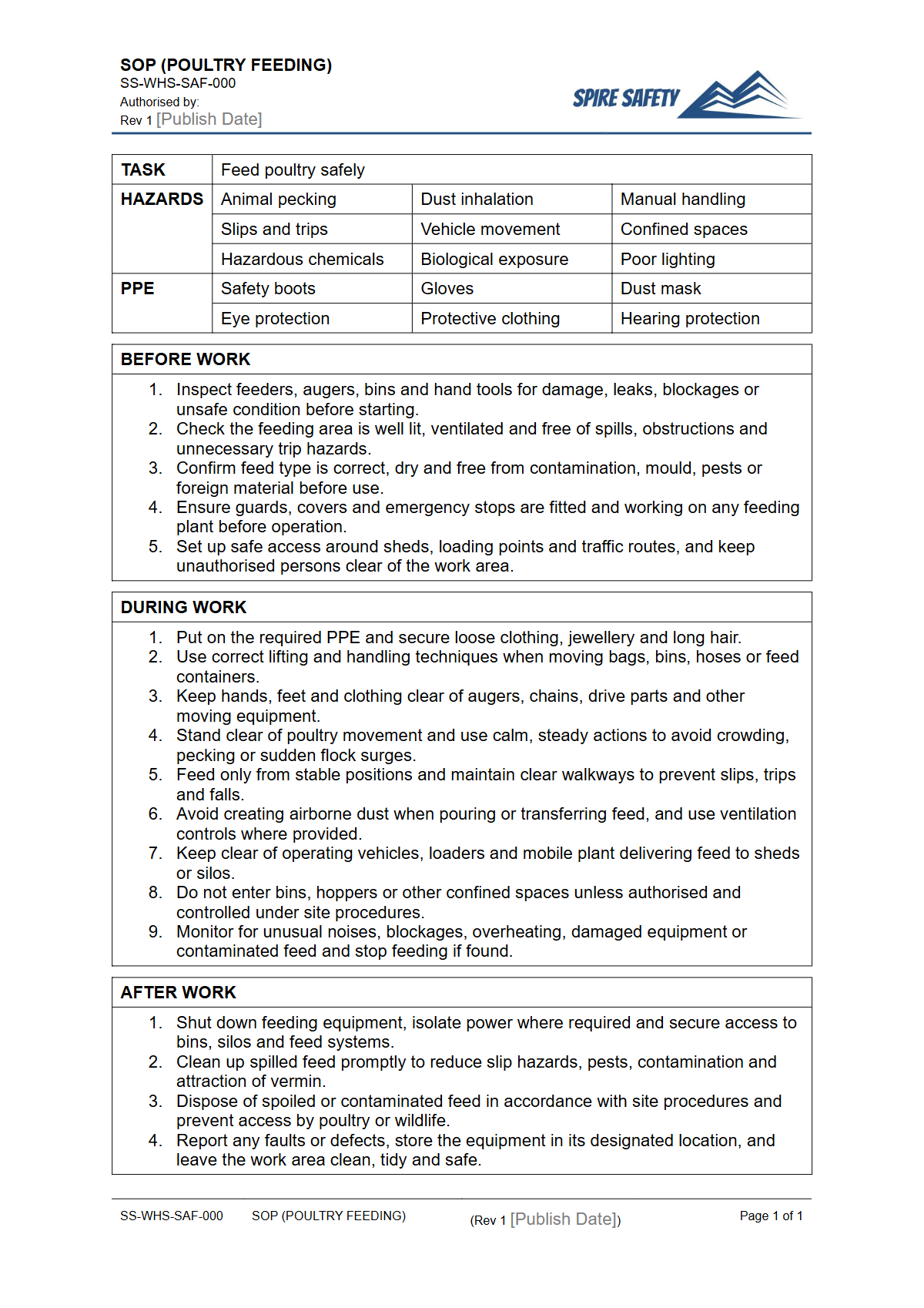
Formalise safety around poultry feeding tasks with our customisable template. Download your free Safe Operating Procedure to get started on improving safety.
Free Safe Operating Procedure (Poultry Feeding) Template
DOCX • 126 KB + PDF
Updated Oct 2026
No signup required
Purpose of the Free Safe Operating Procedure (Poultry Feeding) Template
Managing safety in an agricultural environment requires clear, practical guidance for high-risk tasks. Our Free Safe Operating Procedure (Poultry Feeding) Template provides a structured starting point for farms to formalise risk controls.
Poultry feeding involves significant hazards, including mechanical risks from augers and conveyors, respiratory illnesses from feed dust, manual handling injuries from lifting heavy bags, and biological hazards from direct contact with poultry. This SOP template helps you systematically address these risks by outlining step-by-step instructions for workers, required personal protective equipment (PPE), and emergency procedures.
Implementing a documented SOP demonstrates a commitment to workplace safety and provides a consistent training tool for new and existing staff. Well-developed SOPs are a critical component of effective WHS management systems, helping to standardise and communicate safe work practices across your entire operation.
Key Hazards Addressed:
- Mechanical: Entanglement in augers, conveyors, or other moving parts of automated feeding systems.
- Respiratory: Inhalation of organic dust from feed, which can lead to conditions like Farmer's Lung or Occupational Asthma.
- Manual Handling: Strains and sprains from lifting, carrying, and tipping heavy bags of feed.
- Biological: Exposure to pathogens, such as Salmonella and Campylobacter, and zoonotic diseases.
- Slips, Trips, and Falls: Hazards from spilled feed, water, and uneven surfaces within poultry sheds.
Video walkthrough
How to use the Free Safe Operating Procedure (Poultry Feeding) Template
This document is provided as a fully editable DOCX file, allowing for complete customisation. The key to an effective SOP is ensuring it reflects the specific equipment, environment, and processes of your workplace.
Begin by conducting a risk assessment on your poultry feeding tasks, involving the workers who perform them daily. Their input is invaluable for identifying practical hazards and effective controls.
Note: We have created this template as a starting point. It is not a complete, out-of-the-box solution.
You must adapt the content to align with your farm's unique machinery, feed types, shed layout, and existing safety procedures. For instance, if your site uses specific machinery to move bulk feed bags, you may need to cross-reference with procedures like our Telehandler SOP.
When to use it
A Safe Operating Procedure for poultry feeding should be a living document, used actively rather than filed away. It is essential during worker induction and training to ensure new team members understand the established safe methods from day one.
It should also be a reference point for pre-start checks and a resource during toolbox talks to refresh knowledge and discuss any recent near misses. The SOP must be reviewed and updated whenever there is a change in equipment, feed type, or work processes, or following any incident or injury.
Who should use it
This SOP is designed for use by anyone involved in the poultry production chain. Farm Owners and Managers should use it to fulfil their duty of care by establishing a safe system of work.
WHS Officers and Supervisors are responsible for implementing the SOP, providing training, and ensuring workers adhere to its instructions. Most importantly, the workers performing the feeding tasks must use the SOP to understand the hazards and the safety measures they need to follow to protect themselves and their colleagues. You can find other useful templates and checklists in our library of free WHS resources.
Common mistakes
Common mistakes to avoid
- Using the template without conducting a site-specific risk assessment.
- Failing to train workers on the finalised SOP and confirm their understanding.
- Not reviewing or updating the SOP after an equipment change or near miss.
- Storing the document in an office instead of making it easily accessible to workers in their work area.
Legal references
Legal considerations
The following legal requirements may be relevant to this type of work.
- Work Health and Safety Act (Harmonised) — Provides the primary duties for protecting workers and other people from work health and safety risks.
- Work Health and Safety Regulations (Harmonised) — Sets out requirements supporting the management of workplace hazards and risks.
The following codes may be relevant to this type of work.
- Managing WHS Risks Code of Practice — Provides practical guidance on identifying hazards, assessing risks and applying effective controls.
- Work Health and Safety Consultation, Cooperation and Coordination Code of Practice — Provides practical guidance on consulting workers and coordinating with other duty holders.
- Managing the Work Environment and Facilities Code of Practice — Provides practical guidance on safe work environments, workplace facilities and related controls.
Did you know
Dust Dangers
Organic dust in poultry sheds can contain feed particles, dried faeces, and microbes. Chronic inhalation can lead to serious respiratory conditions known as 'Farmer's Lung', making appropriate respiratory protective equipment (RPE) essential.
Auger Accidents
Augers, commonly used in automated feeding systems, are a leading cause of serious farm injuries. A person can become entangled in an unguarded auger in seconds, often resulting in amputation or death.
FAQ
Frequently asked questions
01What are the main hazards in poultry feeding?
02Is this template suitable for all types of poultry farms?
03How often should an SOP for poultry feeding be reviewed?
04Who is responsible for enforcing a Safe Operating Procedure?
Share this resource
Free Safe Operating Procedure (Poultry Feeding) Template
Browse Categories
How To Use It
- 1Download and open in Word or PDF.
- 2Replace the placeholders with your business details.
- 3Get it reviewed by a WHS specialist before rollout.
Need it customised?
Our WHS consultants can adapt this template to your site, run a gap analysis, or audit what you already have in place.
Book a Free Consultation WHS consulting servicesor call 1300 156 382
Related templates
- Free Safe Operating Procedure (Poultry Litter Change) Template
- Free Safe Operating Procedure (Powder Coating) Template
- Free Safe Operating Procedure (Power File) Template
- Free Safe Operating Procedure (Power Scraper) Template
- Free Safe Operating Procedure (Power Shears) Template
- Free Safe Operating Procedure (Power Trowel) Template