
Free Safe Operating Procedure (Poultry Litter Change) Template
Properly managing poultry litter changes is crucial for biosecurity and worker safety. Download our free Safe Operating Procedure template to get started.
Free Safe Operating Procedure (Poultry Litter Change) Template
DOCX • 126 KB + PDF
Updated Oct 2026
No signup required
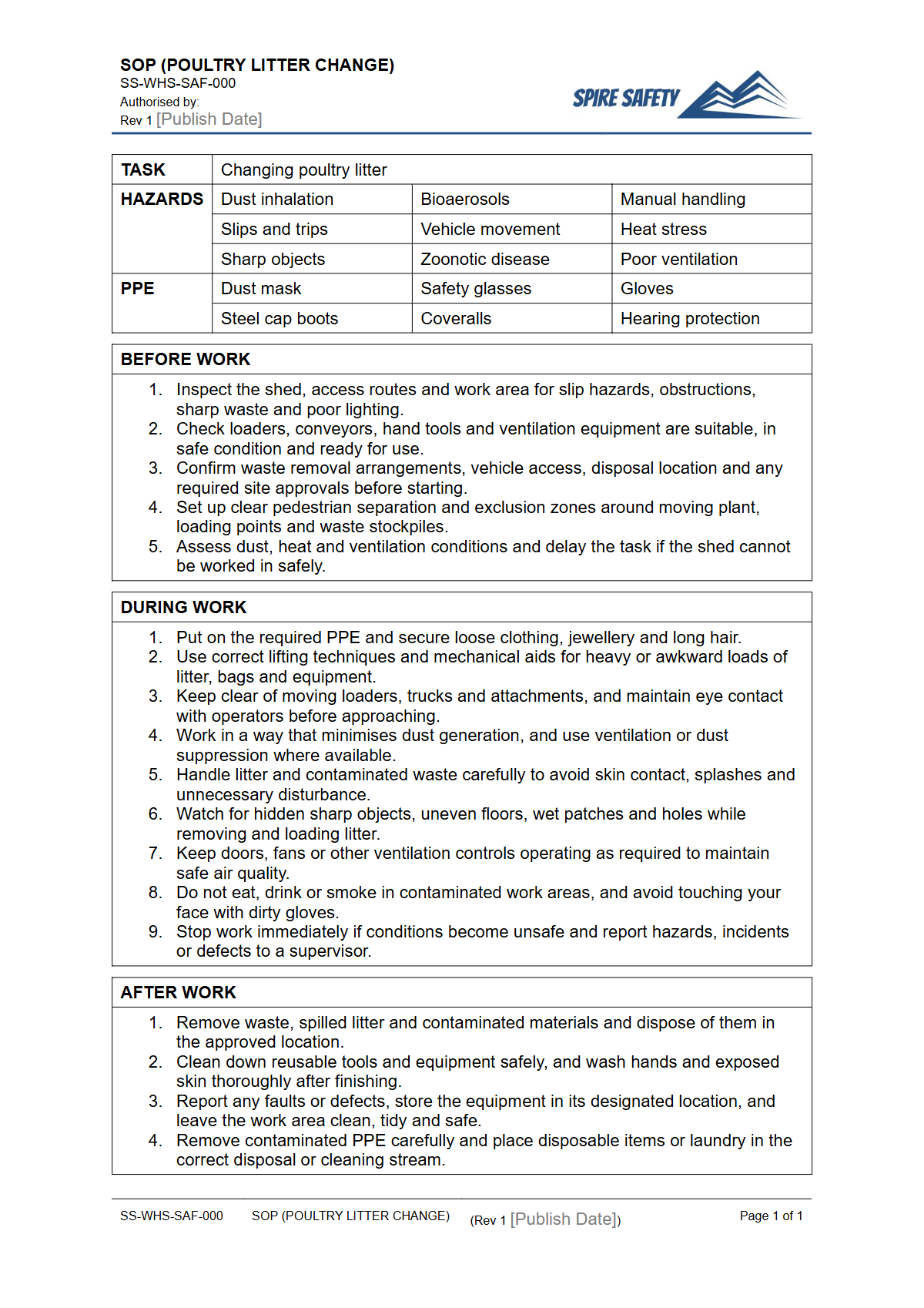
Purpose of the Free Safe Operating Procedure (Poultry Litter Change) Template
Changing poultry litter is a high-risk activity that involves exposure to biological hazards, dust, ammonia, and potential machinery-related incidents. This Free Safe Operating Procedure (Poultry Litter Change) Template provides a structured framework for documenting a safe system of work for this critical farm task.
A documented SOP helps ensure that all workers follow a consistent, safe method, minimising the risk of respiratory illness, zoonotic diseases, and musculoskeletal injuries. Implementing robust SOPs is a fundamental part of effective WHS management systems, demonstrating a commitment to proactive risk management in your agricultural operation.
Video walkthrough
How to use the Free Safe Operating Procedure (Poultry Litter Change) Template
This template is designed as a starting point. It must be customised to reflect the specific equipment, layout, and conditions of your poultry sheds.
To use the template, download the DOCX file and work through each section, consulting with the workers who actually perform the task. Detail the specific personal protective equipment (PPE), pre-operational checks for machinery like skid steers or tractors, and the step-by-step process for removing old litter and applying new bedding.
For related tasks involving machinery, you might also find our FREE Spreader SOP a useful reference for applying new bedding material.
Important: Customise to Your Workplace
This document is a template, not a finished product. We cannot guarantee it covers all specific hazards at your site.
You must adapt it by adding your company name, ABN, and site-specific details. It is crucial to conduct your own risk assessment and consult with your team to ensure the final SOP is comprehensive and accurately reflects your operational reality.
When to use a Safe Operating Procedure for Poultry Litter Change
An SOP for poultry litter change should be used every time the task is performed, whether it's a partial top-up or a full clean-out between flocks. It is especially critical when training new employees, introducing new equipment, or when contractors are brought on-site to assist.
Regularly reviewing the SOP with experienced operators ensures procedures remain current and effective. For example, if your process involves using specific machinery, you should have corresponding SOPs, such as our FREE Telehandler SOP Template if one is used for moving litter.
Who should use it
This Safe Operating Procedure should be used by all personnel involved in the litter change process, including farmhands, machinery operators, and supervisors. Supervisors are responsible for ensuring workers are trained on the SOP and that the specified controls are implemented and followed.
Farm managers should use the document as a tool for training, competency assessment, and incident investigation. If you require assistance in developing and implementing SOPs tailored to your business, consider engaging expert WHS consulting services.
Key Hazards in Poultry Litter Management
Beyond the procedural steps, it's vital to understand the underlying hazards the SOP aims to control. These include:
- Atmospheric Contaminants: High concentrations of ammonia, hydrogen sulphide, dust, and airborne microorganisms (like bacteria and fungi) can cause severe respiratory issues.
- Biological Hazards: Direct contact with litter can expose workers to pathogens such as Salmonella, Campylobacter, and E. coli.
- Musculoskeletal Injuries: The task often involves manual handling, awkward postures, and operating machinery, all of which carry risks of sprains and strains.
- Plant and Equipment: Hazards associated with tractors, skid-steer loaders, or automated systems include collisions, entanglement, and crushing injuries. Referencing a specific document like our FREE Scraper SOP can help manage risks for particular machinery.
Reviewing and Updating Your SOP
A Safe Operating Procedure is a living document. It should be reviewed regularly—at least annually—or whenever a change occurs in the workplace. This includes after an incident or near miss, when new equipment is introduced, or if monitoring reveals that existing controls are ineffective. A formal process of review, which can be part of a broader WHS compliance auditing program, ensures your safety documentation remains relevant and actively protects your workers. Explore our extensive free WHS resources library for more templates and guides to support your safety management efforts.
Common mistakes
Common mistakes to avoid
- Inadequate ventilation of the shed before, during, and after the clean-out process.
- Using incorrect, poorly fitted, or unmaintained respiratory protective equipment (RPE).
- Failure to de-energise and lock out machinery before performing maintenance, unblocking, or cleaning.
- Underestimating manual handling risks when moving equipment, barriers, or bags of new bedding.
Legal references
Legal considerations
The following legal requirements may be relevant to this type of work.
- Work Health and Safety Act (Harmonised) — Provides the primary duties for protecting workers and other people from work health and safety risks.
- Work Health and Safety Regulations (Harmonised) — Sets out requirements supporting the management of workplace hazards and risks.
The following codes may be relevant to this type of work.
- Managing WHS Risks Code of Practice — Provides practical guidance on identifying hazards, assessing risks and applying effective controls.
- Work Health and Safety Consultation, Cooperation and Coordination Code of Practice — Provides practical guidance on consulting workers and coordinating with other duty holders.
- Managing the Work Environment and Facilities Code of Practice — Provides practical guidance on safe work environments, workplace facilities and related controls.
Did you know
Ammonia Exposure
Ammonia levels in poultry sheds can exceed 25 parts per million (ppm) during litter change-outs, the Safe Work Australia exposure limit for an 8-hour shift. Short-term exposure limits can be exceeded much faster.
Complex Dust
The dust generated from poultry litter contains a complex mixture of feed particles, dried faeces, feathers, skin cells, and microorganisms, posing a significant and multi-faceted respiratory health risk.
FAQ
Frequently asked questions
01What is the essential PPE for changing poultry litter?
02How often should a poultry litter change SOP be reviewed?
03What are the main respiratory hazards during a poultry litter change?
04Can this template be used for other types of livestock bedding?
Share this resource
Free Safe Operating Procedure (Poultry Litter Change) Template
Browse Categories
How To Use It
- 1Download and open in Word or PDF.
- 2Replace the placeholders with your business details.
- 3Get it reviewed by a WHS specialist before rollout.
Need it customised?
Our WHS consultants can adapt this template to your site, run a gap analysis, or audit what you already have in place.
Book a Free Consultation WHS consulting servicesor call 1300 156 382
Related templates
- Free Safe Operating Procedure (Powder Coating) Template
- Free Safe Operating Procedure (Power File) Template
- Free Safe Operating Procedure (Power Scraper) Template
- Free Safe Operating Procedure (Power Shears) Template
- Free Safe Operating Procedure (Power Trowel) Template
- Free Safe Operating Procedure (Powered Pallet Mover) Template