
Free Safe Operating Procedure (Powder Coating) Template
Need to document safe powder coating processes? Our free Safe Operating Procedure (Powder Coating) Template provides a structured starting point. Download now.
Free Safe Operating Procedure (Powder Coating) Template
DOCX • 126 KB + PDF
Updated Oct 2026
No signup required
Purpose of the Free Safe Operating Procedure (Powder Coating) Template
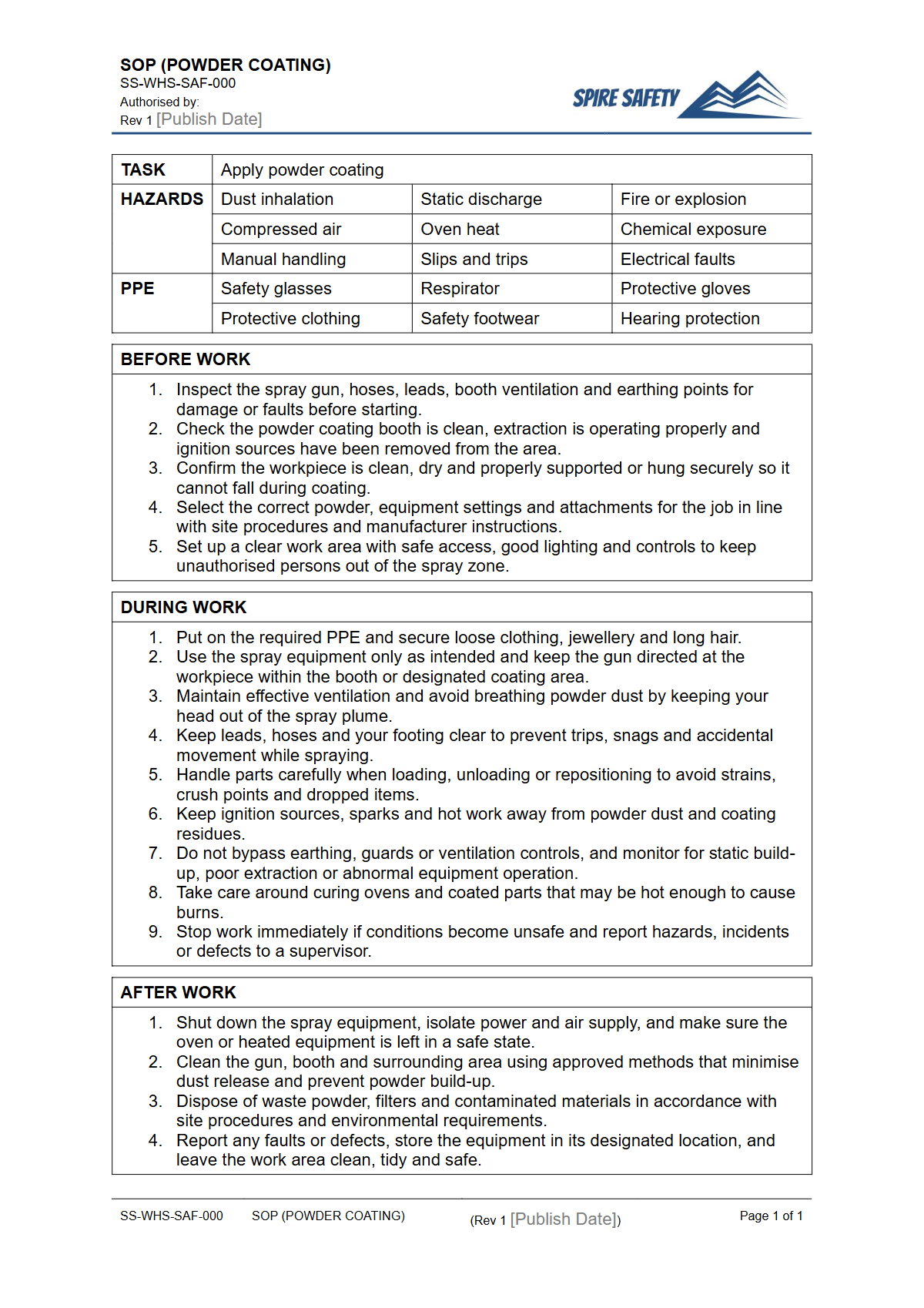
The primary purpose of this Free Safe Operating Procedure (Powder Coating) Template is to provide a documented, systematic approach to performing powder coating tasks safely. Powder coating involves significant hazards, including exposure to fine chemical powders, the risk of dust explosions, electrical dangers from electrostatic equipment, and potential burns from curing ovens.
This SOP helps Persons Conducting a Business or Undertaking (PCBUs) manage these risks by outlining step-by-step instructions for pre-operational checks, operation, shutdown, and emergency procedures.
By implementing a clear and comprehensive Safe Operating Procedure (SOP), organisations can standardise their processes, meet training obligations, and demonstrate a commitment to workplace health and safety. This template, aligned with Australian WHS principles, provides a solid foundation for developing a site-specific document that effectively controls the risks associated with powder coating operations.
Key Hazards in Powder Coating
- Chemical Exposure: Inhalation of fine powder dust can lead to respiratory irritation and long-term health effects. Dermal contact can also cause skin sensitisation.
- Fire and Explosion: A sufficient concentration of powder dust suspended in the air can form an explosive mixture if an ignition source (like a spark from poorly grounded equipment) is present.
- Electrical Hazards: Electrostatic powder coating guns operate at high voltages, creating a risk of electric shock if not used and maintained correctly.
- Heat and Burns: Curing ovens operate at high temperatures, presenting a significant burn risk to workers.
- Manual Handling: Moving parts to and from the coating and curing areas can lead to musculoskeletal injuries if not managed correctly.
A critical component of many powder coating systems is the air supply, which must also be managed safely. Our free Air Compressor SOP provides guidance for this specific equipment.
Video walkthrough
How to use the Free Safe Operating Procedure (Powder Coating) Template
Download this Safe Operating Procedure in your preferred format (DOCX or PDF). The DOCX version is fully editable, allowing you to adapt the content to your organisation's specific requirements.
It is crucial to review every section and add details about the particular powder coating guns, booths, powders, and curing ovens used at your site. A thorough risk assessment should form the foundation of your customised SOP.
Important: This document is a template designed to be a starting point. It is essential that you customise it to reflect the specific equipment, chemicals, processes, and control measures used in your workplace.
We are not liable for any incidents that may occur from the use of this template.
Once customised, your SOP should be stored in a central, accessible location with other key safety documents. You can find more templates to build out your documentation library in our free WHS resources library.
When to use this Safe Operating Procedure
A completed Safe Operating Procedure is a versatile WHS tool. It should be used as the primary document for training new operators on safe powder coating practices, ensuring they understand the hazards and controls before they begin work.
It also serves as an excellent resource for conducting periodic refresher training for experienced staff, reinforcing safe work habits and communicating any changes in procedure.
The SOP acts as a clear benchmark during day-to-day work and can be referenced by supervisors and workers to resolve questions about correct procedure. Furthermore, the procedure also forms a critical piece of evidence during safety inspections and can be used as a checklist for internal reviews or formal WHS compliance auditing.
Who should use this Safe Operating Procedure
This SOP is intended for all personnel involved in the powder coating process. This includes the operators who perform the work, supervisors who oversee them, and maintenance staff who service the equipment.
WHS managers and coordinators will also use this document to develop training programs, conduct risk assessments, and ensure safety records are maintained. The development and review of the SOP should be a consultative process involving the workers who actually perform the task, as their direct experience is invaluable for identifying practical risks and effective controls.
An SOP for a specific task should be part of an organisation's broader safety framework. This framework should be built into your organisation's comprehensive WHS management systems to ensure it is properly managed, reviewed, and communicated to all relevant personnel.
In facilities with automated or semi-automated lines, this procedure should also align with documentation for associated machinery. For example, the safe interaction between the coating station and automated transport systems should reference the relevant Conveyer System SOP.
Common mistakes
Common mistakes to avoid
- Using the template without customising it for site-specific equipment, powders, and controls.
- Failing to ensure proper grounding of the part, the spray equipment, and the operator, which increases fire and explosion risk.
- Providing inadequate ventilation or dust extraction, leading to hazardous atmospheric conditions.
- Neglecting worker training and competency checks on the specific procedures and emergency responses outlined in the SOP.
Legal references
Legal considerations
The following legal requirements may be relevant to this type of work.
- Work Health and Safety Act (Harmonised) — Provides the primary duties for protecting workers and other people from work health and safety risks.
- Work Health and Safety Regulations (Harmonised) — Sets out requirements supporting the management of workplace hazards and risks.
The following codes may be relevant to this type of work.
- Managing WHS Risks Code of Practice — Provides practical guidance on identifying hazards, assessing risks and applying effective controls.
- Work Health and Safety Consultation, Cooperation and Coordination Code of Practice — Provides practical guidance on consulting workers and coordinating with other duty holders.
- Managing the Work Environment and Facilities Code of Practice — Provides practical guidance on safe work environments, workplace facilities and related controls.
Did you know
Electrostatic Attraction
Powder coating works by electrostatically charging the fine powder particles as they leave the gun. These charged particles are then strongly attracted to the grounded metal part, creating a uniform layer that clings to the surface until it is melted and cured in an oven.
A Greener Finish
Unlike many liquid paints, powder coatings contain no solvents and release negligible volatile organic compounds (VOCs). Oversprayed powder can often be collected and reused, significantly reducing waste and making it a more environmentally friendly finishing option.
FAQ
Frequently asked questions
01Is powder coating dust dangerous to breathe?
02What personal protective equipment (PPE) is required for powder coating?
03How often should a Safe Operating Procedure be reviewed?
04Can I use this template for wet spray painting?
Share this resource
Free Safe Operating Procedure (Powder Coating) Template
Browse Categories
How To Use It
- 1Download and open in Word or PDF.
- 2Replace the placeholders with your business details.
- 3Get it reviewed by a WHS specialist before rollout.
Need it customised?
Our WHS consultants can adapt this template to your site, run a gap analysis, or audit what you already have in place.
Book a Free Consultation WHS consulting servicesor call 1300 156 382
Related templates
- Free Safe Operating Procedure (Power File) Template
- Free Safe Operating Procedure (Power Scraper) Template
- Free Safe Operating Procedure (Power Shears) Template
- Free Safe Operating Procedure (Power Trowel) Template
- Free Safe Operating Procedure (Powered Pallet Mover) Template
- Free Safe Operating Procedure (Powered Respirator) Template