
Free Safe Operating Procedure (Potato Peeler) Template
Download our free Safe Operating Procedure (Potato Peeler) Template to document the safe use of commercial potato peelers.
Free Safe Operating Procedure (Potato Peeler) Template
DOCX • 126 KB + PDF
Updated Oct 2026
No signup required
Purpose of the Free Safe Operating Procedure (Potato Peeler) Template
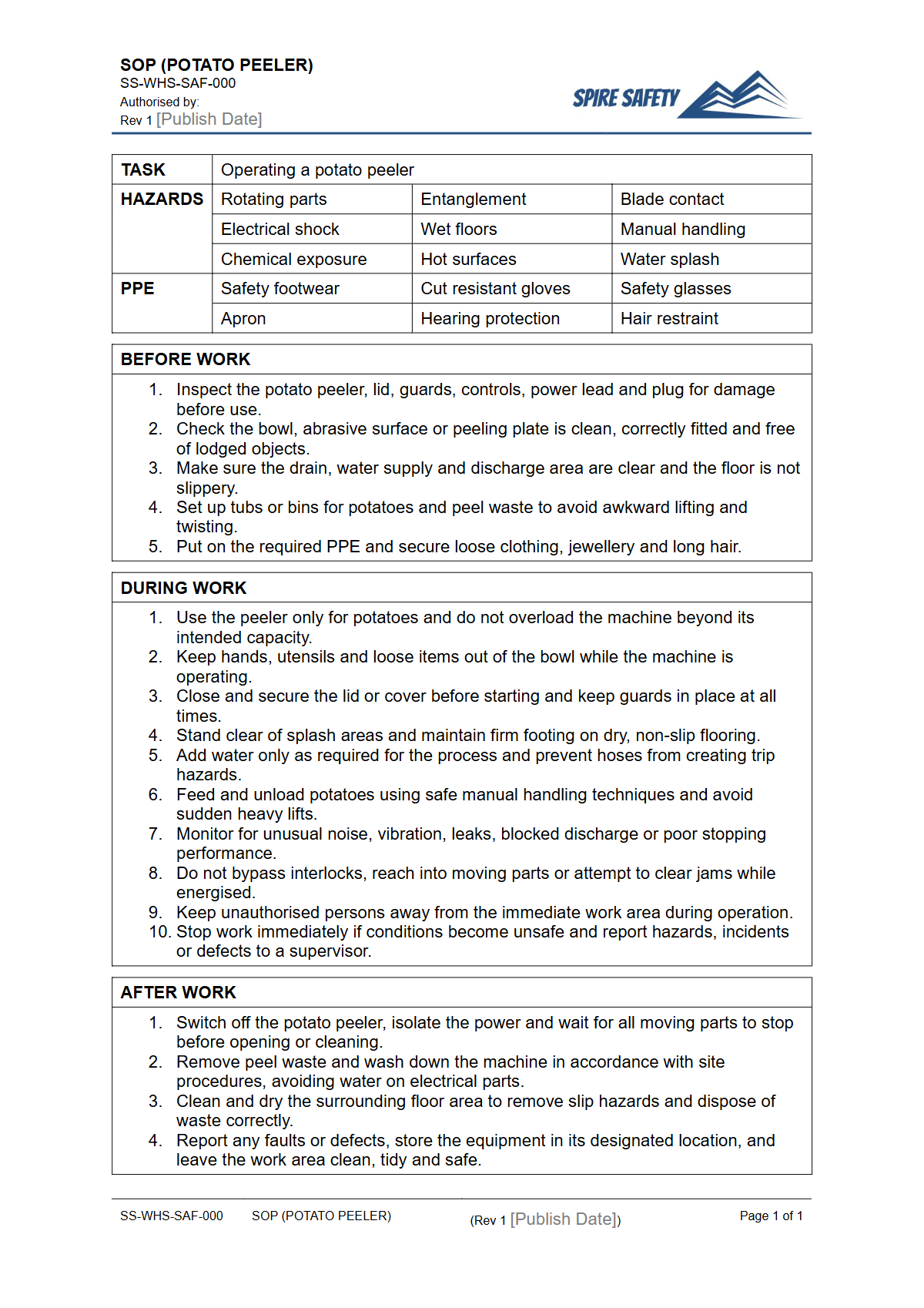
Operating machinery in a commercial kitchen, including a potato peeler, introduces specific workplace risks. This Free Safe Operating Procedure (Potato Peeler) Template provides a structured starting point for your organisation to document the step-by-step process for safely using this equipment.
It helps identify hazards such as entanglement in moving parts, cuts from peeling blades, electrical faults, and manual handling risks associated with loading and unloading. Formalising these procedures is a fundamental step in controlling risk and ensuring worker safety.
A documented SOP serves as a critical training tool, a daily on-the-job reference, and evidence of a systematic approach to safety. Integrating this document into your broader safety framework demonstrates a commitment to meeting your WHS obligations.
A well-developed SOP is a key component of effective WHS management systems, helping to standardise safe work practices across all shifts and personnel.
Hazards and Risks
Using a commercial potato peeler can expose operators to several significant hazards, including:
- Entanglement: Loose clothing, long hair, or jewellery getting caught in the rotating drum or drive mechanism.
- Cuts and Lacerations: Contact with the abrasive peeling surface or internal blades, especially during cleaning, maintenance, or clearing blockages.
- Electrical Hazards: Faulty wiring, improper electrical connections, or water ingress leading to electric shock.
- Manual Handling: Strains and sprains from lifting heavy bags of potatoes to load the machine or handling the finished product.
- Slips, Trips, and Falls: Water or vegetable debris on the floor around the machine can create a slippery surface.
Video walkthrough
How to use the Free Safe Operating Procedure (Potato Peeler) Template
This template is available in both DOCX and PDF formats for your convenience. The DOCX version is fully editable, allowing you to tailor every section to your specific operational needs.
It includes pre-defined sections for outlining required Personal Protective Equipment (PPE), pre-operational checks, step-by-step operating instructions, and post-operational cleaning and shutdown procedures. This structure is aligned with Australian WHS practice for developing safe work method statements.
Important: This document is a template and must be customised. We strongly advise that a competent person adapts the content to reflect the specific make and model of the potato peeler at your site.
You must also consider the unique environmental conditions of your workplace, the substances used (e.g., cleaning chemicals), and the training and competency levels of your workers. Effective safety procedures are not one-size-fits-all.
Consultation is a key part of the customisation process. Involve the workers who actually operate the equipment.
Their direct experience is invaluable for identifying practical hazards and effective control measures. This collaborative approach improves the quality of the SOP and increases worker buy-in. The principles for developing this SOP can be applied to other kitchen equipment, such as when creating a Safe Operating Procedure for a deep fryer.
When to use this Safe Operating Procedure
An SOP for a potato peeler should be a dynamic document used in various daily and periodic activities. It is a primary training resource for inducting new kitchen staff or apprentices, ensuring they learn the correct, safe method from the outset.
It should also be used for refresher training to prevent complacency and reinforce safe behaviour. Operators should have easy access to the SOP as a quick reference guide before they begin work.
Beyond training, the SOP is a vital tool for supervisors to monitor performance and for conducting safety observations. It also provides a baseline for incident investigations; if an incident occurs, the SOP can be reviewed to determine if the documented procedure was followed and if it needs improvement.
This review process can be integrated into your regular WHS compliance audits to ensure continuous improvement.
Who should use this SOP
The primary users of this Safe Operating Procedure are the kitchen hands, chefs, and other workers tasked with operating the potato peeler. They rely on it for clear, unambiguous instructions on how to perform their job safely.
Following the SOP helps protect them and their colleagues from injury.
Supervisors, kitchen managers, and head chefs are also key users. They are responsible for implementing the SOP through training, supervision, and enforcement.
They use it to verify that work is being performed to the established safety standard and to guide corrective actions when unsafe practices are observed. This document supports them in fulfilling their duty of care for the workers they supervise.
Finally, Health and Safety Representatives (HSRs) and WHS committee members will find this template useful when reviewing risk assessments and contributing to the development of safety documentation across the workplace. A standardised approach can be used for other plant and equipment, like what is outlined in our Air Compressor SOP. You can explore our complete free WHS resources library for other templates to support your safety management system.
Common mistakes
Common mistakes to avoid
- Using the template without customising it for the specific machine and workplace.
- Failing to electrically isolate and disconnect the machine from power before cleaning or clearing a jam.
- Wearing loose clothing, gloves, or jewellery that can become entangled in moving parts.
- Overloading the machine beyond the manufacturer's specified capacity, leading to strain and potential failure.
Legal references
Legal considerations
The following legal requirements may be relevant to this type of work.
- Work Health and Safety Act (Harmonised) — Provides the primary duties for protecting workers and other people from work health and safety risks.
- Work Health and Safety Regulations (Harmonised) — Sets out requirements supporting the management of workplace hazards and risks.
The following codes may be relevant to this type of work.
- Managing WHS Risks Code of Practice — Provides practical guidance on identifying hazards, assessing risks and applying effective controls.
- Work Health and Safety Consultation, Cooperation and Coordination Code of Practice — Provides practical guidance on consulting workers and coordinating with other duty holders.
- Managing the Work Environment and Facilities Code of Practice — Provides practical guidance on safe work environments, workplace facilities and related controls.
Did you know
Kitchen Hazards
Cuts and lacerations are among the most frequent injuries in the hospitality industry. A significant portion of these are caused by powered kitchen equipment, highlighting the need for robust safety procedures.
Mechanical Origins
The first mechanical potato peeler was invented in the 1890s to serve institutions and large hotels. Its design principles, involving an abrasive rotating drum, are still used in many commercial models today.
FAQ
Frequently asked questions
01What is a Safe Operating Procedure (SOP)?
02Are commercial potato peelers dangerous?
03Do I need a separate SOP for different potato peeler models?
04How often should a Safe Operating Procedure be reviewed?
Share this resource
Free Safe Operating Procedure (Potato Peeler) Template
Browse Categories
How To Use It
- 1Download and open in Word or PDF.
- 2Replace the placeholders with your business details.
- 3Get it reviewed by a WHS specialist before rollout.
Need it customised?
Our WHS consultants can adapt this template to your site, run a gap analysis, or audit what you already have in place.
Book a Free Consultation WHS consulting servicesor call 1300 156 382
Related templates
- Free Safe Operating Procedure (Potting Bench Cleaning) Template
- Free Safe Operating Procedure (Potting Mix Handling) Template
- Free Safe Operating Procedure (Poultry Feeding) Template
- Free Safe Operating Procedure (Poultry Litter Change) Template
- Free Safe Operating Procedure (Powder Coating) Template
- Free Safe Operating Procedure (Power File) Template