
Free Safe Operating Procedure (Portal Crane) Template
Effectively manage portal crane operations with our structured Safe Operating Procedure template. Download this free, customisable guide to enhance safety.
Free Safe Operating Procedure (Portal Crane) Template
DOCX • 126 KB + PDF
Updated Oct 2026
No signup required
Purpose of the Free Safe Operating Procedure (Portal Crane) Template
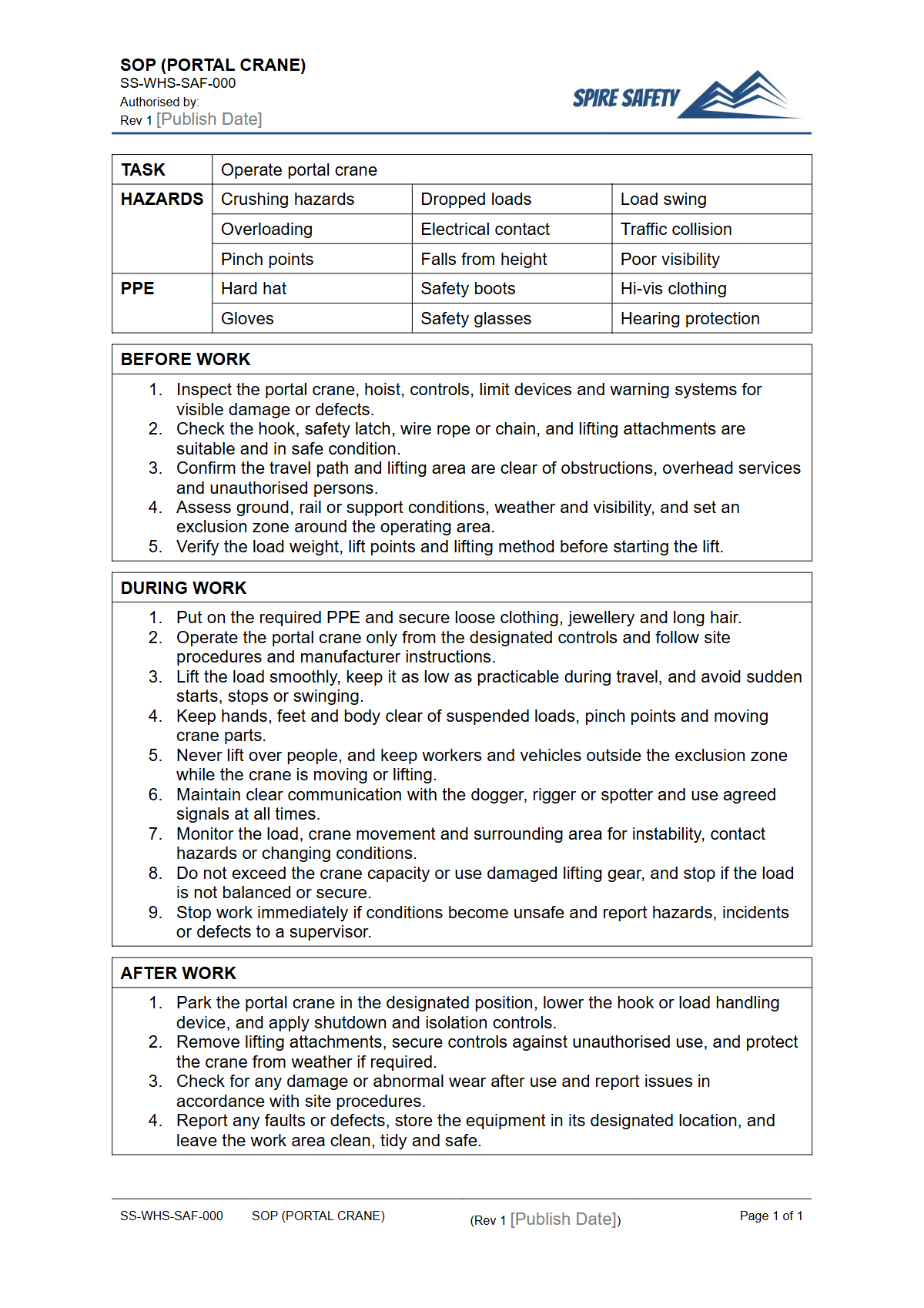
The primary purpose of this Free Safe Operating Procedure (Portal Crane) Template is to provide a structured starting point for developing a site-specific document. A well-drafted SOP minimises the risk of incidents by standardising operating methods for high-risk tasks like lifting, moving, and placing loads.
It serves as a key training tool for new operators and a reference for experienced personnel, reinforcing safe work practices and helping to meet legislative duties to provide a robust WHS management system. This procedure is a vital tool for any organisation utilising material handling equipment, just as a comprehensive Conveyer System SOP is for managing conveyor risks.
Video walkthrough
How to use the Free Safe Operating Procedure (Portal Crane) Template
To get the most value from this template, you must adapt it to the specific context of your workplace. It is designed as a foundation, not a final product.
Download the DOCX file and have a competent person—such as a site supervisor or WHS advisor with crane experience—edit each section.
Important: This is a template that we have prepared as a guide. It must be customised to reflect your specific machinery, site conditions, tasks, and risk control measures before use.
Key Sections to Customise
Your site-specific SOP should be comprehensive. Focus on customising these key areas to match your operational reality:
- Plant and Equipment Details: List the specific make, model, and capacity of your portal crane(s).
- Required PPE: Go beyond generalities. Specify the exact Personal Protective Equipment required for operators, doggers, and any personnel in the operating area.
- Hazard Identification: Document all foreseeable hazards unique to your site, such as ground-level obstructions, proximity to public areas, specific environmental conditions, or overhead power lines.
- Pre-Start Checks: Create a detailed checklist that operators must complete before every shift. This is a critical step, much like the pre-start process outlined in our free Telehandler SOP.
- Step-by-Step Procedures: Detail the sequence for safe operation, covering everything from planning the lift and communication signals to traversing the load and shutdown procedures.
- Emergency Response: Clearly outline the actions to take in an emergency, including crane failure, power loss, or medical incidents.
When to use a Portal Crane SOP
A Portal Crane SOP should be developed and implemented before any work with the crane begins. It is a living document that should be used consistently for:
- Inducting and training new crane operators, doggers, and riggers.
- Conducting refresher training for experienced team members.
- Planning specific or non-routine lifts that may have unique risks.
- A reference guide during pre-start meetings and toolbox talks.
- Investigating and reviewing work practices after an incident or near miss.
Regular reviews are essential to keep the SOP current, especially when new hazards are identified or work processes change. This review process is a fundamental part of maintaining safe systems of work for all heavy machinery, including those covered in a detailed Grader SOP.
Who should use this SOP?
This procedure is designed for a range of personnel involved in and around crane operations. Key users and stakeholders include:
- Crane Operators: To follow prescribed steps for pre-start checks, operation, and shutdown.
- Doggers and Riggers: To understand communication protocols, slinging techniques, and their critical role in directing the crane safely.
- Supervisors and Managers: To ensure work is conducted according to the agreed procedure and to use it as a tool for training, monitoring, and performance reviews.
- WHS Professionals: To integrate the SOP into the broader safety framework and use it as evidence during WHS compliance auditing activities.
By formalising procedures, you create a safer, more predictable work environment for everyone on site. For more templates and safety guides to support your WHS program, browse our complete free WHS resources library.
Common mistakes
Common mistakes to avoid
- Failing to conduct and document daily pre-start inspections.
- Exceeding the crane's Safe Working Load (SWL).
- Using poor communication or unclear hand signals between the operator and dogger.
- Operating the crane too close to overhead power lines without adequate controls.
Legal references
Legal considerations
The following legal requirements may be relevant to this type of work.
- Work Health and Safety Act (Harmonised) — Provides the primary duties for protecting workers and other people from work health and safety risks.
- Work Health and Safety Regulations (Harmonised) — Sets out requirements supporting the management of workplace hazards and risks.
The following codes may be relevant to this type of work.
- Managing WHS Risks Code of Practice — Provides practical guidance on identifying hazards, assessing risks and applying effective controls.
- Work Health and Safety Consultation, Cooperation and Coordination Code of Practice — Provides practical guidance on consulting workers and coordinating with other duty holders.
- Managing the Work Environment and Facilities Code of Practice — Provides practical guidance on safe work environments, workplace facilities and related controls.
Did you know
Load Stability is Key
A portal crane's capacity rating assumes a perfectly vertical lift. Any swinging or 'side loading' of the hook can introduce significant horizontal forces, potentially overloading the crane's structure even if the load is below the rated capacity.
Origin of 'Portal'
The name 'portal crane' comes from the 'portal' or opening created by its frame, which allows vehicles or other materials to pass through underneath the crane structure.
FAQ
Frequently asked questions
01What is the difference between a portal crane and a gantry crane?
02Does every portal crane operator need a high-risk work licence?
03How often should a Safe Operating Procedure for a portal crane be reviewed?
04Can this SOP template be used for other types of cranes?
Share this resource
Free Safe Operating Procedure (Portal Crane) Template
Browse Categories
How To Use It
- 1Download and open in Word or PDF.
- 2Replace the placeholders with your business details.
- 3Get it reviewed by a WHS specialist before rollout.
Need it customised?
Our WHS consultants can adapt this template to your site, run a gap analysis, or audit what you already have in place.
Book a Free Consultation WHS consulting servicesor call 1300 156 382
Related templates
- Free Safe Operating Procedure (Post Driver) Template
- Free Safe Operating Procedure (Post Hole Digger) Template
- Free Safe Operating Procedure (Potable Water Cart) Template
- Free Safe Operating Procedure (Potato Peeler) Template
- Free Safe Operating Procedure (Potting Bench Cleaning) Template
- Free Safe Operating Procedure (Potting Mix Handling) Template