
Free Safe Operating Procedure (Portable Bandsaw) Template
Download our Free Safe Operating Procedure (Portable Bandsaw) Template to define clear, safe work steps for your team. Get your customisable DOCX and PDF now.
Free Safe Operating Procedure (Portable Bandsaw) Template
DOCX • 126 KB + PDF
Updated Oct 2026
No signup required
Purpose of the Free Safe Operating Procedure (Portable Bandsaw) Template
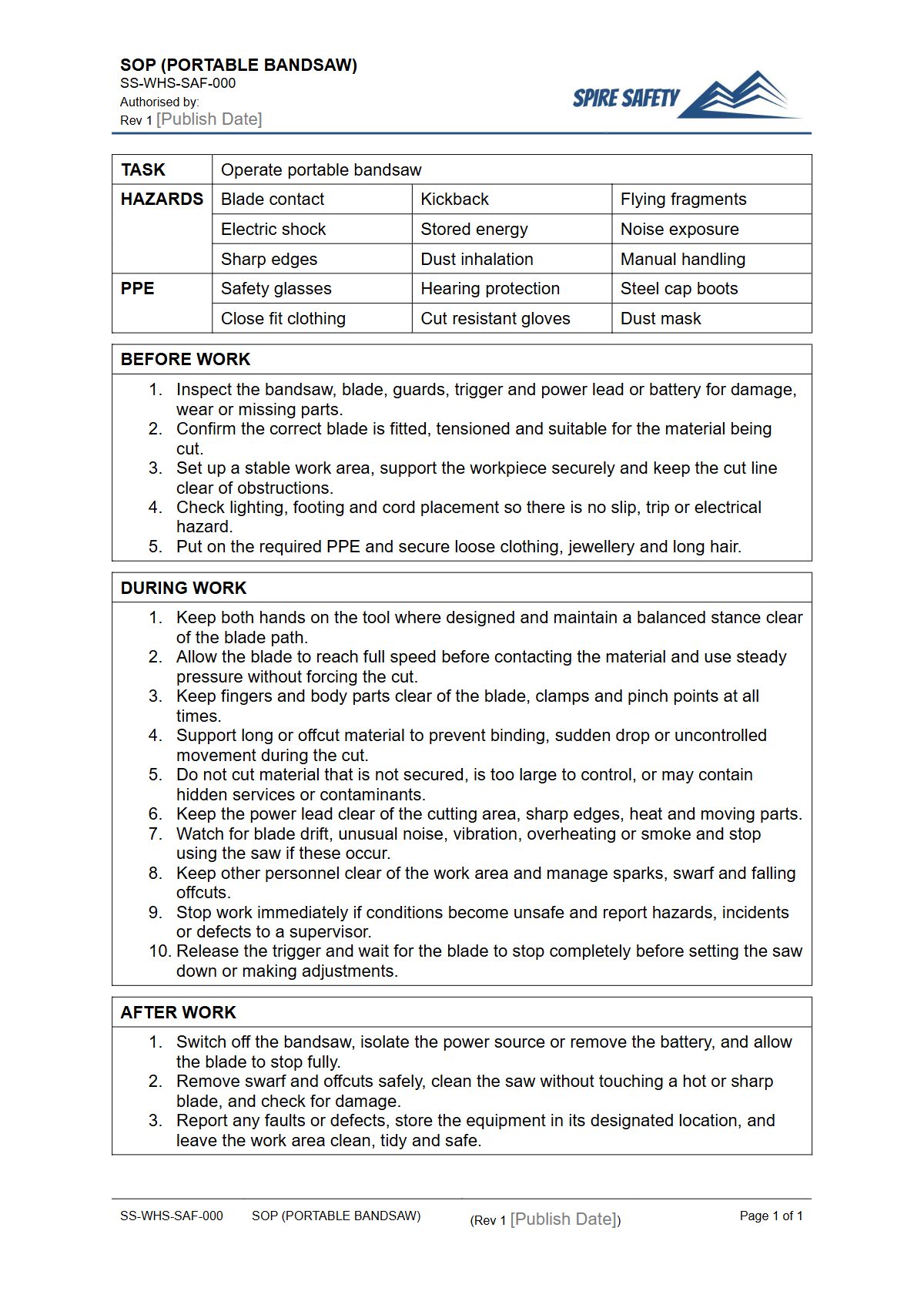
This free Safe Operating Procedure (Portable Bandsaw) Template provides a structured framework for documenting the safe use of portable bandsaws in your workplace. Portable bandsaws are versatile tools, but they introduce significant risks, including cuts, lacerations, and musculoskeletal injuries if not used correctly.
A clear, well-defined SOP is a critical tool for managing these risks, ensuring operational consistency, and fulfilling your duty of care under Australian WHS laws.
A documented procedure helps standardise operations for all workers, regardless of their experience level. It serves as an essential reference for pre-operational checks, safe cutting techniques, and emergency responses.
Much like the specific controls needed for other power tools, which are detailed in our free Circular Saw SOP template, a dedicated procedure for portable bandsaws ensures hazards unique to that tool are systematically addressed.
Key objectives of this SOP template include:
- Identifying hazards associated with portable bandsaw use, such as sharp blades, moving parts, ejected materials, noise, and vibration.
- Outlining a step-by-step process for safe operation, from pre-start checks to task completion and shutdown.
- Defining the required Personal Protective Equipment (PPE) for operators and others in the vicinity.
- Providing a consistent basis for worker training, induction, and competency assessment.
Video walkthrough
How to use the Free Safe Operating Procedure (Portable Bandsaw) Template
After downloading, you will receive a template in both DOCX and PDF formats. The DOCX file is fully editable and should be adapted to reflect the specific conditions of your worksite.
It is crucial to recognise that this document is a starting point, not a finished product. Effective safety management requires that all procedures are tailored to your unique environment, equipment, and tasks.
Important: This document is a template and must be customised to your specific workplace. You are required to consult with your team and review your specific portable bandsaw models, the materials being cut, and the work environment.
We are not responsible for the outcomes of the use of this template. Fill in all bracketed information like [Company Name], review every section, and add or remove content to ensure it accurately reflects your operational risks and control measures.
Always consult the manufacturer's instruction manual for your specific bandsaw model and incorporate its recommendations into the final SOP. Developing these tailored procedures is a core component of building and maintaining effective WHS management systems that genuinely protect your workers.
When to use it
A Safe Operating Procedure for a portable bandsaw is a live document that should be used actively and regularly within your organisation. It is not meant to be filed away after completion. Key times to use and refer to the SOP include:
- Worker Training and Induction: Before any worker is permitted to operate a portable bandsaw for the first time.
- Pre-Operational Checks: As a daily or pre-use checklist to ensure the tool is safe to operate.
- Refresher Training: During toolbox talks or safety meetings to reinforce safe work practices.
- Incident Investigations: As a reference document when investigating a near miss or injury involving a bandsaw to identify procedural gaps.
- Process Changes: When a new model of bandsaw is introduced or the type of material being cut changes.
Keeping safety documentation current and accessible is a key part of compliance and risk management. You can find more document templates to support your processes in our main free WHS resources library.
Who should use it
This SOP is intended for use by various personnel within an organisation to ensure a shared understanding of safety requirements:
- Workers and Operators: To understand the correct, safe steps for preparing, using, and maintaining the portable bandsaw.
- Supervisors and Managers: To enforce safe work practices, conduct workplace inspections, and ensure workers are adequately trained and competent.
- WHS/OHS Professionals: To integrate the SOP into the broader safety management system, use it as a basis for risk assessments, and guide continuous improvement.
- Training Coordinators: As a foundational document for developing and delivering competency-based training programs for portable power tools.
The effectiveness of an SOP relies on its correct implementation and consistent review. If you require an independent assessment of your site-specific procedures and their application, you may benefit from our WHS compliance auditing services.
While portable bandsaws are common, many workplaces use a variety of powered equipment, each with its own risks. Ensuring each has a dedicated procedure is best practice.
For example, pneumatic tools often require a different set of safety considerations, which are covered in resources like our Free Air Compressor SOP Template, demonstrating the need for tool-specific guidance.
Common mistakes
Common mistakes to avoid
- Using a generic template without customising it for the specific bandsaw model and workplace tasks.
- Failing to consult with experienced operators during the drafting and review process.
- Treating the SOP as a one-time task and failing to review or update it regularly.
- Neglecting to provide practical, hands-on training and competency assessment alongside the written document.
Legal references
Legal considerations
The following legal requirements may be relevant to this type of work.
- Work Health and Safety Act (Harmonised) — Provides the primary duties for protecting workers and other people from work health and safety risks.
- Work Health and Safety Regulations (Harmonised) — Sets out requirements supporting the management of workplace hazards and risks.
The following codes may be relevant to this type of work.
- Managing WHS Risks Code of Practice — Provides practical guidance on identifying hazards, assessing risks and applying effective controls.
- Work Health and Safety Consultation, Cooperation and Coordination Code of Practice — Provides practical guidance on consulting workers and coordinating with other duty holders.
- Managing the Work Environment and Facilities Code of Practice — Provides practical guidance on safe work environments, workplace facilities and related controls.
Did you know
Vibration Risk
Prolonged use of power tools like portable bandsaws can expose operators to excessive vibration, potentially leading to Hand-Arm Vibration Syndrome (HAVS), a permanent and debilitating condition.
Blade Speed
The blade on a portable bandsaw can travel at speeds exceeding 150 metres per minute, making contact for even a fraction of a second sufficient to cause a severe injury.
FAQ
Frequently asked questions
01What should be included in a portable bandsaw SOP?
02Who is responsible for writing a Safe Operating Procedure?
03How often should an SOP for a portable bandsaw be reviewed?
04Is training required in addition to a written SOP?
Share this resource
Free Safe Operating Procedure (Portable Bandsaw) Template
Browse Categories
How To Use It
- 1Download and open in Word or PDF.
- 2Replace the placeholders with your business details.
- 3Get it reviewed by a WHS specialist before rollout.
Need it customised?
Our WHS consultants can adapt this template to your site, run a gap analysis, or audit what you already have in place.
Book a Free Consultation WHS consulting servicesor call 1300 156 382
Related templates
- Free Safe Operating Procedure (Portable Heater) Template
- Free Safe Operating Procedure (Portable Hoist Check) Template
- Free Safe Operating Procedure (Portable Ramp Setup) Template
- Free Safe Operating Procedure (Portable Sawmill) Template
- Free Safe Operating Procedure (Portal Crane) Template
- Free Safe Operating Procedure (Post Driver) Template