
Free Safe Operating Procedure (Portable Heater) Template
Effectively manage the risks of using portable heaters in your workplace with our free template.
Free Safe Operating Procedure (Portable Heater) Template
DOCX • 126 KB + PDF
Updated Oct 2026
No signup required
Purpose of the Free Safe Operating Procedure (Portable Heater) Template
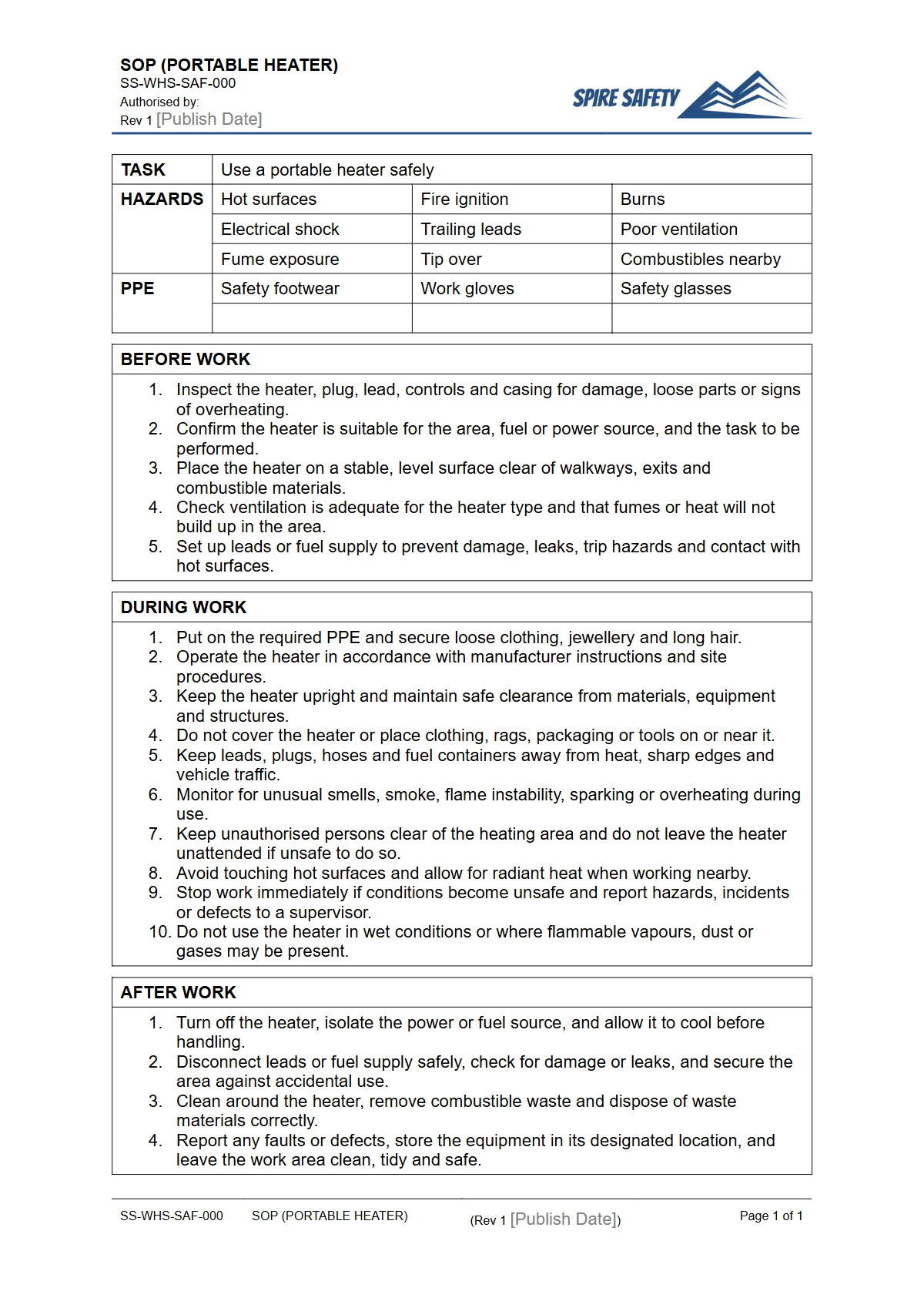
Our Free Safe Operating Procedure (Portable Heater) Template provides a solid foundation for documenting the safe use of portable heating equipment in your workplace. Portable heaters, while useful for providing temporary warmth, introduce significant risks, including fires from proximity to combustibles, burns from direct contact, and electrical hazards from faulty wiring or overloaded circuits.
Establishing a clear SOP is a critical step in controlling these risks and ensuring worker safety.
By formalising a step-by-step process, you reduce the likelihood of incidents caused by inconsistent or unsafe practices, much like how a Safe Operating Procedure for a Deep Fryer manages heat-related risks in a kitchen environment. This SOP serves as a critical training tool for new employees, a refresher for existing staff, and a key component of your overall WHS management system. Having a clear, written process helps demonstrate due diligence and a commitment to proactively managing workplace hazards.
Video walkthrough
How to use the Free Safe Operating Procedure (Portable Heater) Template
This document is a template, not a finished product. To make it effective, you must customise it to suit the specific context of your workplace.
Download the DOCX file and adapt the content to reflect the types of portable heaters you use (e.g., fan, oil-filled, radiant), the specific environment they are used in, and your organisation's unique safety rules.
Important: We have provided a structured starting point aligned with Australian WHS principles. However, it is your responsibility to ensure the final document is comprehensive and accurately reflects the hazards and control measures relevant to your operations.
This includes adding site-specific details, emergency contacts, and referencing any relevant internal policies.
Key Elements Covered in the Template
Our template provides a comprehensive structure covering the essential aspects of portable heater safety. It includes sections for:
- Required Personal Protective Equipment (PPE): While often minimal for heaters, it may include gloves for handling hot units.
- Pre-operational Safety Checks: Detailing the visual inspection of the cord, plug, casing, and safety features like tip-over switches. This is a critical step for any electrical equipment, as outlined in our free Air Compressor SOP template.
- Step-by-Step Operating Procedure: Covering safe placement, clearance from combustibles, turning the unit on and off, and monitoring.
- Post-operational Checks: Instructions for safely powering down, allowing the unit to cool, and proper storage.
- Potential Hazards and Control Measures: A summary of risks (fire, burns, electrical shock, fumes) and the controls your SOP implements.
When to use a Portable Heater SOP
A Safe Operating Procedure for portable heaters should be a core part of your daily safety framework. It is not a document to be filed away and forgotten. It should be actively used in several key situations:
- During induction and training for any new workers who may operate or work near heaters.
- As a pre-start checklist before using a portable heater for the first time each day or shift.
- As a reference guide for workers to consult if they are unsure about a specific step.
- During toolbox talks or safety meetings, especially before the winter months begin.
- As a basis for incident investigations if a near miss or accident involving a heater occurs.
Regularly reviewing and reinforcing the SOP helps embed safe behaviour across the team. Just as you might have a circular saw SOP template for power tools, this procedure addresses the specific risks of heating equipment.
Who should use this SOP
This SOP is intended for anyone who interacts with portable heaters in the workplace. The responsibility for its implementation and use extends across several roles:
- Workers and Operators: To follow the step-by-step procedure for safe setup, operation, and shutdown.
- Supervisors and Team Leaders: To ensure workers are trained on the SOP, are following it correctly, and that heaters are being inspected as required.
- WHS Managers and Advisors: To develop, review, and update the SOP as part of the broader safety system. They may also use it as evidence during a WHS compliance auditing process.
Ultimately, every person on site has a duty to contribute to a safe working environment, and following established procedures for high-risk equipment is a fundamental part of that duty. You can find many other useful templates for different equipment and tasks in our free WHS resources library to build out your safety documentation.
Common mistakes
Common mistakes to avoid
- Placing heaters within one metre of combustible materials like paper, curtains, or furniture.
- Using a heater that has a damaged cord, plug, or casing.
- Leaving a portable heater unattended while it is operating.
- Using domestic-grade heaters in an industrial or commercial setting where they are not sufficiently robust.
Legal references
Legal considerations
The following legal requirements may be relevant to this type of work.
- Work Health and Safety Act (Harmonised) — Provides the primary duties for protecting workers and other people from work health and safety risks.
- Work Health and Safety Regulations (Harmonised) — Sets out requirements supporting the management of workplace hazards and risks.
The following codes may be relevant to this type of work.
- Managing WHS Risks Code of Practice — Provides practical guidance on identifying hazards, assessing risks and applying effective controls.
- Work Health and Safety Consultation, Cooperation and Coordination Code of Practice — Provides practical guidance on consulting workers and coordinating with other duty holders.
- Managing the Work Environment and Facilities Code of Practice — Provides practical guidance on safe work environments, workplace facilities and related controls.
Did you know
Fire Risk
Heating equipment is one of the leading causes of workplace fires. A significant portion of these incidents are caused by placing portable heaters too close to flammable items like paper, furniture, and textiles.
Electrical Load
A standard portable electric heater can draw 1,500 watts of power or more. This can easily overload a typical 10-amp circuit if other devices are running, leading to tripped breakers or, in worse cases, an electrical fire.
FAQ
Frequently asked questions
01What are the main hazards of portable heaters in the workplace?
02How often should portable heaters be inspected?
03Is a Safe Operating Procedure a legal requirement for portable heaters?
04Can I use an extension cord with a portable heater?
Share this resource
Free Safe Operating Procedure (Portable Heater) Template
Browse Categories
How To Use It
- 1Download and open in Word or PDF.
- 2Replace the placeholders with your business details.
- 3Get it reviewed by a WHS specialist before rollout.
Need it customised?
Our WHS consultants can adapt this template to your site, run a gap analysis, or audit what you already have in place.
Book a Free Consultation WHS consulting servicesor call 1300 156 382
Related templates
- Free Safe Operating Procedure (Portable Hoist Check) Template
- Free Safe Operating Procedure (Portable Ramp Setup) Template
- Free Safe Operating Procedure (Portable Sawmill) Template
- Free Safe Operating Procedure (Portal Crane) Template
- Free Safe Operating Procedure (Post Driver) Template
- Free Safe Operating Procedure (Post Hole Digger) Template